
◆ Last updated: ◆ By LeDiamont — Zervan GmbH
Years of farming for one harvest
Caviar is expensive because the four sturgeon types compared here have indicative first-harvest ranges of approximately 7 to 20+ years, only females produce it, each female provides one harvest in the traditional method described here, and the eggs are cleaned, salted, graded and packed through skilled processing. International trade in sturgeons has been regulated under CITES since 1998. [1] Traceability and temperature-controlled handling add further costs. The production methods below describe industry practices; consult individual product labels for their specific source and ingredients.
Key takeaways
- ◆Time is a major cost. Fish rearing involves years of feed, water, energy and care before a first caviar harvest.
- ◆Only females produce roe. Identifying and managing male and female stock takes resources; males may also be sold for meat.
- ◆Roe yield varies. The example below assumes roe weighing 10% of a female’s body weight; this is an illustration, not a universal yield.
- ◆Skilled processing adds cost. Harvesting, screening, salting and grading involve trained staff and careful handling.
- ◆Regulation and logistics add cost. Trade documentation, traceability and chilled storage require equipment, staff and careful handling.
What exactly is caviar?
Caviar is the salted roe (eggs) of sturgeon. The European Commission’s caviar-market report describes caviar as roe from sturgeons. [4] Salmon, trout and lumpfish produce other kinds of fish roe; they are different products and should be compared by their actual species and labelling.

The 8 reasons caviar costs so much
Sturgeon take years to mature
A female sturgeon must mature before a caviar harvest. The following are indicative planning ranges for the four types compared here; actual first-harvest timing varies with species and farming conditions:
| Species | Caviar | Years to first harvest (farmed) |
|---|---|---|
| Acipenser baerii | Baeri (Siberian) | 7–10 |
| Acipenser stellatus | Sevruga | 8–12 |
| Acipenser gueldenstaedtii | Ossetra | 10–15 |
| Huso huso | Beluga | 15–20+ |
During the rearing period, producers pay for feed, clean water, energy, veterinary care, staff and space. Published producer interviews report varying ages at first harvest and different harvesting methods. [5]
Only females produce caviar
Only females carry the roe used for caviar. Identifying sex and monitoring reproductive development require time, equipment and skilled staff. Ultrasound is used by some producers to assess reproductive development. [5] Males can also be sold for meat, so it is inaccurate to treat all male stock as producing no value.
Yield and harvesting method affect cost
Roe yield varies by fish and production conditions. The illustration below assumes roe weighing 10% of a female’s body weight; it does not predict the output of every farm. In the traditional harvesting method described here, a female provides one harvest. Repeated non-lethal harvesting methods also exist, so the number of harvests per fish depends on the method. [5]
Harvesting and processing require skill
Caviar production involves several careful steps, beginning before the roe is collected. The outline below describes a traditional process; equipment and methods vary by producer:
- 1Checking ripeness with ultrasound or a small biopsy, so eggs are harvested at the right moment.
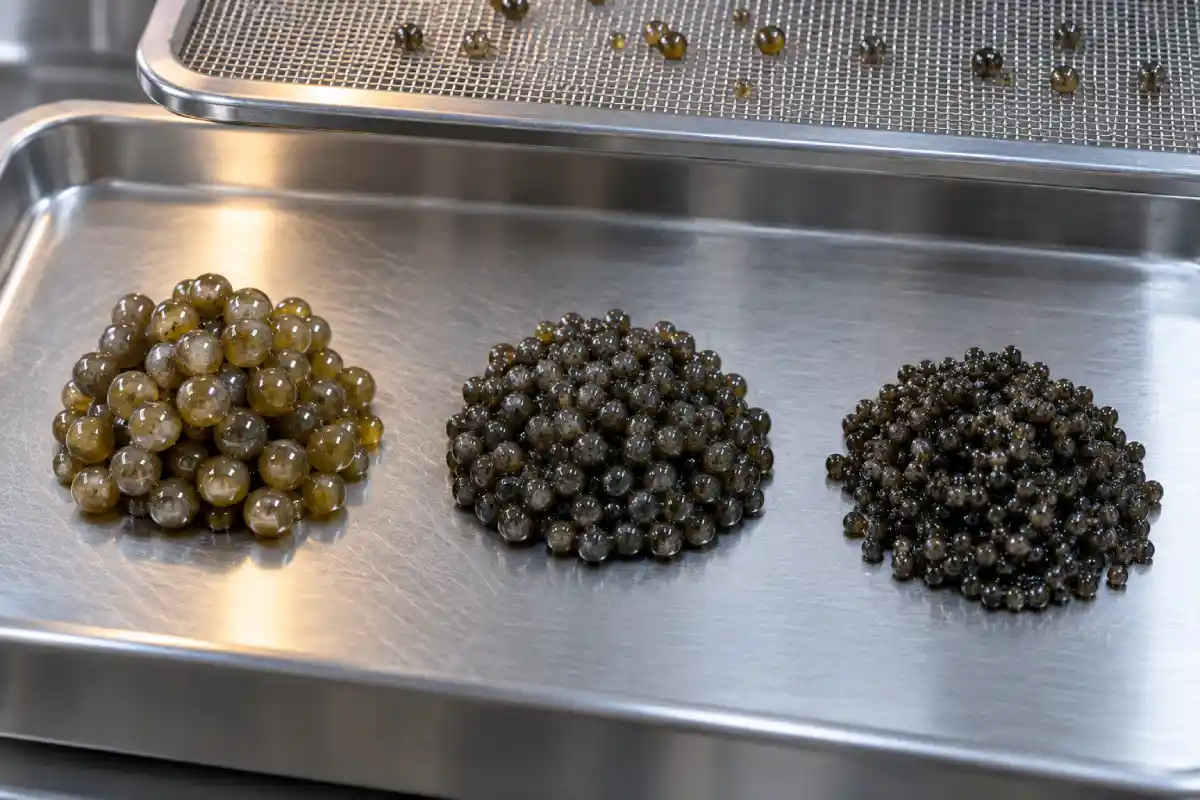
- 2Screening: gently rubbing the roe through a mesh to separate the eggs from the membrane.
- 3Rinsing and draining in cold water.
- 4Salting: salt is added according to the producer’s specification. Check the product’s ingredient list rather than assuming all producers use the same recipe.
- 5Grading: each batch is sorted by pearl size, colour, firmness and flavour.
- 6Packing into tins, sealing and applying the required traceability labels.
A mistake at any step, such as too much salt or crushed eggs, lowers the grade and the value of the whole batch.
Grade and quality selection
Producers assess characteristics such as pearl size, colour, texture and flavour when selecting batches. Grading names vary between businesses, so a label alone should not be treated as a universal quality scale. Compare the product description and your preferred flavour profile, rather than assuming a particular house name guarantees a defined grade.
Wild sturgeon are protected and scarce
International trade in all sturgeon species has been regulated under CITES since 1998. [1] The IUCN Sturgeon Specialist Group’s 2022 assessment recorded threatened sturgeon and paddlefish species alongside species already classified as Extinct or Extinct in the Wild. [3] All caviar sold today comes from farmed sturgeon. [4]
Regulation, traceability and permits
CITES publishes a universal labelling system for sturgeon caviar in domestic and international trade, using non-reusable labels to identify source and origin. [2] The Swiss FSVO also sets out certificates, permits and exceptions for protected-species imports. [6] Documentation and record-keeping add administrative costs and support traceability; a label alone does not prove every quality or authenticity claim.
Cold chain from farm to fridge
Keep caviar between −3 °C and +3 °C, following the product label and maintaining the cold chain. Chilled storage, insulated packaging and temperature-controlled handling require equipment and care, adding costs to the product.
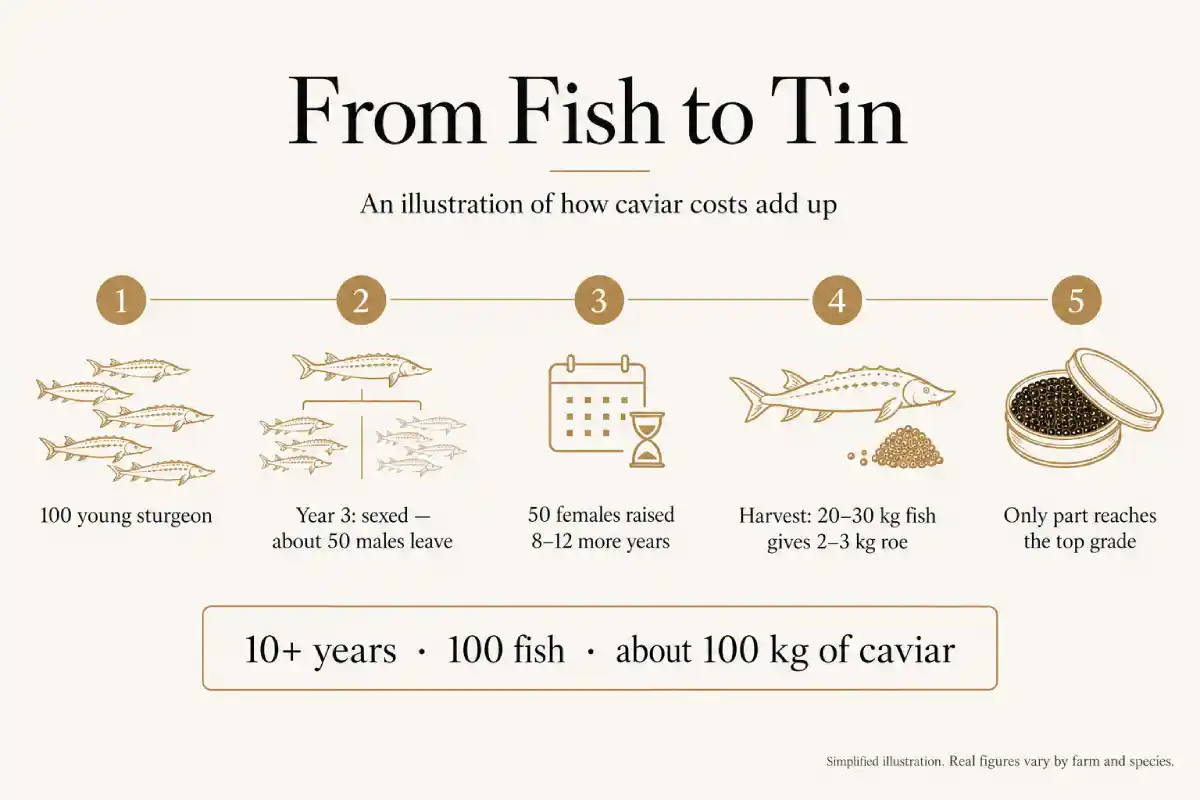
From fish to tin: an illustration
The following is a hypothetical example, not a report from a particular farm. It assumes 100 young fish, a 50:50 sex split and roe equal to 10% of female body weight. Real survival, yield, timing and processing losses vary.
Illustration
Before mortality and processing losses, 50 females × approximately 2–3 kg each = approximately 100–150 kg of roe. This is raw roe, not a guaranteed quantity of finished caviar. The final output depends on survival, actual yield and processing losses; the example shows why long rearing cycles and limited output contribute to cost.
Why Beluga often commands a high price
Beluga is associated with a long wait before harvest: this guide uses an indicative range of approximately 15–20+ years for Huso huso. Actual farm results vary. Long rearing periods, batch selection and traceability contribute to its price; price alone does not make one caviar better for every palate. See how it compares in Ossetra vs Beluga caviar, or discover our Iranian Beluga AA® Caviar.
Why some caviar is surprisingly cheap
A lower price can reflect a different product, species, production scale or preservation method. Price alone cannot establish authenticity or quality:
- ◆Other fish roe: lumpfish, capelin, salmon or trout roe are different products; check the actual species and description.
- ◆Preservation and recipe: check whether a product is pasteurised and how its ingredients and storage instructions differ, rather than assuming a single quality ranking.
- ◆Batch characteristics: pearl size, appearance and texture differ; compare the description with what you enjoy.
- ◆Different species or hybrids can have different rearing cycles and production costs (see Kaluga vs Beluga caviar).
- ◆Large-scale aquaculture: the European Commission’s 2021 report identified China as the leading supplier to the EU caviar market. That is a dated market finding, not a current ranking of product quality. [4]
- ◆Labelling and traceability: check the species, origin and applicable CITES labelling; investigate unclear descriptions rather than judging legality by price alone.
For a Swiss retail reference, LeDiamont 30 g tins displayed prices from CHF 57 for Baeri to CHF 115 for Beluga on 16 October 2026, equivalent to approximately CHF 1.90–3.83 per gram, including VAT and excluding delivery. This is a dated comparison of these products, not a market-wide range or an authenticity threshold. For other formats and varieties, see our Caviar Price Guide.
How caviar compares with other luxury foods
| Luxury food | Price indication per gram | Why it’s expensive |
|---|---|---|
| Sturgeon caviar | approximately CHF 1.90–3.83; 30 g Baeri to Beluga tins, 16 October 2026 | Long rearing cycles, one harvest per female in the traditional method, skilled processing |
| Saffron | approximately CHF 4.92–5.13; LeDiamont snapshot, 13 October 2026 | Approximately 150,000–170,000 flowers for 1 kg; labour-intensive harvesting |
| Fresh black truffle | varies strongly by season | Seasonal availability and cultivation costs |
Caviar and saffron are sold in small quantities and involve skilled handling. Compare offers in the same currency; the table above does not make an exchange-rate conversion. Our Iranian Saffron was listed in a 5 g tin when checked on 21 October 2026, at CHF 24.62 (approximately CHF 4.92/g). These are dated reference prices and may change. [7]
Will caviar get cheaper?
There is no guaranteed price trend. Larger-scale production may reduce some costs, while long rearing cycles, energy, labour, selection and demand continue to influence prices. Actual retail prices can move in either direction; compare dated offers and avoid assuming that a species or grade name fixes its future price.
Is caviar worth the price?
That depends on what you value. You are paying for more than fish eggs: rearing cycles, skilled processing, traceability and chilled handling all contribute to the price. The time and cost vary by producer and species. Served properly, about 30 g per person is enough for a memorable tasting (see how much caviar per person). To get the most value:
- ✓Compare price per gram, not price per tin.
- ✓Buy a tin you can finish within 48 hours of opening for best quality; keep it refrigerated at −3 to +3 °C and follow any shorter period on the label.
- ✓Choose by flavour and budget, rather than assuming a fixed hierarchy of species.
- ✓Check the species name and CITES code on the label.
Read also: our complete guide to Iranian caviar, its history, its varieties and how to buy it in Switzerland.
Frequently asked questions
Why is caviar so expensive?
The four sturgeon types compared here have indicative first-harvest ranges of approximately 7 to 20+ years. Only females produce roe. In the traditional harvesting method described here, each female provides one harvest; repeated non-lethal methods also exist. Skilled processing, trade documentation and chilled handling add costs.
How long does it take to make caviar?
This guide uses indicative first-harvest ranges of approximately 7–10 years for Baeri, 8–12 for Sevruga, 10–15 for Ossetra and 15–20+ for Beluga. Actual timing varies with species and farming conditions; the subsequent processing time also depends on the method.
How much caviar does one sturgeon produce?
Output varies. If you assume roe equal to 10% of body weight, a female weighing approximately 20–30 kg would yield approximately 2–3 kg of roe before processing. This is the illustrative assumption used here, not a universal yield or a guarantee of finished caviar.
Why does Beluga caviar often have a high price?
Beluga’s long rearing period, batch selection and traceability requirements contribute to its price. This guide uses an indicative first-harvest range of approximately 15–20+ years; actual farm conditions and prices vary.
Does farming affect the price of caviar?
All caviar sold today comes from farmed sturgeon. Retail price still varies by species, batch, producer and market. Check the species and the CITES details on the label.
Why is some caviar so cheap?
A lower price can reflect another type of fish roe, a different species or batch, preservation method, production scale or retailer. Price alone does not prove low quality or illegality. Check the actual species, ingredients, origin and applicable traceability labels.
Is caviar worth the money?
That depends on your taste, budget and occasion. A classic tasting portion is 30 g per person. Compare price per gram and choose a tin you can enjoy within 48 hours after opening for best quality, following the label and refrigeration requirements.
Taste the difference
Sources
- Sturgeons — CITES Secretariat. Regulation of international trade in sturgeon species since 1998.
- Universal Caviar Labelling Requirements — CITES Secretariat. Non-reusable labels for source and origin in domestic and international trade.
- 2022 Report of the IUCN SSC Sturgeon Specialist Group. The 2022 Red List assessment and species-conservation categories.
- The caviar market: production, trade and consumption in and outside the EU — EUMOFA, 2021. Product definition, aquaculture and the dated EU-market description.
- Animal welfare in European caviar production: insights from sturgeon producers — Frontiers in Fish Science, 2026. Producer interviews describing variable maturity timing, ultrasound and traditional or repeated non-lethal harvesting methods.
- Import permits — Swiss Federal Food Safety and Veterinary Office (FSVO). Certificates, permits and exceptions for protected-species imports.
- Iranian Saffron — LeDiamont. Historical product-price snapshot checked on 13 October 2026; see the product page for displayed prices.