
◆ Last updated: ◆ By LeDiamont — Zervan GmbH
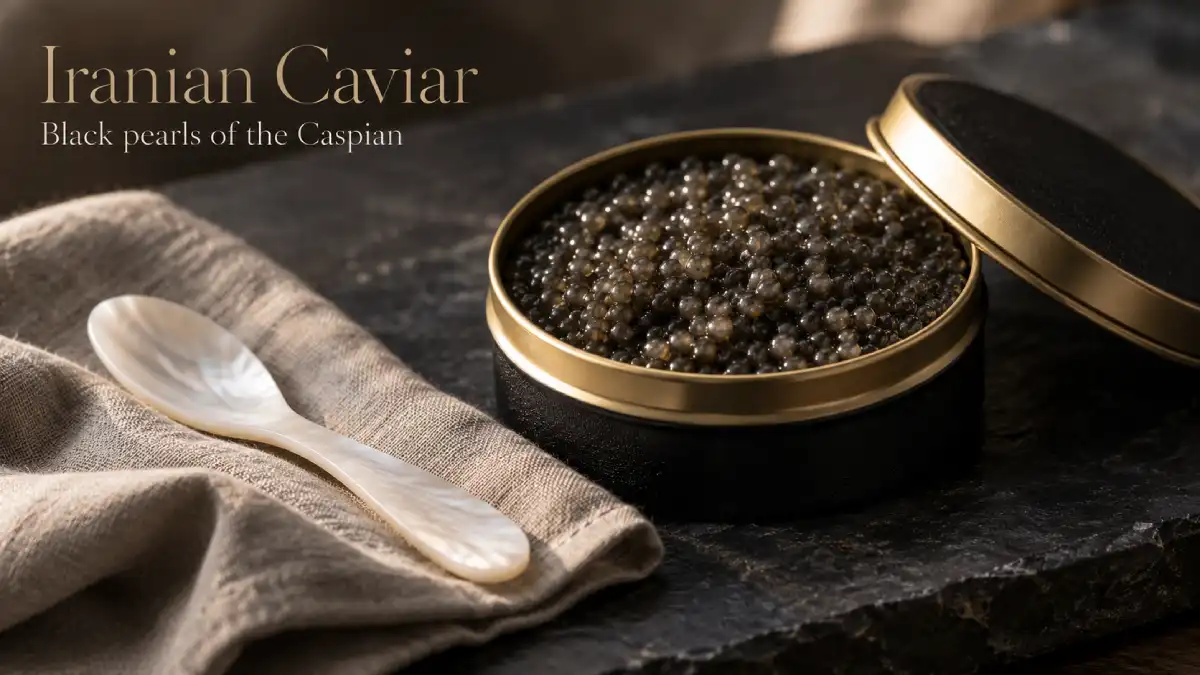
Black pearls of the Caspian
Iranian, or Persian, caviar is the salted roe of sturgeon from the southern Caspian Sea, the Iranian shore. The classic varieties are Beluga, Ossetra and Sevruga. Since wild sturgeon became critically endangered and the trade in wild Caspian caviar was frozen in 2006, the caviar sold today is farmed and traded under CITES rules. The code on the tin tells you the species, whether the fish was farmed, the country and the year.
Key takeaways
- ◆Persian and Iranian caviar are the same thing: roe from sturgeon of the southern Caspian, salted the traditional malossol way.
- ◆Today it is farmed. All 26 remaining sturgeon species are threatened (IUCN, 2022), and wild Caspian caviar trade was frozen in 2006.
- ◆The CITES code on the tin is your best check: species, source (W wild, C captive-bred), country and year.
- ◆The species matters more than the flag: Iranian and Russian caviar come from the same Caspian species; freshness and handling make the difference.
- ◆Start with Ossetra or Sevruga, keep Beluga for a special moment, and plan around 30 g for a tasting.
Contents
What is Iranian (Persian) caviar?
Caviar is the salted roe of sturgeon, an ancient family of fish. “Iranian” or “Persian” caviar comes from the sturgeon of the southern Caspian Sea, along Iran’s northern coast, where rivers and brackish water once gave the fish ideal spawning grounds. For centuries, the roe was processed around Bandar Anzali and along the coast towards Gorgan.
Even the word has Persian roots. According to the Encyclopaedia Iranica, the Persian name comes from khāya-dār, “having eggs”, first used for the egg-bearing fish and later for the eggs themselves. Russians, the other great caviar nation of the Caspian, simply call it ikra, roe.
Real caviar is lightly salted: the Russian term malossol means “little salt”. The salt preserves the eggs without masking their taste, which is why good caviar tastes of the sea rather than of salt.
A short history of Iranian caviar
- ◆A royal delicacy. Caspian caviar was traded for centuries and became a symbol of luxury at the courts of Europe and Russia.
- ◆The fisheries. In the 20th century, Iran’s sturgeon fishing and caviar processing were organised by a state fisheries company, known as Shilat, with Bandar Anzali as the main processing centre.
- ◆A Swiss connection. Iranian customs figures quoted by the Encyclopaedia Iranica show a total export of 264,310 kg of caviar in 1988–89, and the largest buyer was Switzerland, with 115,698 kg.
- ◆From the wild to farms. Overfishing, poaching and dams on spawning rivers pushed the Caspian sturgeon towards extinction. Wild trade was frozen in 2006, and caviar production moved to sturgeon farms, in Iran as elsewhere.
Farmed caviar: Iranian caviar and CITES today
All sturgeon species have been listed by CITES, the convention on international trade in endangered species, since 1998: every international shipment of caviar needs CITES documents. In January 2006, CITES froze the international trade in wild caviar from the Caspian states, because the countries could not show that their quotas were sustainable.
The situation of the fish has not improved. In its 2022 update, the IUCN Red List found that all 26 remaining sturgeon species are threatened with extinction, and lists the Beluga (Huso huso) as Critically Endangered. That is why the caviar you can buy legally today comes from farmed sturgeon. Farming takes pressure off the last wild fish, and it also means fresher caviar, processed within hours of harvest.
In Switzerland, the CITES authority is the Federal Food Safety and Veterinary Office (FSVO/BLV). Caviar of sturgeon species may only be imported with the corresponding CITES documents.
How to read the CITES code on a caviar tin
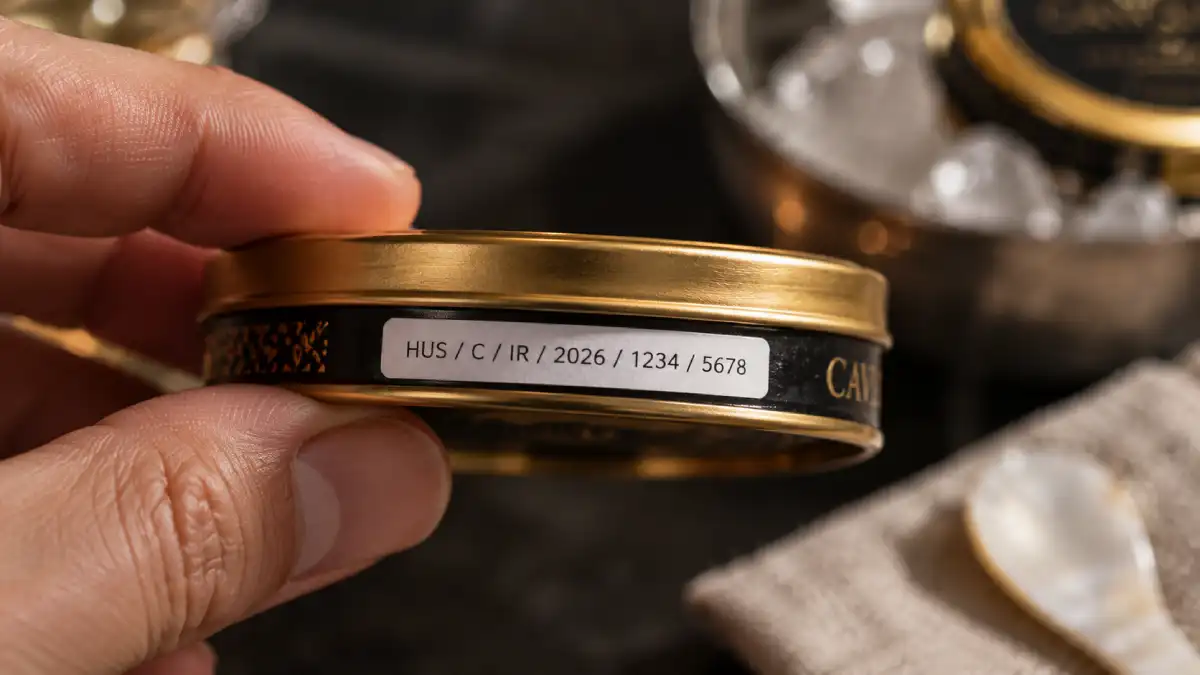
Under CITES Resolution Conf. 12.7, every primary container of sturgeon caviar must carry a label with a standard code. It reads from left to right:
HUS / C / IR / 2026 / xxxx / yyyyIllustrative example, not a real code
| Part | Example | What it tells you |
|---|---|---|
| Species code | HUS | Three letters for the sturgeon species: HUS = Beluga (Huso huso), GUE = Russian sturgeon (Ossetra), STE = stellate sturgeon (Sevruga), BAE = Siberian sturgeon (Baeri). Hybrids show the male and female codes, e.g. GUE x BAE |
| Source code | C | W = wild; C = bred in captivity; F = born in captivity but not meeting the CITES definition of “bred in captivity” |
| Country of origin | IR | Two-letter ISO code of the country where the caviar was produced, e.g. IR for Iran |
| Year | 2026 | Year of harvest |
| Plant code | xxxx | Official registration code of the processing (or repackaging) plant |
| Lot | yyyy | Batch number for traceability |
If a tin has been repackaged, the label shows the country of repackaging instead of the country of origin, together with the repackaging plant’s code. No code, or a code that does not match the variety on the lid, is a reason to ask questions. Before you buy, you can ask the seller for the CITES code of the tin.
The four varieties of Iranian caviar
Iranian caviar is named after the sturgeon species. The three historic Caspian caviars are Beluga, Ossetra and Sevruga. Baeri comes from the Siberian sturgeon, which is not native to the Caspian but is widely farmed.
| Variety | Species (CITES code) | Grains | Taste |
|---|---|---|---|
| Beluga AA® | Huso huso (HUS) | The largest grains, light to dark grey | Mild, delicate, long finish |
| Ossetra | Russian sturgeon, Acipenser gueldenstaedtii (GUE) | Medium grains, brown to golden | Rich, buttery, nutty |
| Sevruga | Stellate sturgeon, Acipenser stellatus (STE) | Fine, even grains, grey | Bold and briny |
| Baeri | Siberian sturgeon, Acipenser baerii (BAE) | Medium grains, deep grey to black | Round and buttery, with hints of nuts |
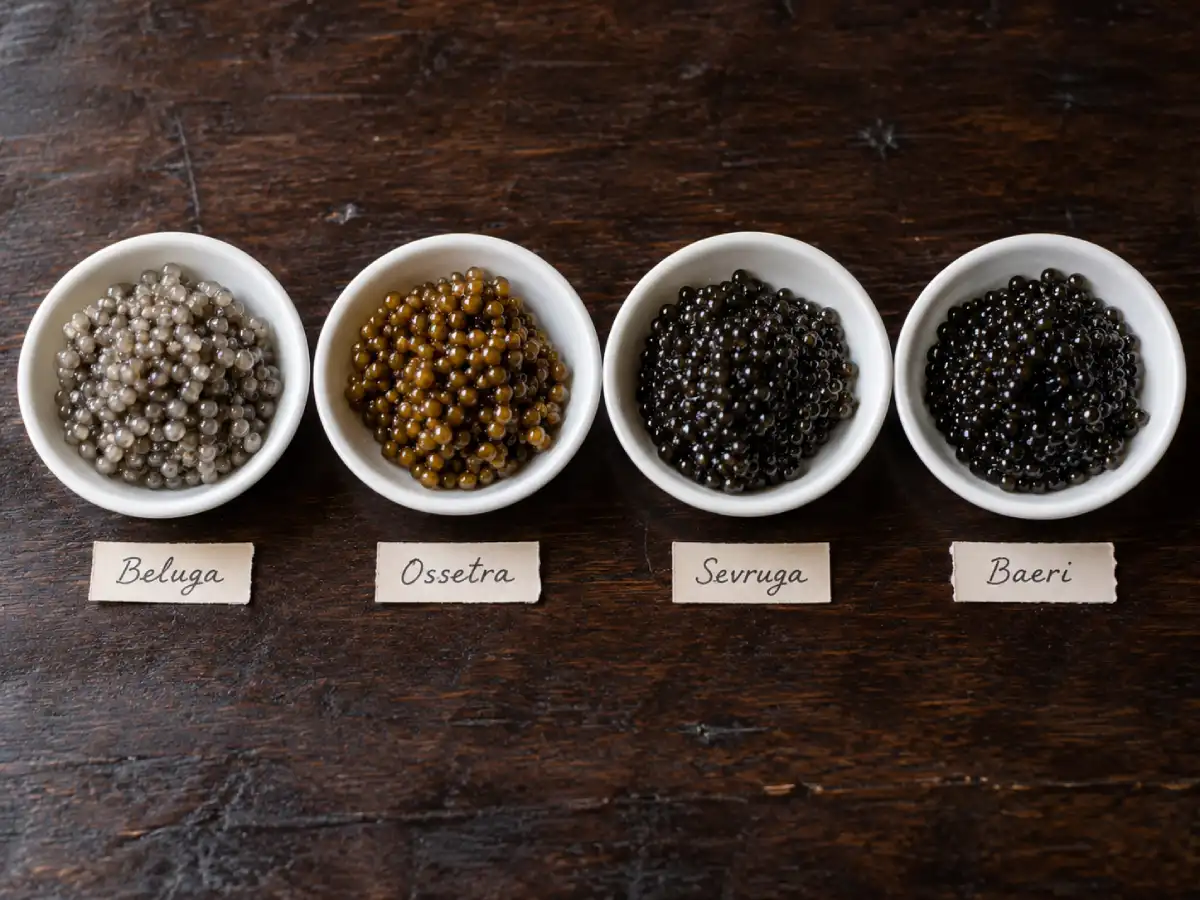
In the Iranian tradition, Beluga was also sorted by colour: light grey (000), grey (00), dark (0) and black (X). These are colour codes, not sizes. For a side-by-side comparison of the two most popular varieties, read Ossetra vs Beluga.
Iranian vs Russian caviar: is there a difference?
Historically, Iran and Russia shared the same sea and the same fish: Beluga, Ossetra and Sevruga live on both shores of the Caspian. Iran was known for careful processing and light salting, Russia for the sheer volume of its fisheries.
Today, with farmed caviar, the country on the label matters less than three things: the species, the farm and its processing (freshness, salt level, hygiene) and the cold chain from the farm to your table. “Russian caviar” or “Iranian caviar” is a style and an origin, not a guarantee of quality on its own.
What does Iranian caviar taste like, and how is it served?
Good caviar tastes of the sea, buttery and clean, with a gentle salinity and a long finish. The grains should roll on the tongue and then pop. To enjoy it fully:
- 1Keep it cold: place the tin on a bed of crushed ice, without the pearls touching the ice, and open it just before serving.
- 2Use the right spoon: mother-of-pearl, glass, porcelain, horn or wood. Avoid silver, which can give a metallic taste.
- 3Taste it plain first, from the back of the hand or on the spoon, then with blini and a little crème fraîche.
- 4Plan the quantity: around 30 g per person for a tasting, about 50 g for a generous aperitif.
With several varieties, taste from the most delicate to the most powerful. More ideas in our guides to hosting a caviar tasting, how much caviar per person and homemade blini.
How to recognise good Iranian caviar
- ◆The grains are whole, separate and glossy, with no oil pooling at the bottom of the tin.
- ◆The smell is fresh and marine, never fishy or sour.
- ◆The texture: grains roll, then pop gently. Mushy or broken grains are a sign of poor handling.
- ◆The label shows the CITES code, a use-by date and storage temperature.
Not all “caviar” is caviar. Lumpfish, salmon or trout roe are not sturgeon caviar. A genetic study of caviar sold in Bulgaria and Romania found that only 10 of 27 samples were correctly labelled; six were counterfeit, three without any animal DNA at all. A clear CITES code and a seller who can explain it are the best protection.
How much does Iranian caviar cost?
The price follows the species: the rarer the sturgeon and the longer it takes to mature, the higher the price. Our prices for a 30 g tin, as displayed on 21 October 2026:
| Variety | 30 g tin | Price per gram |
|---|---|---|
| Baeri | CHF 57.00 | about CHF 1.90 |
| Sevruga | CHF 64.00 | about CHF 2.13 |
| Ossetra | CHF 83.00 | about CHF 2.77 |
| Beluga AA® | CHF 115.00 | about CHF 3.83 |
To understand what drives these prices, read why caviar is so expensive, and for a broader overview, our caviar price guide.
How to store Iranian caviar
Keep the closed tin in the coldest part of the fridge, at the temperature shown on the label, and never freeze it. Once opened, eat it within two to three days, as indicated on the tin, and keep it covered. All the details are in our guide how long does caviar last.
Buying Iranian caviar in Switzerland
At LeDiamont, the four varieties are available in our Iranian caviar collection, in tins from 30 g. All our caviar stock is held in Switzerland, and orders are shipped chilled by Swiss Post, in an insulated box with ice packs, for delivery in 1 to 2 working days.
Caviar also pairs beautifully with saffron on a festive plate: discover our guide to Iranian saffron.
To choose between species, see our comparison Ossetra vs Sevruga vs Baeri and our guide to farmed vs wild caviar.
Frequently asked questions
Is Persian caviar the same as Iranian caviar?
Yes. Persian caviar and Iranian caviar are two names for caviar from sturgeon of the southern Caspian Sea, on the Iranian shore.
Is Iranian caviar wild or farmed?
Today it is farmed. International trade in wild Caspian caviar was frozen in 2006, and all remaining sturgeon species are threatened. The source letter in the CITES code shows it: C means bred in captivity, W means wild.
Is Iranian caviar better than Russian caviar?
Not by principle. Both come from the same Caspian species. With farmed caviar, the species, the farm’s processing, the freshness and the cold chain matter more than the country.
Is Iranian caviar legal in Switzerland?
Caviar of sturgeon species may be imported into Switzerland only with the required CITES documents, checked by the Federal Food Safety and Veterinary Office (FSVO/BLV). Each tin should carry a CITES code.
Which Iranian caviar should I choose first?
Ossetra is a good start, with its nutty, buttery taste. Sevruga is bolder and more marine, Baeri round and accessible, and Beluga the most delicate, for a special occasion.
How much does Iranian caviar cost?
It depends on the species. At LeDiamont, a 30 g tin cost from CHF 57.00 for Baeri to CHF 115.00 for Beluga AA® on 21 October 2026.
What do 000, 00 and 0 mean on Beluga caviar?
In the Iranian tradition they are colour codes: 000 for light grey, 00 for grey and 0 for dark grains. They do not describe the size of the grain.
How should Iranian caviar be stored?
Closed, in the coldest part of the fridge at the temperature shown on the tin, and never frozen. Once opened, eat it within two to three days.
Sources
- Encyclopaedia Iranica: Caviar (H. Alam): etymology, processing, grades and export figures
- IUCN (21 July 2022): IUCN Red List update: 100% of remaining sturgeon species threatened
- United Nations press (January 2006): CITES halts trade in wild Caspian caviar
- CITES: Resolution Conf. 12.7 (Rev. CoP17): Conservation of and trade in sturgeons and paddlefish
- Federal Food Safety and Veterinary Office (FSVO/BLV): CITES in Switzerland
- Leibniz-IZW (2015): Fake caviar from Bulgaria and Romania
- Ludwig A. et al. (2015), Journal of Applied Ichthyology: Caviar fraud in Bulgaria and Romania: genetic analysis