
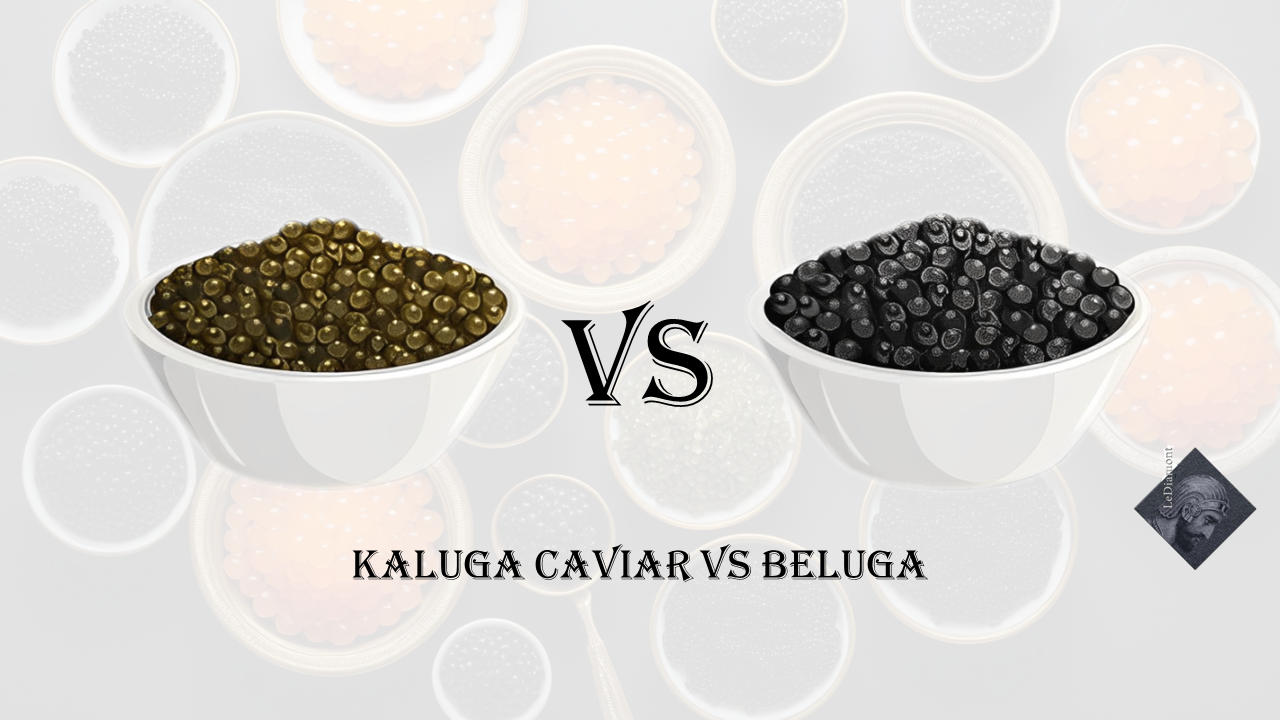
Kaluga and Beluga are different sturgeon caviars. The CITES identification guide lists Kaluga as Huso dauricus and Beluga as Huso huso. Before choosing a tin, compare its exact identity, tasting description, quantity and current price.
Start with the species on the label
A commercial name is only a starting point. Check whether the product identifies a species or a hybrid, and distinguish the origin of the caviar from its place of packaging. The DGCCRF warns about misleading species and origin descriptions.
For this comparison, do not treat a product described as Kaluga, a hybrid selection and Beluga as interchangeable references. If a label is unclear, ask the seller for the exact identification before ordering.
Compare the actual selection
Species, farming and preparation influence a caviar’s characteristics. Read the tasting notes for the selection you are considering. A commercial name does not guarantee a particular grain diameter, colour or texture.
- For grain size, look for a measurement or a description specific to that selection.
- For texture and flavour, compare the producer’s tasting notes rather than a general ranking of the two names.
- For ingredients and salt content, use the label and the product information.
Compare prices for the same quantity
Use the same net weight and currency. Check the price of the actual tin and whether it is available. This guide does not assign a fixed price or price ratio to Kaluga and Beluga; current offers belong on the product pages.
Check claims and storage instructions
Do not infer an environmental guarantee from the name Kaluga or Beluga, or from a reference to farming alone. If sustainability is part of your selection criteria, ask which evidence supports the claim for that product.
Follow the storage temperature, use-by date and instructions after opening printed on the tin. A general comparison cannot replace the instructions for the batch you receive.
The LeDiamont selection
To explore the current catalogue, see Iranian Beluga AA® caviar and Iranian Sevruga caviar. Check their product pages for formats, prices and availability. You can also browse our caviar collection.


Read also: our complete guide to Iranian caviar, its history, its varieties and how to buy it in Switzerland.
Frequently asked questions
What is the difference between Kaluga and Beluga caviar?
Both sturgeons belong to the genus Huso. Beluga (Huso huso) is native to the Caspian and Black Seas; Kaluga (Huso dauricus) comes from the Amur River between Russia and China. Both give large pearls, but the taste depends on the farm.
Is Kaluga a Beluga?
No. Kaluga is a distinct species, sometimes sold as an alternative to Beluga and often from Kaluga × Amur hybrids. Check the Latin name on the label: Huso huso for Beluga, Huso dauricus for Kaluga.
How can I identify the species on a tin?
The CITES code on the label names the species: HUS for Beluga, DAU for Kaluga and DAU × SCH for the Kaluga × Amur hybrid.
Why is Kaluga often cheaper?
It is farmed in large volumes, especially in China, and its hybrids often mature faster than Beluga, which needs around twenty years.