
◆ Last updated: ◆ By LeDiamont — Zervan GmbH
Little salt, all the flavour
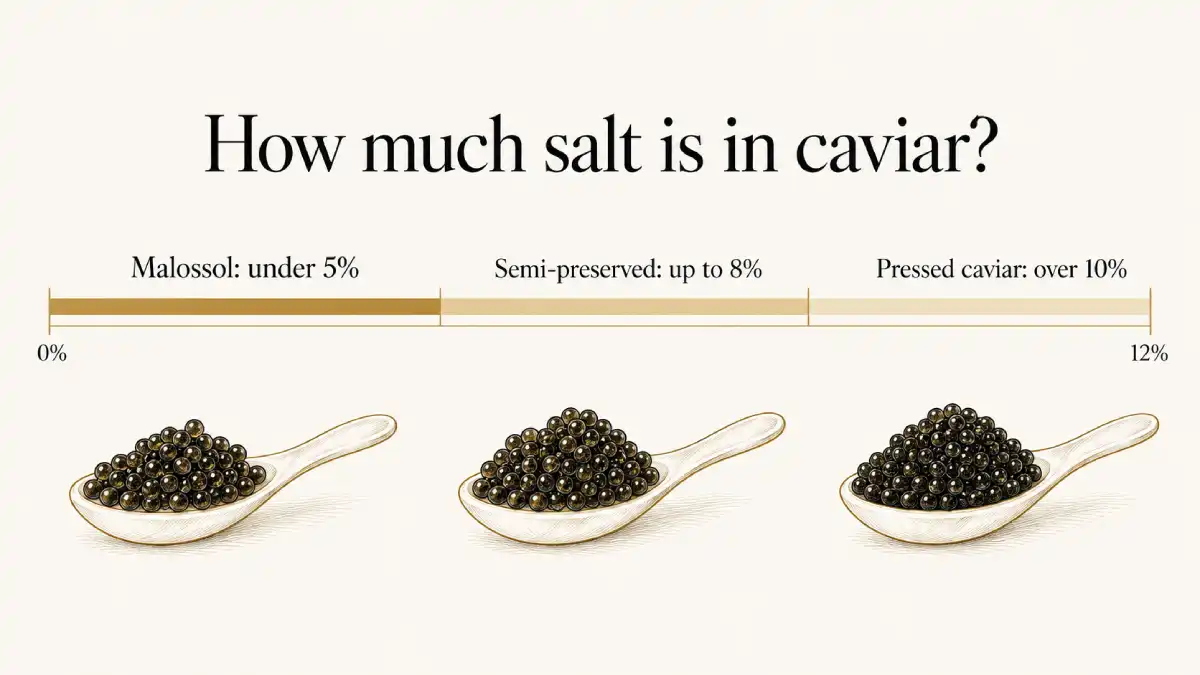
Malossol is Russian for “little salt”. It describes caviar cured with only a small amount of salt: less than 5% of the roe’s weight, and traditionally about 3 to 4%, compared with up to 8% for semi-preserved caviar and more than 10% for pressed caviar. Malossol is not a type of sturgeon but a curing style. It keeps the natural taste and texture of the eggs, but the caviar must stay cold and keeps for a shorter time.
Key takeaways
- ◆Malossol means lightly salted. It is a method, not a species: Ossetra, Sevruga, Baeri and Beluga can all be malossol.
- ◆Salt level: under 5%, traditionally about 3 to 4%. There is no single legal definition, so producers quote slightly different limits.
- ◆Less salt means more flavour, but a shorter shelf life. Malossol caviar must stay in the fridge, at the temperature shown on the tin.
- ◆Some caviar also contains borates (E284/E285). In the EU they are allowed only in sturgeon caviar, and must appear in the ingredient list.
- ◆The tin tells you a lot: ingredients, CITES code, origin and whether the caviar was repacked.
Contents
What does “malossol” mean?
The word comes from Russian malosol: malo means “little” and sol means “salt”. In English it is spelled malossol or malosol; both are correct.
Before refrigeration, caviar had to be heavily salted to survive long journeys from the Caspian Sea. As cold storage and transport improved, producers could use much less salt, and lightly salted malossol became the standard for premium caviar. Today, almost all fine caviar sold fresh is malossol, so the word on a label is a sign of style rather than a rare distinction.
The term is also used for other lightly salted foods, such as malossol cucumbers or lightly cured herring, but in the world of fine food it almost always refers to caviar.
How much salt is in malossol caviar?
There is no single international legal standard for the term. Food scientists describe malossol as caviar with less than 5% salt, and an older FAO definition puts it at 3 to 4%. Most high-quality caviar today stays at the lower end.
| Curing style | Salt | Taste and texture | Keeps (closed, chilled) |
|---|---|---|---|
| Malossol (lightly salted) | Under 5%, traditionally about 3–4% | Natural and delicate; the species flavour comes through | Until the date on the tin |
| Semi-preserved / “salted” | Up to about 8% | Saltier, firmer, less nuance | Longer |
| Pressed caviar (payusnaya) | More than 10% | A dense, very intense, salty paste | Longer |
| Pasteurised caviar | Varies | Firmer pearls, slightly “cooked” notes | Up to about a year (see the label) |
Why the salt level matters to you:
- ◆Taste: with less salt, you notice the nutty, buttery or briny character of each species. See our Ossetra vs Sevruga vs Baeri comparison.
- ◆Texture: salt draws water out of the eggs. Light salting keeps the pearls plump, with a clean pop.
- ◆Storage: less salt means the caviar is more perishable. It must stay cold from the farm to your table.
How is malossol caviar made? Step by step
Good malossol caviar is made fast and cold. The steps below describe how farmed sturgeon caviar is typically produced:
- 1Checking ripeness. Farmers check the roe by ultrasound or a small sample, so it is harvested at the right stage: too early gives soft eggs, too late gives eggs that break easily.
- 2Purging and harvesting. The fish are kept in clean water before harvest, then the roe is removed in a clean, chilled room. Some producers use “no-kill” methods that allow the fish to produce again; our guide to farmed vs wild caviar explains them.
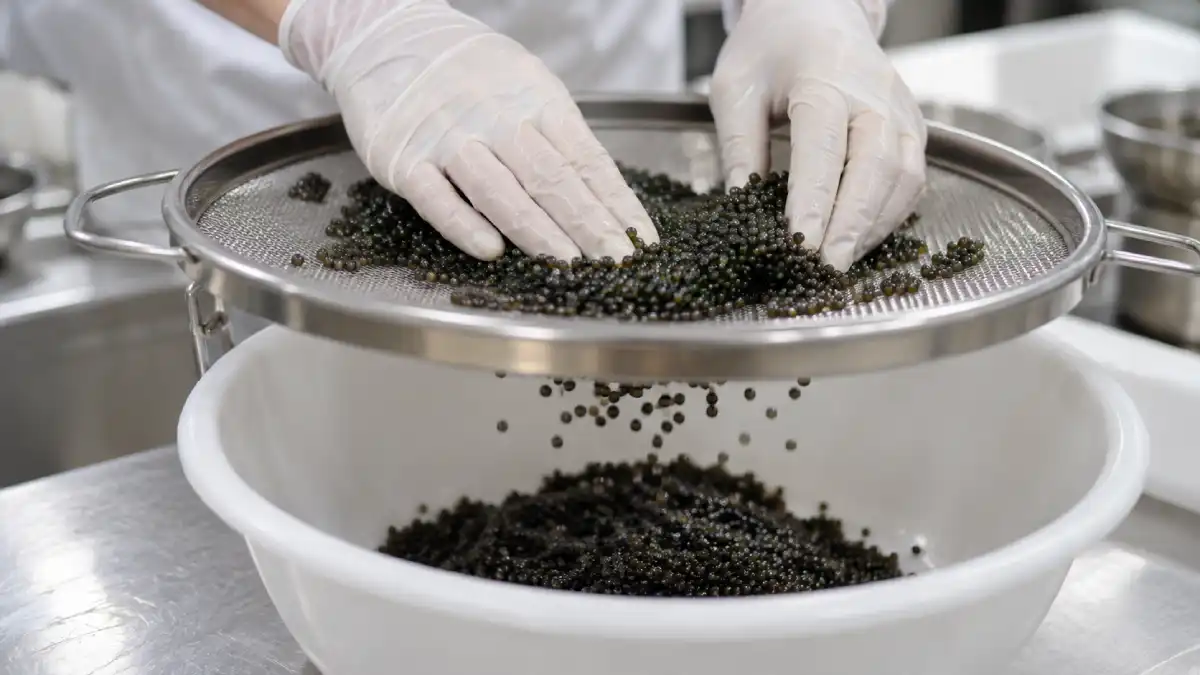
- 3Screening. The roe is gently rubbed over a mesh screen. The individual eggs fall through; the membrane stays behind.
- 4Rinsing and cleaning. The eggs are rinsed repeatedly in cold water, and broken eggs or remaining tissue are removed by hand, often with tweezers.
- 5Grading. The caviar master judges the batch by pearl size, colour, firmness and flavour.
- 6Salting. The roe is weighed and a precise amount of very fine salt is mixed in by hand. This is the step that makes it malossol.
- 7Resting and draining. The salted eggs rest in the cold, from a few minutes to a few hours, so the salt is absorbed evenly, then the excess liquid is drained off.
- 8Tinning and maturing. The caviar is packed into lacquer-lined tins, pressed so the lid pushes out the air, and sealed. Many producers let it mature in the cold before sale, which rounds out the flavour.
From then on, caviar must stay in the cold chain. To learn how long it keeps at home, see how long caviar lasts.
Salt only, or salt and borates?
Salt is the traditional preservative, but some caviar also contains boric acid (E284) or sodium tetraborate, also called borax (E285). Producers use them because they extend shelf life and keep the pearls firm, so less salt is needed.
In the European Union, E284 and E285 are authorised only for sturgeon eggs (caviar), up to 4 g per kilo, expressed as boric acid, and they must appear in the ingredient list. Outside Europe the rules differ: borates, for example, do not appear on Health Canada’s list of permitted preservatives.
What this means for you as a buyer:
- ◆Read the ingredient list. “Sturgeon roe, salt” means salt only. “E284”, “E285”, “boric acid” or “sodium tetraborate” means borates were added.
- ◆Borates are legal for caviar in Europe and widely used. Their presence is a matter of production choice and regulation, not a sign of fake caviar.
- ◆Rules depend on the country. A reputable seller knows the rules of the country where the caviar is sold.
Malossol caviar can be made with or without borates. The word only refers to the low salt level.
Fresh vs pasteurised caviar
Most premium caviar is sold fresh, that is, unpasteurised. Some caviar is pasteurised: the sealed tin or jar is gently heated to destroy bacteria, which allows much longer storage.
| Fresh malossol | Pasteurised | |
|---|---|---|
| Storage | Fridge, at the temperature shown on the tin | As stated on the label; some can be kept at room temperature |
| Keeps (closed) | Until the date on the tin | Up to about a year |
| Texture | Plump, soft, clean pop | Firmer, sometimes slightly rubbery |
| Flavour | Fresh, nuanced | More muted, sometimes slightly cooked |
| Best for | Tasting on its own, special occasions | Back-up stock, cooking, travel |
If a product does not say “pasteurised”, treat it as fresh and keep it cold.
Caviar tins: original tins, repacked tins and jars
How caviar is packed affects its freshness, so it is worth knowing what you are buying:
- ◆Original (master) tins. At the farm, caviar is often packed into large tins. Restaurants and some retailers buy these directly.
- ◆Repacked tins. Many retail tins are filled from these master tins by a licensed repackaging plant. Repacking is normal and legal, and it must be shown on the CITES label.
- ◆Vacuum-sealed tins. Smaller tins are often vacuum-sealed and held shut with a rubber band, which protects the caviar from oxygen.
- ◆Glass jars. Common for pasteurised caviar and for roe from other fish. Glass lets you see the pearls but also lets in light.
Whatever the format, an unopened tin should be well sealed. A bulging lid is a warning sign. For more signs of quality, read how to tell if caviar is real.
How to read a caviar label
A legal tin of sturgeon caviar in international trade carries a CITES code that identifies the species, the source, the country and the producer. For example (illustrative):
GUE / C / IR / 2026 / xxxx / yyyyIllustrative example, not a real code
| Part | Meaning |
|---|---|
| GUE | Species code (here Russian sturgeon, Ossetra). Others: HUS = Beluga, STE = Sevruga, BAE = Baeri |
| C | Source code: C or F = farmed, W = wild |
| IR | ISO code of the country of origin; on repacked tins, the country of repackaging |
| 2026 | Year of harvest, or of repackaging on repacked tins |
| xxxx | Registration code of the processing or repackaging plant |
| yyyy | Lot number, for traceability |
Next to the CITES code, look for the ingredient list (salt only, or salt plus E284/E285), the use-by date, the storage temperature and the word malossol if the producer uses it.
Does malossol caviar taste different?
Yes. With light salting, you taste the roe rather than the salt. Expect:
- ◆A clean, fresh sea aroma, not a strong fishy or salty smell.
- ◆A gentle pop, followed by a creamy or buttery finish.
- ◆Clear species character: nuttiness in Ossetra, intensity in Sevruga, mildness in Baeri.
Heavily salted caviar tastes mainly of salt and can feel drier and firmer. If you are serving caviar for the first time, malossol is the style to choose. Our guide to serving caviar shows the best way to enjoy it.
How to store malossol caviar
Because it is lightly salted, malossol caviar is fragile:
- ◆Keep unopened tins in the coldest part of the fridge, at the temperature shown on the label, and respect the date on the tin.
- ◆Open it just before serving and set the tin on crushed ice, without the pearls touching the ice. Serve small quantities and keep the rest in the fridge.
- ◆Once opened, eat it within two to three days, as indicated on the tin, and keep it covered.
- ◆Do not freeze it: ice crystals break the eggs and ruin the texture.
Frequently asked questions
What does malossol mean on caviar?
Malossol means “little salt” in Russian. On a caviar tin, it means the roe was cured with a small amount of salt: less than 5% of its weight, traditionally about 3 to 4%.
Is malossol caviar better?
For most people, yes. Light salting lets the natural flavour and texture of the roe come through. Its downsides are a shorter shelf life and the need for strict refrigeration.
Is malossol a type of caviar?
No. Malossol is a curing method. Any sturgeon caviar, such as Beluga, Ossetra, Sevruga or Baeri, can be prepared in the malossol style.
How much salt is in malossol caviar?
Less than 5% of the roe’s weight, traditionally about 3 to 4%. There is no single legal definition, and most high-quality caviar stays at the lower end.
Does malossol caviar contain preservatives?
It can. Some malossol caviar is made with salt only; some also contains boric acid (E284) or borax (E285), which the EU allows only in sturgeon caviar. Check the ingredient list.
Is pasteurised caviar still malossol?
It can be lightly salted, but pasteurisation changes the texture and flavour, and it is usually labelled “pasteurised” rather than sold as fresh malossol.
How long does malossol caviar last?
Closed, in the fridge at the temperature shown on the tin, until the date on the label. Once opened, eat it within two to three days.
Taste the difference
The best way to understand malossol is to taste it: a spoonful of lightly salted caviar, straight from a chilled tin. All our caviar comes from farmed sturgeon and is shipped chilled by Swiss Post within Switzerland and Liechtenstein, in 1 to 2 working days. Each product page lists the variety and its origin. To understand what drives caviar prices, read why caviar is so expensive.
Sources
- Institute of Food Technologists, Food Technology (February 2020): How caviar is processed: salt levels, screening, salting and pasteurisation
- Office québécois de la langue française, Grand dictionnaire terminologique: Caviar malossol: definition and salt content (after FAO)
- EU Regulation (EC) No 1333/2008, Annex II, food category 09.3 (summary by D-CODE, IPB): E284/E285: only sturgeon eggs (caviar), max. 4,000 mg/kg expressed as boric acid
- Health Canada: List of Permitted Preservatives
- CITES: Resolution Conf. 12.7 (Rev. CoP17): universal labelling system for caviar