
◆ Last updated: ◆ By LeDiamont — Zervan GmbH
Start with the label, then trust your senses
Real caviar is the salted roe of sturgeon only. To check it, first read the label: genuine caviar names the sturgeon species (for example Huso huso for Beluga) and, in international trade, carries a CITES code giving the species, the source (wild or farmed), the country of origin, the year of harvest, the processing plant and the lot. Then use your senses: real caviar has distinct, glossy, intact pearls, smells clean and lightly of the sea and does not stain a white plate. Be wary of vague names such as “Caspian style”, missing codes and prices far below those of specialist sellers.
Key takeaways
- ◆Only sturgeon roe is caviar. Salmon, trout, lumpfish or capelin roe are fish roe, not caviar.
- ◆The label is your best test. A species name and a complete CITES code are required for sturgeon caviar in international trade.
- ◆Black dye is a red flag. Dyed lumpfish roe can bleed colour; real caviar does not.
- ◆Price is a clue, not proof. Very cheap “Beluga” is rarely Beluga, but a high price alone guarantees nothing.
- ◆Fraud exists. In a 2015 study, only 10 of 27 caviar samples bought in Bulgaria and Romania matched their label.
Contents
What counts as “real” caviar?
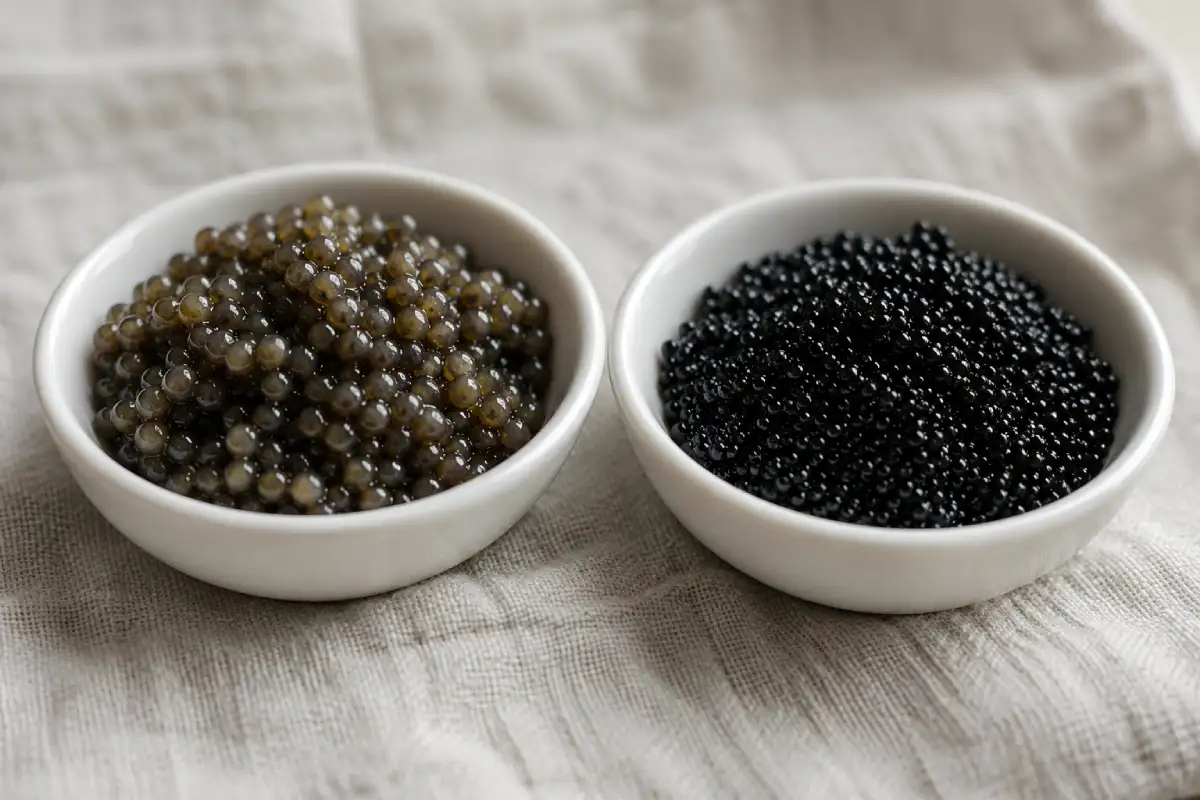
The international food standard Codex Alimentarius defines caviar as “the product made from fish eggs of the Acipenseridae family”, the sturgeon family, “by treating with food grade salt”. Everything else is fish roe or imitation caviar, even when the jar says “caviar” in large letters with a smaller word in front (“salmon caviar”, “lumpfish caviar”).
| Product | What it is | Typical appearance | Is it caviar? |
|---|---|---|---|
| Sturgeon caviar (Beluga, Ossetra, Sevruga, Baeri, Kaluga…) | Salted sturgeon roe | Grey, brown, black or golden pearls, of varying size by species | Yes |
| Hybrid sturgeon caviar | Roe of a cross between two sturgeon species | Similar to sturgeon caviar | Yes, when both species are named |
| Hackleback | Roe of the shovelnose sturgeon, a small American sturgeon | Small, dark | Yes |
| Paddlefish roe | Roe of a close relative of sturgeon (not a sturgeon) | Small, grey | Not sturgeon caviar under the Codex standard |
| Salmon or trout roe | Roe of salmon or trout | Large, bright orange | No, fish roe |
| Lumpfish or capelin roe | Small roe, often dyed black or red | Tiny, uniform, very dark | No, fish roe |
| Tobiko or masago | Flying fish or capelin roe, often coloured | Tiny, crunchy, bright colours | No |
| Seaweed, agar or “molecular” pearls | Plant-based or gelled spheres | Perfectly round and identical | No, imitation |
Why fake caviar is a real problem
Caviar is valuable, sturgeon are protected, and the product is hard to identify by eye. That combination attracts fraud.
In a 2015 study, researchers from the Leibniz Institute for Zoo and Wildlife Research (IZW), working with WWF, analysed 27 caviar samples bought in Bulgaria and Romania:
- ◆only 10 labelled tins or jars matched the species code on their label;
- ◆4 were mislabelled;
- ◆7 were sold without any label on the container;
- ◆6 were counterfeit: three contained no animal DNA at all, one was lumpsucker roe, and two were most likely made from sturgeon meat rather than roe.
- ◆4 samples, sold as wild Danube caviar, came from the critically endangered Beluga sturgeon and were traded illegally.
The lesson: a beautiful tin is not proof. The label, the seller and a few simple checks are.
Checks 1–4: read the label
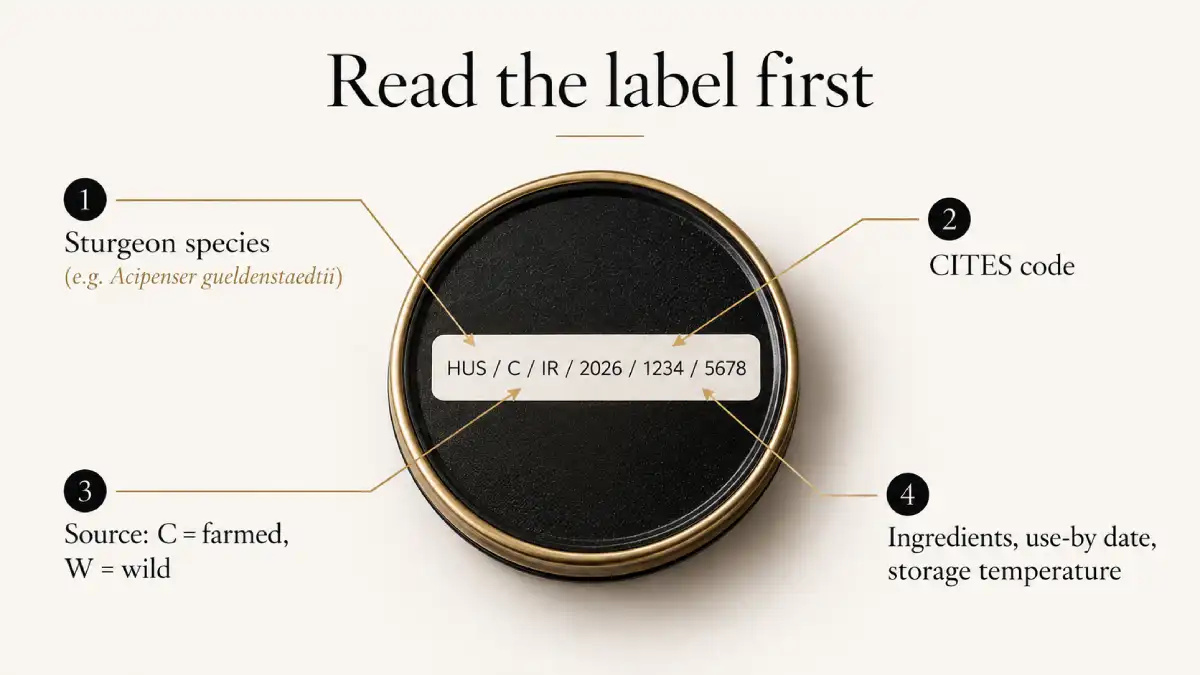
1. Look for the sturgeon species
Genuine caviar names the fish, ideally with its Latin name. The three-letter codes below are the official CITES species codes used on caviar labels:
| Caviar | Species | CITES code |
|---|---|---|
| Beluga | Huso huso | HUS |
| Ossetra (Osetra, Oscietra) | Acipenser gueldenstaedtii | GUE |
| Sevruga | Acipenser stellatus | STE |
| Baeri (Siberian sturgeon) | Acipenser baerii | BAE |
| Kaluga | Huso dauricus | DAU |
| Amur sturgeon (often in Kaluga hybrids) | Acipenser schrenckii | SCH |
| White sturgeon | Acipenser transmontanus | TRA |
| Sterlet | Acipenser ruthenus | RUT |
A hybrid is shown with two codes: the code of the male species, then “x”, then the code of the female species (for example DAUxSCH). If a tin only says “black caviar”, “Russian-style caviar” or “Caspian caviar”, without a species, be cautious.
2. Find the CITES code
Since 1 April 1998, all sturgeon and paddlefish species have been listed under CITES, the Convention on International Trade in Endangered Species. Under the CITES universal labelling system, every primary container of caviar in international trade carries a non-reusable label with a code like this one (illustrative example):
GUE / C / IT / 2026 / xxxx / yyyyIllustrative example, not a real code
| Element | Example | Meaning |
|---|---|---|
| Species code | GUE | Acipenser gueldenstaedtii (Ossetra) |
| Source code | C | W = wild; C = bred in captivity; F = born in captivity, not meeting the CITES definition of “bred in captivity” |
| Country of origin | IT | ISO two-letter code of the country where the caviar was produced |
| Year of harvest | 2026 | When the roe was harvested |
| Processing plant | xxxx | Official registration code of the processing plant |
| Lot number | yyyy | Batch identification number |
If caviar has been repackaged, the repackaging plant adds its own label with the year of repackaging, its registration code (which includes the country of repackaging) and a lot or permit number.
3. Check the source code
Caviar sold legally today comes from sturgeon farms, shown by C (or sometimes F). A W (wild) code is a red flag: trade in wild caviar is banned today, and such a product is almost always illegal or counterfeit.
4. Check ingredients, dates and storage
Fresh caviar lists sturgeon roe and salt, sometimes with a permitted preservative (in the EU, for example, borax/boric acid E 285 is authorised only for sturgeon eggs). It has a use-by date and says keep refrigerated. A jar of “caviar” stored for months on an unrefrigerated shelf is either pasteurised (and labelled as such) or not fresh sturgeon caviar; read the label carefully.
Checks 5–8: use your senses
5. Look at the pearls
- ◆Real: distinct, round, glossy pearls of a fairly even size for the species, with natural colour variations (grey, brown, olive, golden). A small lighter spot is sometimes visible on each egg.
- ◆Fake or poor quality: dull, mushy or broken eggs; perfectly identical spheres (often a sign of a gelled imitation); an unnatural jet-black colour.
6. Do the white-plate test for dye
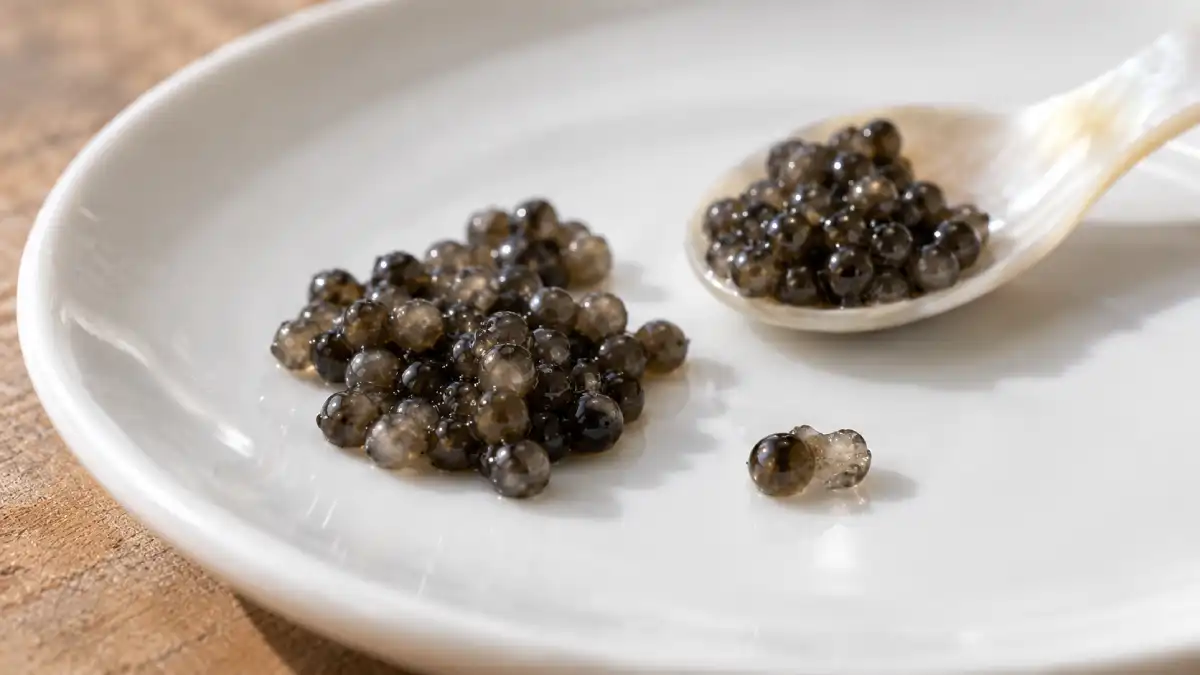
Put a few pearls on a white plate or a piece of kitchen paper, or on a little crème fraîche, and wait a minute. Dyed lumpfish or capelin roe can leave black or blue-black stains. Real sturgeon caviar does not bleed colour.
7. Smell it
Real caviar smells clean, fresh and faintly of the sea. A strong fishy, sour, chemical or ammonia smell points to poor quality, spoilage or a cheap substitute. If it smells wrong, don’t taste it; see how to tell if caviar has gone bad.
8. Taste and texture
Press a few pearls gently against the roof of your mouth:
- ◆Real: the pearls pop gently and release a buttery, nutty or briny flavour with a long, clean finish.
- ◆Imitation: crunchy (lumpfish, tobiko) or gelatinous (seaweed or agar pearls), very salty or one-dimensional, with almost no finish.
Checks 9–10: the price and the seller
9. Compare the price per gram
Real sturgeon caviar is expensive because sturgeon take many years to mature before they produce roe (see why caviar is so expensive). For reference, the 30 g tins on our own product pages ranged from about CHF 1.90 to CHF 3.83 per gram on 21 October 2026 (see our Caviar Price Guide).
- ◆“Caviar” sold for a small fraction of that is almost certainly fish roe or an imitation.
- ◆“Beluga” priced like entry-level caviar is very likely a hybrid or another species.
- ◆A high price is not proof either. Check the label as well.
10. Check the seller
A trustworthy caviar seller:
- ◆names the species, origin and producer of every product;
- ◆can show the CITES code and documentation on request;
- ◆ships chilled, in insulated packaging;
- ◆gives clear storage instructions and use-by dates;
- ◆has a real company name, address and contact details.
Be careful with marketplace listings, social-media sellers and “too good to be true” offers without documentation.
Quick checklist: is this caviar real?
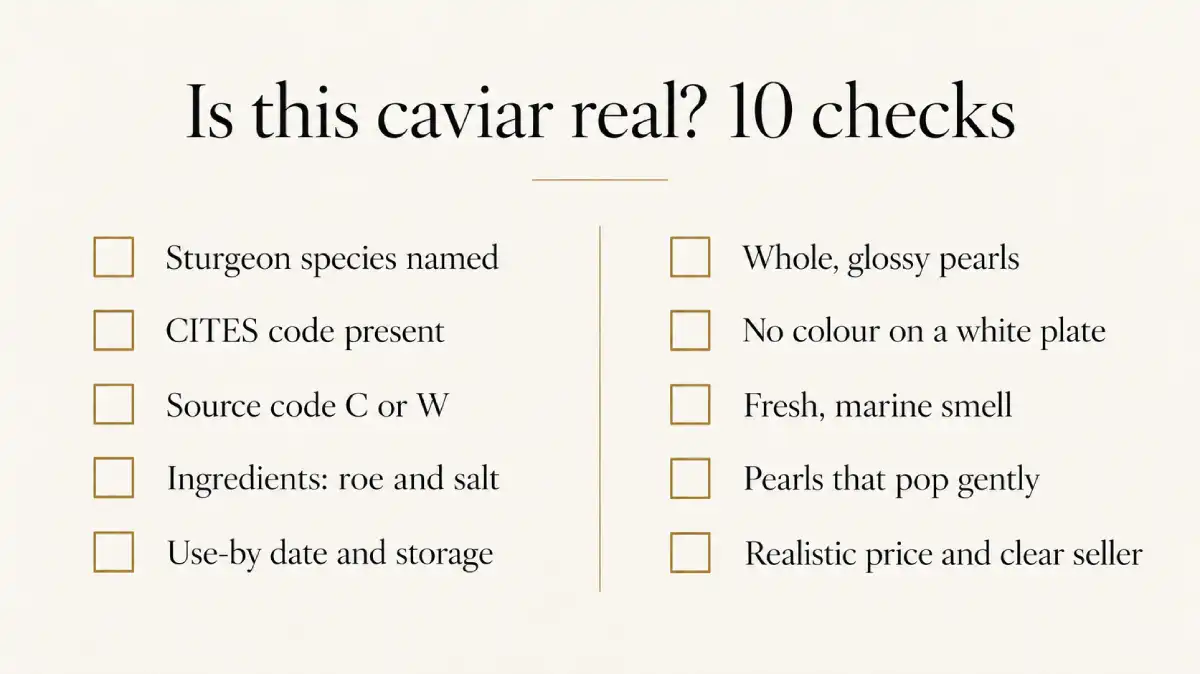
| Check | Real caviar | Warning sign |
|---|---|---|
| Name | Sturgeon species named (e.g. Huso huso) | “Black caviar”, “Caspian style”, no species |
| CITES code | Complete code on the tin | Missing or incomplete code |
| Source | C or F (farmed) | W on an endangered species from an ordinary shop |
| Ingredients | Sturgeon roe, salt | Colourings, thickeners, flavourings |
| Storage | Refrigerated, use-by date | Sold at room temperature (unless pasteurised and labelled) |
| Look | Glossy, distinct, natural colour | Dull, mushy, perfectly uniform, jet-black |
| Dye test | No stain | Black or blue stain on the plate or crème fraîche |
| Smell | Clean, lightly marine | Strong fishy, sour, chemical |
| Texture | Gentle pop, long finish | Crunchy or gel-like, no finish |
| Price | Consistent with specialist sellers | A small fraction of usual prices |
What to do if you suspect fake caviar
- 1Don’t eat it if it smells or looks wrong.
- 2Photograph the tin, the label and the packaging.
- 3Contact the seller with your photos and ask for the CITES documentation.
- 4Ask for a refund if the product doesn’t match its description.
- 5Report it: for food concerns, to your cantonal food control authority; for suspected illegal wildlife trade, to the CITES management authority (in Switzerland, the Federal Food Safety and Veterinary Office, FSVO) or to customs.
How we help you buy with confidence
At LeDiamont, our product pages state the origin of each caviar and, for most of them, the sturgeon species; we ship caviar chilled, with storage instructions. Check the code on your tin, and if you have any question about a product’s species, origin or CITES documentation, contact our team.
Two more useful markers: the term malossol, which means lightly salted, and the difference between farmed and wild caviar.
Frequently asked questions
How can you tell if caviar is real?
Check that the label names a sturgeon species and shows a complete CITES code. Then look for glossy, distinct pearls that don’t stain a white plate, a clean sea smell, and a gentle pop with a long, buttery finish.
What is fake caviar made of?
Usually lumpfish, capelin or salmon roe (often dyed black), or imitation pearls made from seaweed, agar or other gelling agents.
Is lumpfish caviar real caviar?
No. Lumpfish roe is fish roe, not sturgeon caviar. It is often dyed black and is much cheaper and crunchier.
What does the CITES code on caviar mean?
It identifies the species, the source (wild, bred in captivity or born in captivity), the country of origin, the year of harvest, the processing plant and the lot number.
Is cheap caviar fake?
Products sold for a small fraction of the price of specialist sturgeon caviar are almost always fish roe or imitations. A high price alone is not proof, so always check the label too.
Does real caviar stain your fingers or plate?
No. Real sturgeon caviar does not bleed colour. Black or blue stains are a sign of dyed fish roe.
Is farmed caviar real caviar?
Yes. Farmed sturgeon caviar is real caviar. Most caviar sold legally today comes from sturgeon farms, shown by the source code C (or F) on the label.
Can caviar be tested in a lab?
Yes. DNA analysis can identify the sturgeon species, and researchers use it to detect mislabelled and illegal caviar.
Sources
- Codex Alimentarius: Standard for Sturgeon Caviar, CXS 291-2010 (list of Codex standards)
- CITES: Resolution Conf. 12.7 (Rev. CoP17): Conservation of and trade in sturgeons and paddlefish, including the universal labelling system for caviar
- Leibniz Institute for Zoo and Wildlife Research (IZW): Fake caviar from Bulgaria and Romania (press release, 15 July 2015)
- Ludwig A., Lieckfeldt D., Jahrl J. (2015): Mislabeled and counterfeit sturgeon caviar from Bulgaria and Romania, Journal of Applied Ichthyology
- Federal Food Safety and Veterinary Office (FSVO): CITES in Switzerland
- LeDiamont: Caviar product pages: species, origin and prices (consulted 21 October 2026)