
◆ Last updated: ◆ By LeDiamont — Zervan GmbH
Three caviars, three characters
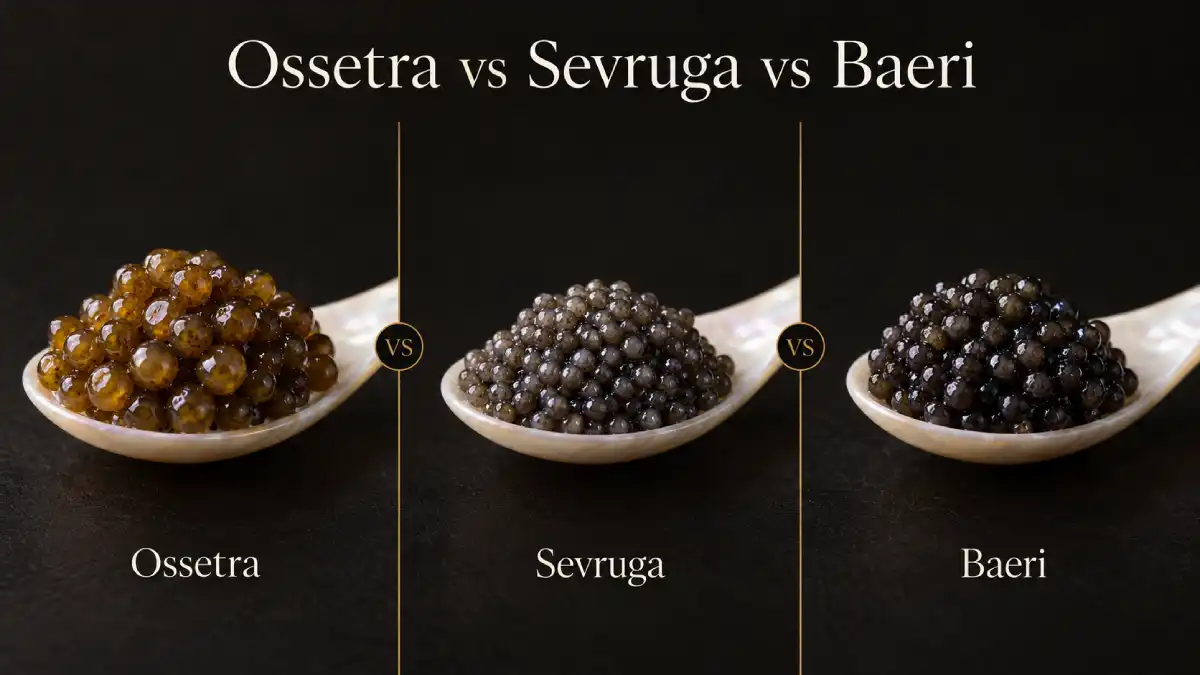
Ossetra has medium to large pearls, brown to golden, with a nutty, buttery taste and a long finish. Sevruga has the smallest pearls, dark grey, and the most intense, briny flavour. Baeri sits in between in size, with a mild, clean, creamy taste and the most accessible price. Choose Ossetra for a special occasion, Sevruga if you love the taste of the sea, and Baeri for a first tasting or a larger group.
Key takeaways
- ◆Ossetra is the all-rounder. Nutty, rich and complex; for many connoisseurs, the favourite after Beluga.
- ◆Sevruga is the most intense. Small, firm pearls with a strong briny, mineral taste and a short, clean finish.
- ◆Baeri is the gentle entry point. Mild, creamy and accessible, ideal for first-timers and canapés.
- ◆Bigger pearls are not automatically better. Freshness, firmness and salting matter more than size.
- ◆Price follows maturity. Siberian sturgeon (Baeri) produce roe earliest; Ossetra takes the longest of the three.
Contents
What are Ossetra, Sevruga and Baeri caviar?
All three are true caviar: salted roe from sturgeon. The name of the caviar is the name of the sturgeon species it comes from.
- ◆Ossetra (also spelled Osetra, Oscietra, Asetra; in French, Osciètre) comes from the Russian sturgeon (Acipenser gueldenstaedtii) and the closely related Persian sturgeon (Acipenser persicus). Its historic home is the Caspian Sea.
- ◆Sevruga comes from the starry or stellate sturgeon (Acipenser stellatus), a slim Caspian and Black Sea species with a long, pointed snout.
- ◆Baeri comes from the Siberian sturgeon (Acipenser baerii), native to Siberian rivers. It adapts well to aquaculture and matures relatively early, which is why it is one of the most widely farmed caviars today.
Together with Beluga (Huso huso), Ossetra and Sevruga form the classic “big three” of Caspian caviar. Baeri joined the luxury market later but now features on many fine-dining menus. If you are weighing Ossetra against Beluga, see our Ossetra vs Beluga comparison, and for the newer Amur species, Kaluga vs Beluga.
Ossetra vs Sevruga vs Baeri at a glance
| Ossetra | Sevruga | Baeri | |
|---|---|---|---|
| Species | A. gueldenstaedtii / A. persicus | A. stellatus | A. baerii |
| CITES species code | GUE (Russian sturgeon) | STE | BAE |
| Pearl size | Medium to large | Small | Small to medium |
| Colour | Dark brown, olive, amber to golden | Dark grey to near black | Dark grey to black, sometimes brown hints |
| Texture | Firm, plump, distinct “pop” | Small, firm, crisp | Soft to medium-firm, smooth |
| Flavour | Nutty (hazelnut, walnut), buttery, complex | Intense, briny, mineral, iodine | Mild, clean, creamy, light nuttiness |
| Finish | Long | Short and sharp | Medium |
| Maturity of the fish | The longest of the three | In between | The earliest |
| LeDiamont 30 g tin | CHF 83.00 (about CHF 2.77/g) | CHF 64.00 (about CHF 2.13/g) | CHF 57.00 (about CHF 1.90/g) |
| Best for | Special occasions, gifts, tasting on its own | Caviar lovers, pairing with vodka or very dry champagne | First tasting, canapés, larger groups |
Premium selections such as Golden Ossetra cost more. See our Caviar Price Guide for the full picture.
How do they taste?
Taste is the main reason to choose one over another, and it is also where descriptions get vague. Here is what you will actually notice on the spoon.
Ossetra: nutty, buttery, layered
Ossetra is known for its nutty character: think toasted hazelnut or walnut, with a buttery, creamy middle and a gentle sea note. The flavour develops in the mouth and stays for a long time. No two batches are identical: colour and taste vary with the individual fish, its age and its diet, which is part of Ossetra’s appeal for connoisseurs. Lighter, golden-amber Ossetra tends to be milder and creamier; darker Ossetra is often more pronounced.
Discover our Iranian Ossetra caviar →
Sevruga: intense, briny, mineral
Sevruga gives the strongest “taste of the sea” of the three. The pearls are small and firm, and the flavour is concentrated: saline, mineral, sometimes with an iodine edge, and a clean, quick finish. Many traditional caviar lovers, especially in Russia and Iran, prefer Sevruga for exactly this intensity. Because the pearls are small, a spoonful holds more eggs and more “pops”.
Discover our Iranian Sevruga caviar →
Baeri: mild, clean, creamy
Baeri is the gentlest of the three. The flavour is clean and lightly marine, with a soft creaminess and a subtle nutty or dried-fruit note. It tastes less salty than Sevruga and is less complex than Ossetra, which makes it easy to enjoy for people trying caviar for the first time, and versatile on canapés, eggs or pasta.
Discover our Iranian Baeri caviar →
Flavour scale
| Characteristic | Ossetra | Sevruga | Baeri |
|---|---|---|---|
| Intensity | 3–4 | 5 | 2 |
| Brininess / saltiness | 3 | 5 | 2–3 |
| Nuttiness | 5 | 2 | 3 |
| Creaminess | 4 | 2 | 4 |
| Length of finish | 5 | 2–3 | 3 |
| Approachability for beginners | 4 | 2 | 5 |
These scores are a guide. Salting, freshness and the individual batch can shift any of them.
Pearl size and colour: does bigger mean better?
Pearl size is the most visible difference: Ossetra pearls are noticeably larger than Sevruga’s, and Baeri sits in between. Size shapes the experience (large pearls give a rounder pop, small pearls a crisper, more concentrated bite), but it is not a measure of quality on its own. When judging any caviar, look for:
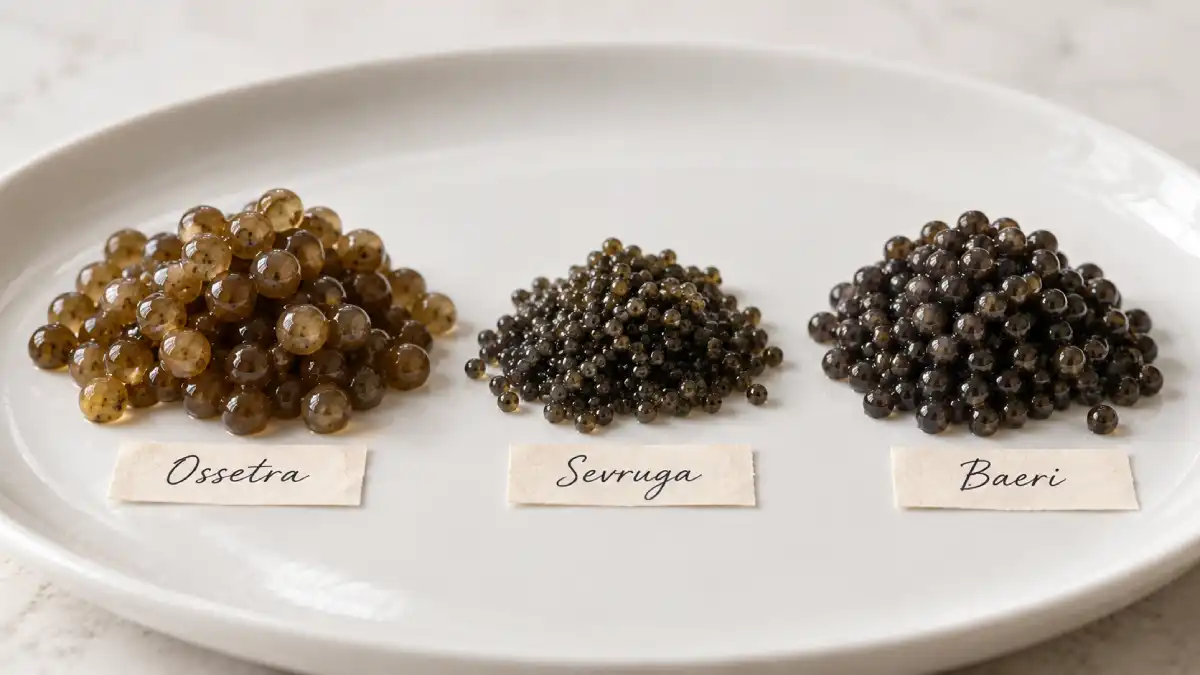
- 1Separate, intact pearls that roll freely and are not mushy or broken.
- 2A glossy surface and a uniform colour within the tin.
- 3A clean, fresh sea smell, never fishy or sour.
- 4A firm pop on the palate, followed by a smooth, not oily, taste.
Colour is also a matter of preference. Golden Ossetra (light amber pearls) is rarer and usually priced higher, but darker Ossetra is not inferior. Sevruga and Baeri are naturally dark grey to black. For more on spotting quality and fakes, read how to tell if caviar is real.
Price: why Ossetra usually costs more than Baeri
Caviar price depends mostly on how long the sturgeon takes to produce roe, how much roe each fish gives and how many fish are farmed. Siberian sturgeon (Baeri) reach maturity earliest and are farmed in large numbers, so Baeri is the most accessible. Sevruga and above all Ossetra take longer, and every extra year means more feed, water, energy and risk for the farmer.
| Variety | 30 g tin | Price per gram | What to expect |
|---|---|---|---|
| Baeri | CHF 57.00 | about CHF 1.90 | A generous, mild tasting |
| Sevruga | CHF 64.00 | about CHF 2.13 | Intense, for lovers of a strong sea flavour |
| Ossetra | CHF 83.00 | about CHF 2.77 | Rich and complex, for a special occasion |
Within one species, price also rises with grade (pearl size, colour uniformity, firmness) and with careful, lightly salted (malossol) processing. For the economics behind it, see why caviar is so expensive.
Which caviar should you choose?
| Your situation | Our suggestion | Why |
|---|---|---|
| First time trying caviar | Baeri | Mild, clean, not too salty, easy to like |
| Romantic dinner or anniversary | Ossetra | Rich, complex, feels special on its own |
| Gift for someone who knows caviar | Ossetra (or Sevruga if they love intensity) | Connoisseurs respect both; Ossetra is the safer pick |
| Party canapés for 10+ guests | Baeri | Best value per gram; the flavour works with toppings |
| Vodka or very dry champagne | Sevruga | Its briny intensity stands up to strong, crisp drinks |
| You loved Beluga but want to spend less | Ossetra | Closest in creaminess and length |
| You want to compare and learn | All three | A side-by-side tasting shows the differences clearly |
Not sure about quantities? Our guide to how much caviar per person covers tastings, aperitifs and larger parties.
How to taste them side by side at home
Tasting the three together is the fastest way to find your favourite, and it makes a memorable evening. Plan about 10 g of each variety per person, so 30 g in total per person, the usual amount for a tasting.
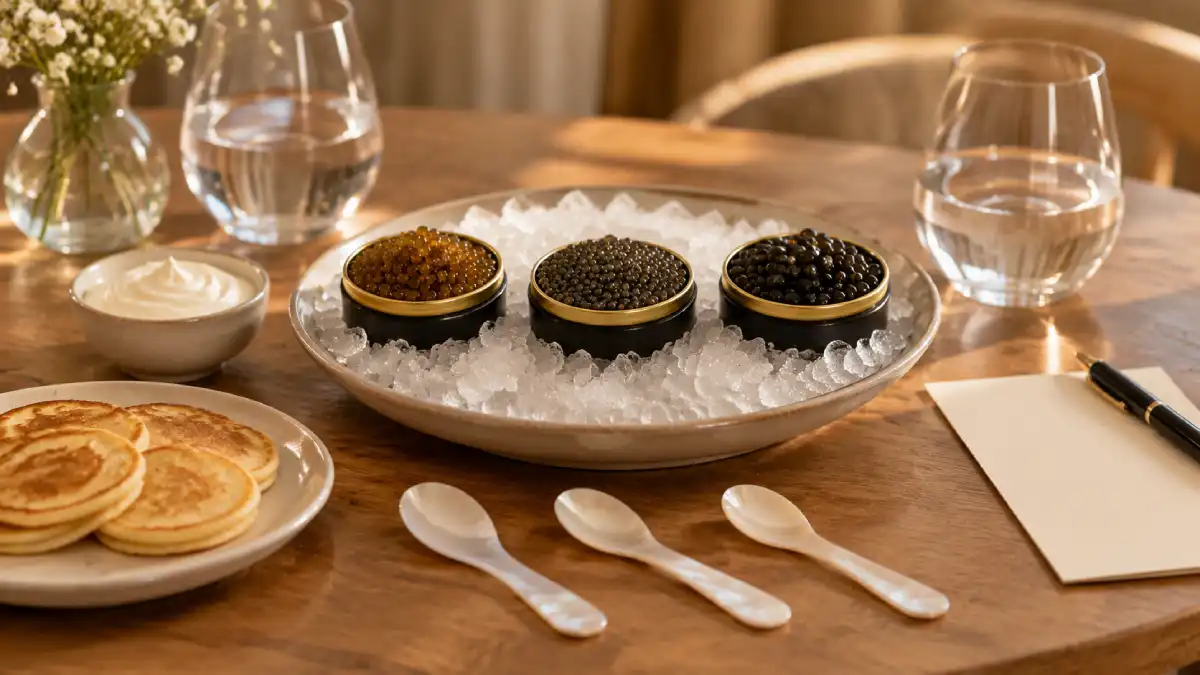
- 1Keep the tins cold until the last moment, then set them on a bed of crushed ice, without the pearls touching the ice.
- 2Use non-metallic spoons: mother-of-pearl, glass, porcelain, horn or wood. Avoid silver, which can give a metallic taste.
- 3Taste plain first, from the back of the hand or a spoon, with no blini and no crème fraîche.
- 4Go from the most delicate to the most powerful: Baeri, then Ossetra, then Sevruga. Starting with Sevruga would overpower the milder ones.
- 5Press the pearls gently against the roof of your mouth; notice the pop, then the flavour, then how long it lasts.
- 6Cleanse between varieties with still water or a plain, unsalted cracker.
- 7Then try each on a small blini with a little crème fraîche, to see how it behaves with food.
- 8Vote: ask each guest for their favourite. The answer is often surprising.
Keep it fresh: serve small quantities at a time, keep the rest in the fridge, and cover anything you are not serving. More ideas in our guide to serving caviar.
What to pair with each type
| Ossetra | Sevruga | Baeri | |
|---|---|---|---|
| Champagne | Blanc de blancs or extra brut, also aged champagne | Brut nature or extra brut | Brut, or a fresh crémant |
| Other drinks | Chilled vodka, dry Chablis | Ice-cold vodka | Dry white wine, chilled vodka |
| Food | Plain on a spoon, a warm blini, soft scrambled eggs | Blini with a little crème fraîche, boiled new potatoes | Canapés, deviled eggs, buttered pasta |
Our caviar and champagne pairing guide goes into more detail.
Where does the caviar come from today?
Wild Caspian sturgeon populations collapsed through overfishing and poaching. All sturgeon species have been listed under CITES (the Convention on International Trade in Endangered Species) since 1998, and the 2022 IUCN Red List update found that all 26 remaining sturgeon species are threatened. Today, legal Ossetra, Sevruga and Baeri come overwhelmingly from farms, and all our caviar comes from farmed sturgeon.
Every legal tin carries a CITES code that tells you the species and the source. Look for the three-letter species code (GUE for Russian sturgeon Ossetra, STE for Sevruga, BAE for Baeri) and the source letter (C or F for farmed). Our article on farmed vs wild caviar explains how to read it.
How to store each type
The rules are the same for all three: keep unopened tins in the coldest part of the fridge, at the temperature shown on the label, never in the freezer, and respect the date on the tin. Once opened, eat the caviar within two to three days, as indicated on the tin. Small-grained Sevruga can lose its firmness slightly faster once opened, so enjoy it promptly. Full details in how long caviar lasts.
Frequently asked questions
Which is better, Ossetra or Sevruga?
Neither is objectively better; they suit different tastes. Ossetra is nutty, buttery and complex with larger pearls, while Sevruga is smaller-grained and more intense and briny. Most people new to caviar prefer Ossetra; lovers of a strong sea flavour often prefer Sevruga.
Is Baeri caviar good quality?
Yes. Good Baeri is a high-quality caviar with a mild, clean, creamy taste. It is less complex than Ossetra but very approachable, and its lower price makes it ideal for first tastings and larger groups.
Which caviar is best for beginners?
Baeri is usually the easiest to enjoy first because it is mild and not too salty. Ossetra is a good second step once you want more depth.
What is the difference between Osetra, Ossetra and Oscietra?
They are the same caviar. The spelling varies by language and producer: Osetra and Ossetra in English, Oscietra in Italian usage, Osciètre in French. All refer to roe from the Russian or Persian sturgeon.
Why is Sevruga caviar so small?
The stellate sturgeon (Acipenser stellatus) is a smaller, slimmer species, and its eggs are naturally the smallest of the classic Caspian caviars.
Is Golden Ossetra a different species?
No. Golden Ossetra is Ossetra with light amber-coloured pearls from the same sturgeon species. The colour is rarer, which is why it usually costs more, but darker Ossetra is not lower in quality.
Which is more expensive: Ossetra, Sevruga or Baeri?
Usually Ossetra is the most expensive of the three, followed by Sevruga, then Baeri. At LeDiamont, a 30 g tin cost CHF 83.00 for Ossetra, CHF 64.00 for Sevruga and CHF 57.00 for Baeri on 21 October 2026.
How much caviar do I need to compare all three?
For a tasting, plan about 10 g of each variety per person, so 30 g in total. One 30 g tin of each variety is enough for a side-by-side tasting for three people.
Which caviar goes best with champagne?
All three work with dry champagne. Ossetra shines with a blanc de blancs, Sevruga with a very dry brut nature, and Baeri with a fresh brut.
Find your favourite
Each caviar tells a different story: Ossetra the rich and nutty, Sevruga the intense and briny, Baeri the mild and approachable. The best way to know which one is yours is to taste. All our caviar comes from farmed sturgeon and is shipped chilled by Swiss Post within Switzerland and Liechtenstein, in 1 to 2 working days.
Sources
- CITES: Resolution Conf. 12.7 (Rev. CoP17): Conservation of and trade in sturgeons and paddlefish, including the universal labelling system and species codes for caviar
- IUCN (21 July 2022): IUCN Red List update: 100% of remaining sturgeon species threatened
- Federal Food Safety and Veterinary Office (FSVO): CITES in Switzerland
- LeDiamont: Product pages for Ossetra, Sevruga and Baeri: species and prices (consulted 21–24 October 2026)