
◆ Last updated: ◆ By LeDiamont — Zervan GmbH
Six golden classics
The classic saffron dishes are Persian saffron rice with tahdig, risotto alla milanese, Spanish paella, Swedish saffron buns (lussekatter), Persian saffron rice pudding (sholeh zard) and saffron tea. Most need only 0.1 to 0.2 g of saffron (about 45 to 100 threads) for four to six people. Always crush the threads and bloom them in a little warm liquid for 15 to 20 minutes before adding them.
Key takeaways
- ◆One small tin goes far: 0.1 to 0.2 g of saffron flavours most dishes for four to six people.
- ◆Bloom first: crush the threads and steep them in 2 to 3 tablespoons of warm water, stock or milk for 15 to 20 minutes.
- ◆Add it late in savoury dishes to keep the aroma; in baking, mix it into the warm milk or butter.
- ◆Saffron loves rice, butter, seafood, cardamom and rose water.
- ◆Lussekatter are a December tradition in Sweden, baked for St Lucia’s Day on 13 December.
Contents
The six recipes at a glance
Four recipes are written out in full below. The other two, Persian saffron rice and sholeh zard, have their own pages, linked in their sections. Before you start, our guide on how to use saffron threads explains blooming, dosage and common mistakes.
| Recipe | Serves | Saffron | Time | Difficulty |
|---|---|---|---|---|
| Risotto alla milanese | 4 | 0.15 g (about 70 threads) | 35 min | Easy to medium |
| Seafood paella | 4 to 6 | 0.2 g (about 90 threads) | 50 min | Medium |
| Swedish saffron buns (lussekatter) | about 24 buns | 0.5 g (about 225 to 250 threads) | 2 h 30 min, including rising | Medium |
| Saffron tea | 2 cups | 0.03 g (about 15 threads) | 15 min | Easy |
1. Persian saffron rice with tahdig
Fluffy, long-grain rice steamed until every grain is separate, topped with golden saffron rice and served with tahdig, the crisp golden crust from the bottom of the pot. It is the centrepiece of Persian cooking, and it has its own full recipe page.
Our step-by-step recipe covers soaking, parboiling, the tahdig base and steaming with the tea-towel trick.
2. Risotto alla milanese
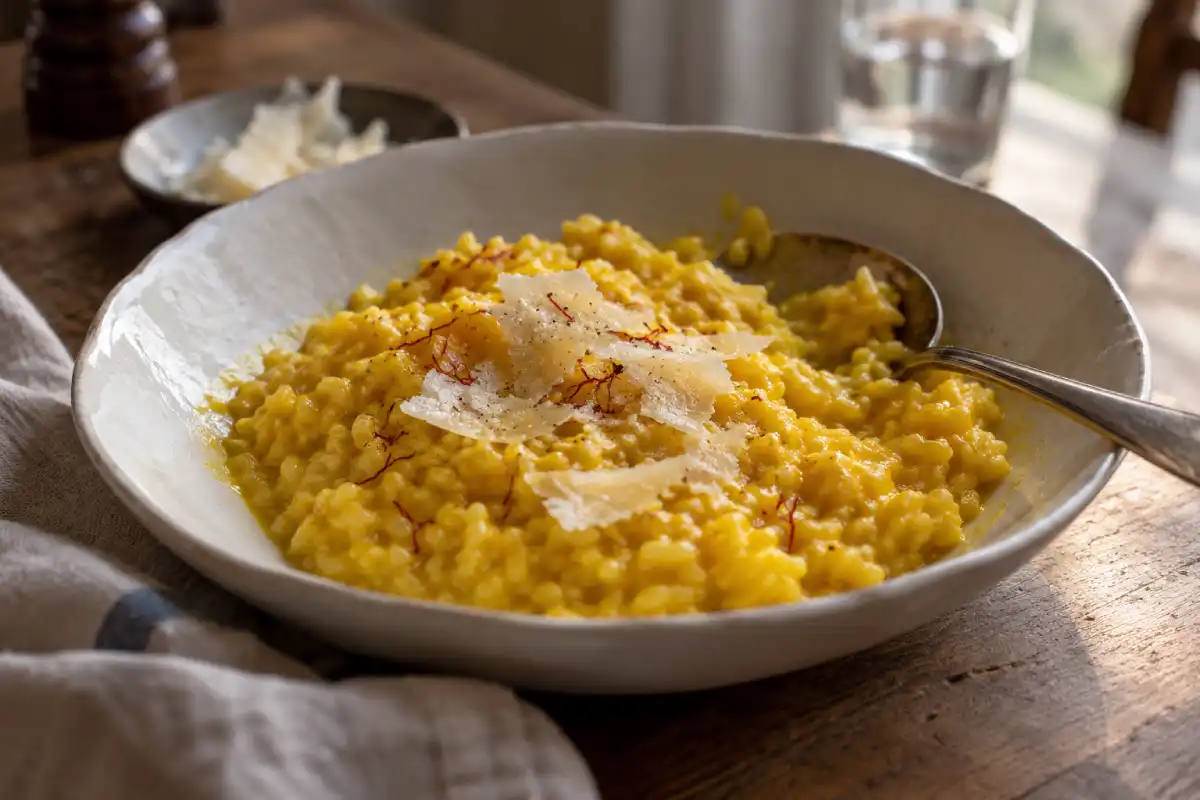
The famous golden risotto from Milan, traditionally served with osso buco but excellent on its own. Saffron gives the colour and a gentle floral, honeyed note.
Serves: 4 · Prep: 10 min · Cook: 25 min
Ingredients
- ◆320 g risotto rice (carnaroli or arborio)
- ◆1.2 to 1.4 litres hot beef or chicken stock
- ◆0.15 g saffron threads (about 70 threads)
- ◆1 small onion, finely chopped
- ◆70 g cold butter, divided
- ◆100 ml dry white wine
- ◆60 g Parmigiano Reggiano, finely grated
- ◆Salt to taste
- ◆Optional: 40 g beef bone marrow (traditional)
Method
- 1Bloom the saffron in a ladle (about 100 ml) of the hot stock for 15 to 20 minutes.
- 2Soften the onion in 30 g of the butter (and the marrow, if using) over low heat for 5 minutes, without browning.
- 3Toast the rice: add the rice and stir for 2 minutes until the grains turn slightly translucent at the edges.
- 4Add the wine and let it evaporate completely.
- 5Cook: add hot stock one ladle at a time, stirring often and waiting until each ladle is almost absorbed before adding the next.
- 6Add the saffron with its liquid about halfway through, after 8 to 10 minutes.
- 7Check the rice after 16 to 18 minutes in total: it should be creamy and just tender, with a slight bite.
- 8Finish (“mantecatura”): take the pan off the heat, add the remaining 40 g cold butter and the Parmigiano, and beat vigorously for 1 minute. Cover for 2 minutes, season and serve immediately.
Tip: the finished risotto should flow slowly across the plate (“all’onda”). If it is stiff, beat in a little more hot stock.
3. Seafood paella
A Spanish rice dish cooked in a wide, shallow pan. Unlike risotto, it is not stirred after the stock goes in, which creates the prized crispy layer at the bottom, the socarrat.
Serves: 4 to 6 · Prep: 20 min · Cook: 30 min
Ingredients
- ◆400 g short-grain paella rice (bomba or calasparra)
- ◆1.2 litres hot fish or seafood stock
- ◆0.2 g saffron threads (about 90 threads)
- ◆5 tablespoons olive oil
- ◆200 g squid, cut into rings
- ◆1 onion, finely chopped
- ◆1 red pepper, diced
- ◆3 garlic cloves, finely chopped
- ◆2 ripe tomatoes, grated (skins discarded)
- ◆1 teaspoon sweet smoked paprika (pimentón)
- ◆12 raw prawns, shell on
- ◆300 g mussels, cleaned
- ◆100 g frozen peas (optional)
- ◆Salt, 1 lemon, fresh parsley
Method
- 1Bloom the saffron in 100 ml of the hot stock for 15 to 20 minutes, then return it to the stock pot.
- 2Sear the prawns in the oil in a 34 to 38 cm paella pan for 1 minute per side; set aside.
- 3Cook the squid for 2 minutes, then add the onion and pepper and cook for 5 to 6 minutes until soft. Add the garlic for 1 minute.
- 4Add the tomato and paprika and cook for 4 to 5 minutes until thick and jammy.
- 5Add the rice, stir for 1 minute to coat it in the sofrito, and spread it evenly.
- 6Pour in all the hot saffron stock, season with salt and shake the pan gently to level the rice. Do not stir from now on.
- 7Simmer over medium-high heat for 10 minutes, then reduce to low. Push the mussels into the rice and scatter the peas.
- 8Cook for another 8 to 10 minutes, until the liquid is absorbed and the rice is tender. Lay the prawns on top for the last 3 minutes.
- 9Make the socarrat: turn the heat up for the final 1 to 2 minutes until you hear a gentle crackle and smell toasting, not burning.
- 10Rest for 5 minutes under a clean tea towel. Serve with lemon wedges and parsley.
Tip: bomba rice stays firm when cooked, which makes it forgiving for beginners. Discard any mussels that stay closed after cooking.
4. Swedish saffron buns (lussekatter)

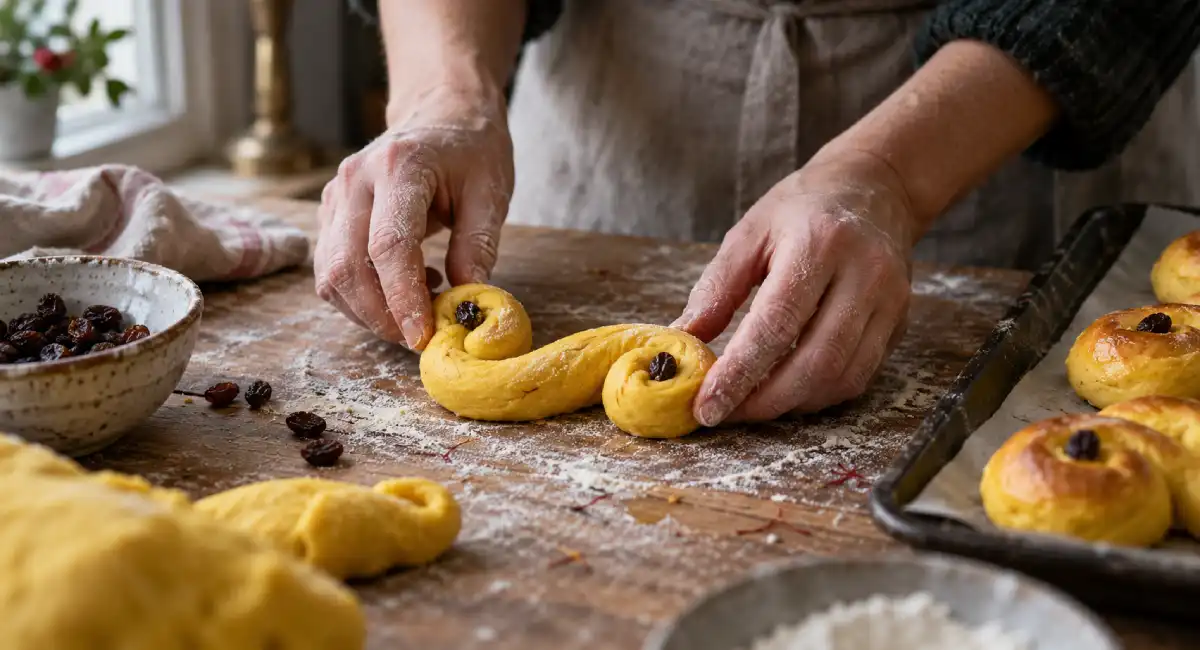
Soft, golden, S-shaped buns with raisins, baked across Sweden for St Lucia’s Day on 13 December and throughout Advent. A perfect December recipe and a lovely homemade gift.
Makes: about 24 buns · Prep: 30 min · Rising: 1 h 30 min · Bake: 8 to 10 min
Ingredients
- ◆0.5 g saffron threads (about 225 to 250 threads)
- ◆1 teaspoon sugar (for grinding the saffron)
- ◆500 ml whole milk
- ◆150 g butter
- ◆50 g fresh yeast (or 14 g instant dried yeast)
- ◆150 g sugar
- ◆½ teaspoon salt
- ◆850 to 900 g plain flour
- ◆Optional: 250 g quark or thick Greek yoghurt for extra-soft buns (add a little more flour)
- ◆About 50 raisins for decoration
- ◆1 egg, beaten, for brushing
Method
- 1Grind the saffron with 1 teaspoon of sugar into a fine powder.
- 2Warm the milk and butter together until the butter has melted and the mixture is just lukewarm (about 37 °C). Stir in the saffron and let it infuse for 10 minutes.
- 3Activate the yeast: crumble the fresh yeast into a large bowl and stir in a little of the warm saffron milk until dissolved (with instant yeast, mix it into the flour instead).
- 4Make the dough: add the rest of the milk, the sugar and salt (and quark, if using), then gradually work in the flour. Knead for 8 to 10 minutes until smooth, elastic and only slightly sticky.
- 5First rise: cover and leave in a warm place for 45 to 60 minutes, until doubled.
- 6Shape: divide into about 24 pieces. Roll each into a 20 cm rope and curl both ends in opposite directions to form an S. Press a raisin into the centre of each curl.
- 7Second rise: place on lined baking trays, cover and leave for 30 minutes. Preheat the oven to 225 °C (fan 210 °C).
- 8Bake: brush with beaten egg and bake for 8 to 10 minutes until golden. Cool on a rack under a tea towel to keep them soft.
Tip: lussekatter are best on the day. Freeze extras as soon as they have cooled and warm them briefly in the oven.
5. Saffron rice pudding (sholeh zard)
A fragrant Persian dessert of soft rice cooked with sugar, saffron, rose water and cardamom, served chilled and decorated with cinnamon, almonds and pistachios. It is traditionally made in large batches to share, and it has its own full recipe page.
Our step-by-step recipe shows how to cook the rice until it breaks apart, when to add the saffron and rose water, and how to decorate it.
6. Saffron tea
The simplest way to enjoy saffron: a golden, lightly floral infusion. Drink it on its own or blend it with green or black tea.
Serves: 2 cups · Prep: 2 min · Steep: 10 min
Ingredients
- ◆About 15 saffron threads (about 0.03 g)
- ◆500 ml water
- ◆Optional: 1 teaspoon green or black tea leaves, 1 cracked cardamom pod, a strip of lemon peel, honey to taste
Method
- 1Lightly crush the threads between your fingers.
- 2Heat the water until just below boiling (about 85 to 90 °C).
- 3Steep the saffron (and cardamom or lemon peel, if using) in the water for 5 to 10 minutes. If adding tea leaves, add them for the last 2 to 4 minutes only.
- 4Strain if you like, or leave the threads in the cup. Sweeten with honey.
Tip: saffron keeps releasing colour, so you can top up the same threads with hot water for a second, lighter cup.
Quick ideas with saffron water
Once you have bloomed saffron, you can use it far beyond these six recipes:
| Idea | How |
|---|---|
| Saffron aioli | Stir 1 to 2 teaspoons of saffron water into mayonnaise with garlic and lemon; good with fish and fries |
| Saffron butter | Beat saffron water into soft butter with a little salt; melt over fish, corn or rice |
| Saffron mashed potatoes | Add saffron water to the hot milk before mashing |
| Saffron honey | Steep crushed threads in warm honey overnight; drizzle over yoghurt or cheese |
| Saffron syrup | Simmer equal parts sugar and water with saffron; use for cocktails, lemonade or cake soaking |
| Saffron ice cream | Infuse saffron in the warm custard base with a pinch of cardamom |
| Golden poached pears | Poach pears in white wine syrup with saffron and vanilla |
How much saffron do you need for all six recipes?
Cooking the four recipes above once uses about 0.9 g of saffron, and with the Persian rice and sholeh zard the set comes to roughly 1.2 g. Our 5 g tin of Iranian Sargol saffron costs CHF 24.62 (21 October 2026), about CHF 4.90 per gram, so a full set of six recipes costs roughly CHF 6 of saffron. To see why that is good value per plate, read why is saffron so expensive.
Make sure the saffron you use is the real thing: deep-red threads, a sweet honeyed smell and a slow golden colour in water. Our guide on how to tell if saffron is real shows 7 quick tests.
Frequently asked questions
What can I make with saffron?
Classic saffron dishes include Persian saffron rice, risotto alla milanese, paella, bouillabaisse, biryani, Swedish saffron buns, saffron rice pudding and saffron tea. It also works in aioli, butter, ice cream, syrups and poached fruit.
How much saffron do I use for rice?
About 0.1 to 0.15 g (45 to 70 threads) for rice for four people. Grind it, bloom it in 2 to 3 tablespoons of warm water, and mix it into part of the cooked rice or drizzle it over the top.
Do I need to soak saffron before cooking?
Yes, for the best result. Crush the threads and steep them in warm water, stock or milk for 15 to 20 minutes, then add both the liquid and the threads to the dish.
When are lussekatter eaten?
In Sweden, saffron buns are baked throughout Advent and especially for St Lucia’s Day on 13 December, when they are served with coffee or mulled wine.
Can I use saffron powder in these recipes?
Yes. Use the same weight of powder as threads (measure by weight, not by spoon, because powder packs more densely) and dissolve it in a little warm liquid first. Buy powder only from a seller you trust, as it is easier to adulterate.
What goes well with saffron?
Rice, butter and cream, seafood, chicken and lamb, cardamom, cinnamon, rose water, vanilla, citrus, almonds and pistachios.
Can I replace saffron with turmeric in these recipes?
Only for colour. Turmeric has a completely different, earthy flavour and will not give saffron’s honeyed aroma. See saffron vs turmeric for the differences.
Cook with good saffron
Every recipe here depends on good saffron. A small tin of deep-red threads is enough for many golden meals.
Recipes are home-cooking versions. Saffron amounts follow our guide how to use saffron threads; adjust to taste and to the strength of your saffron.