
◆ Last updated: ◆ By LeDiamont — Zervan GmbH
About 167 flowers for one gram
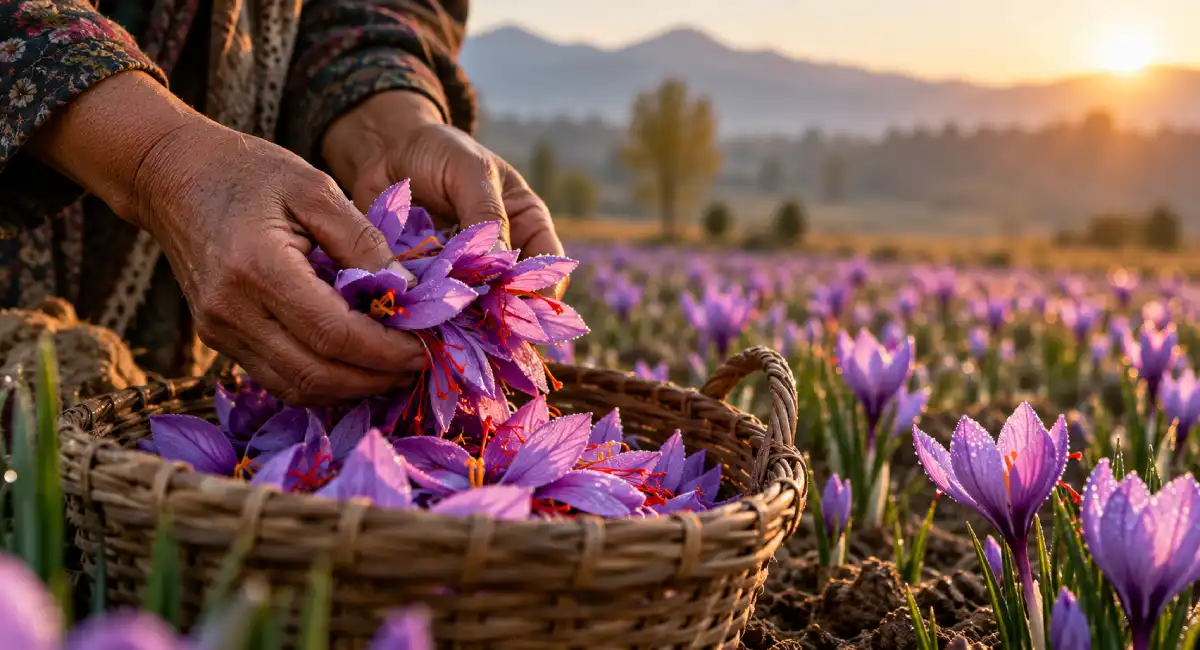
Saffron is expensive because it is almost entirely hand-made. Each crocus flower gives only three tiny red stigmas, it takes about 167 flowers for one gram of dried saffron, and every flower is picked, opened and separated by hand during a few weeks each autumn, which adds up to roughly one hour of hand work per gram. Our 5 g tin of Iranian saffron costs CHF 24.62 (about CHF 4.90 per gram on 21 October 2026), yet a dish for four needs only about 0.1 g, so a serving costs well under one franc.
Key takeaways
- ◆About 167 flowers make one gram, or roughly 150,000 to 170,000 per kilo, all picked and processed by hand.
- ◆Only the red stigma counts. The yellow style and the purple petals add little or nothing as a spice.
- ◆Picking and separating take about an hour per gram, according to timings measured at the University of Vermont.
- ◆Grade and purity drive the price: all-red threads with strong colour cost more than threads with yellow ends.
- ◆“More expensive than gold” is a myth today: at about CHF 106 per gram for gold on 26 October 2026, gold costs more than 20 times as much as our saffron by weight.
Contents
What exactly are you paying for?
Saffron is the dried stigma of the saffron crocus (Crocus sativus), a purple flower that blooms in autumn. Each flower has one pistil that splits into three red stigmas. These threads are the spice.
The plant itself makes production hard to scale:
- ◆It is sterile. It produces no viable seeds and is propagated only from corms, which multiply slowly underground.
- ◆It flowers once a year, for only a few weeks in autumn.
- ◆Each flower must be picked early, in the morning, before sun and heat damage the stigmas.
- ◆It cannot easily be mechanised. The stigmas are too delicate for machines, so picking and separating are done by hand almost everywhere.
How many flowers does it take to make saffron?
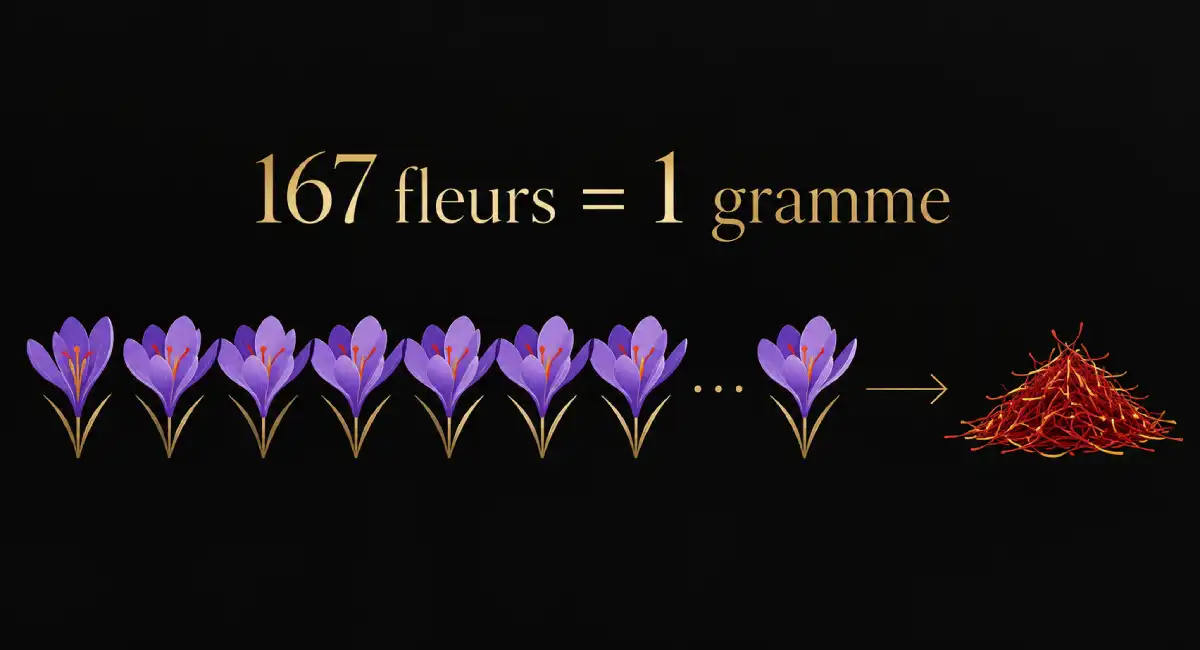
Figures online vary, partly because some sources count per pound and others per kilogram, fresh or dried. Researchers at the University of Vermont, who grow saffron in field trials, found that one flower produces about 0.006 g of dry saffron, so it takes around 167 flowers for 1 gram.
| Amount of dried saffron | Flowers needed (approx.) |
|---|---|
| 1 gram | about 167 |
| 5 grams (our tin) | about 835 |
| 100 grams | about 16,700 |
| 1 kilogram | about 167,000 |
This agrees with the 150,000 to 170,000 flowers per kilogram reported by Cid-Pérez et al. (2021). Estimates differ with flower size and region, but whatever the exact number, it is a very large number of flowers for a very light product.
The cost chain: from flower to tin
The price you pay reflects many steps, most of them manual:
- 1Planting and waiting. Corms are planted ahead of the autumn flowering and must be looked after through the year.
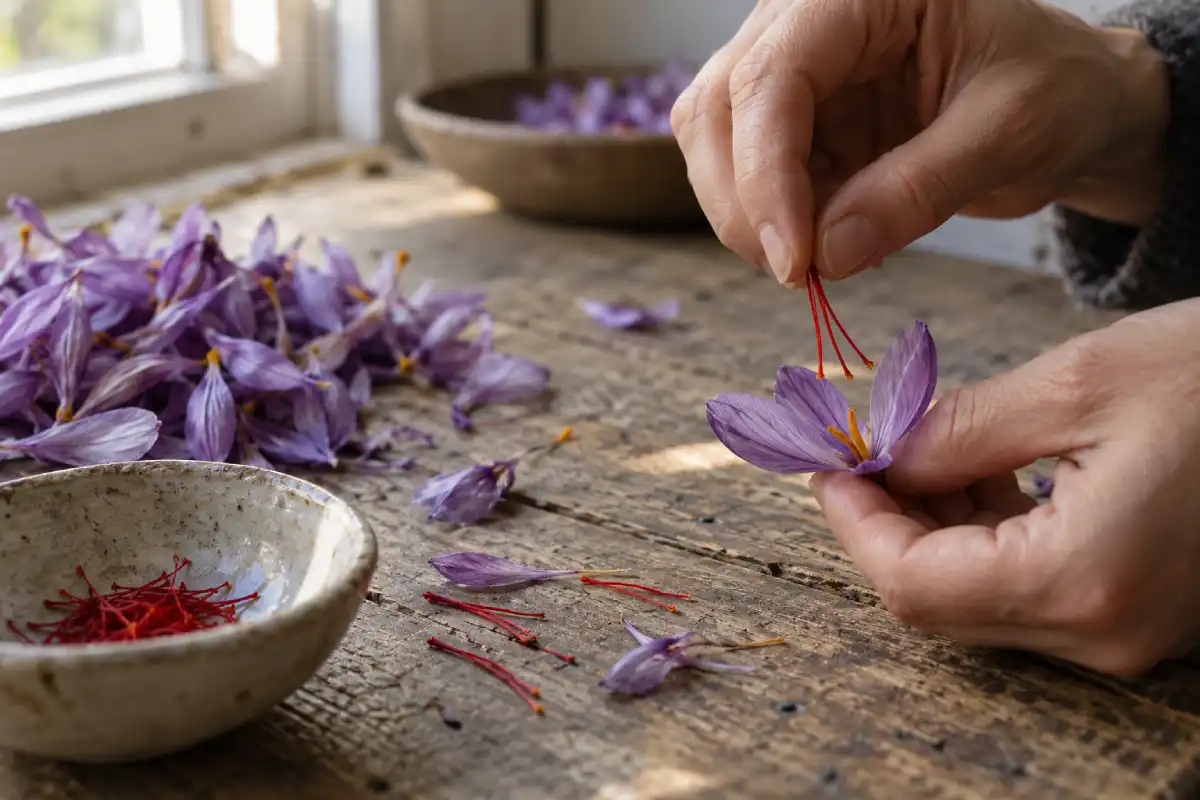
- 2Picking. During the short flowering season, each flower is picked by hand, usually in the morning. University of Vermont timings give about 13 minutes to pick 100 flowers.
- 3Separating the stigmas. Each flower is opened and its stigmas are removed by hand. The same timings give about 23 minutes to separate the stigmas from 100 flowers.
- 4Drying. The fresh stigmas are dried gently, which removes most of their moisture and concentrates colour and aroma.
- 5Sorting and grading. Threads are sorted by colour and by how much yellow style remains, and quality can be tested in a laboratory under ISO 3632.
- 6Packing and storage. Saffron has to be protected from light, air and moisture, so it is packed in small airtight containers.
- 7Transport and retail. Import, distribution, small-format packaging and margins add to the final price.
Add the two timings together and 167 flowers need about one hour of picking and separating, which is what one gram of saffron costs in hand work on a small farm. This is our own calculation from the University of Vermont figures; larger producers organise the work differently. Bad weather during the short flowering season can also reduce a whole year’s harvest and push prices up.
What does saffron cost per gram?
Prices change with season, origin, grade and pack size, so we show our own as a concrete example rather than a market average. Our Iranian saffron is a Sargol from Khorasan, in whole threads:
| Pack | Price | Per gram | A dish for four (0.1 g) |
|---|---|---|---|
| 5 g tin | CHF 24.62 | about CHF 4.90 | about CHF 0.49 |
What moves the price of saffron up or down:
- ◆Grade and cut. All-red threads with strong colour (Super Negin, Negin, Sargol) cost more than cuts with yellow style (Pushal, Dasteh). See our guide to saffron grades.
- ◆Form. Whole threads cost more to sort and are easier to verify than powder.
- ◆Freshness. Recent harvests keep their aroma better; saffron slowly loses aroma over one to two years.
- ◆Laboratory testing and traceability. Saffron sold with an ISO 3632 category or a laboratory result has been checked; untested saffron has not.
- ◆Pack size. Small tins have higher packaging and handling costs per gram than bulk trade.
The full picture of origin, grades and price is in our Iranian saffron guide.
Is saffron really more expensive than gold?
You will often read that saffron is “worth more than its weight in gold”. That saying dates from times when gold was much cheaper relative to saffron.
On 26 October 2026, a live spot-price page showed gold at about CHF 106 per gram (Swiss Bullion). Our saffron costs about CHF 4.90 per gram, so gold is more than 20 times more expensive by weight. Gold prices move every day, so treat this as a snapshot.
What is true:
- ◆Saffron is one of the most expensive spices in the world by weight.
- ◆Rare, small-farm saffron can sell for much more than standard grades.
- ◆Historically, saffron was a luxury good and was sometimes traded almost like currency.
Why does saffron from different origins cost different amounts?
| Factor | Effect on price |
|---|---|
| Scale of production | Iran produces 85 to 90% of the world’s saffron (FAO, 2025). Large-scale production helps keep prices of high grades accessible. |
| Labour costs | Saffron is mostly hand work, so countries with higher wages tend to produce more expensive saffron. |
| Reputation and protected origin | Protected labels such as the Spanish “Azafrán de La Mancha” PDO can carry a premium. |
| Quality and purity | All-red, lab-tested threads cost more than mixed or untested saffron. |
| Freshness | Recent harvests are worth more; saffron slowly loses aroma over one to two years. |
Origin alone does not guarantee quality. Excellent and poor saffron exist in every producing country. For a direct comparison, see Iranian vs Spanish saffron.
Saffron is cheaper per plate than you think
Because saffron is so potent, you need very little. About 0.1 g (45 to 50 threads) flavours a rice dish, risotto or stew for four. At our price of about CHF 4.90 per gram:
| Dish | Saffron | Cost of saffron |
|---|---|---|
| Persian saffron rice (4 to 6 servings) | 0.1 to 0.2 g | CHF 0.49 to 0.98 |
| Risotto alla milanese (4 servings) | 0.1 to 0.15 g | CHF 0.49 to 0.74 |
| Paella (4 to 6 servings) | 0.15 to 0.25 g | CHF 0.74 to 1.23 |
| Saffron tea or latte (1 cup) | 0.01 to 0.02 g | CHF 0.05 to 0.10 |
The key is to use it well: crush, bloom and add it at the right moment. Our guide on how to use saffron threads shows how, with amounts for each dish.
Why cheap saffron is usually a bad deal
Because real saffron is so costly to produce, it is one of the most frequently faked foods. Very cheap “saffron” is often:
- ◆safflower or marigold petals sold as saffron,
- ◆corn silk, paper or silk dyed red,
- ◆real saffron mixed with yellow styles, extra moisture or syrup to add weight,
- ◆powder mixed with turmeric or paprika.
Even when cheap saffron is genuine, it is often old or low grade, so you need more of it for the same colour and aroma. The “bargain” disappears in the pot.
Simple rule: if the price per gram is far below that of specialist sellers, walk away. And test any saffron you buy with the water test from our real vs fake saffron guide.
How to get the most value from your saffron
- 1Buy threads, not powder, unless you trust the seller completely.
- 2Buy small amounts more often. Saffron is at its best within about one to two years of the harvest.
- 3Store it well: airtight, dark, dry, at room temperature, away from the stove.
- 4Crush and bloom it in warm liquid for 15 to 20 minutes before use.
- 5Use the right amount. Too much saffron makes food bitter, so more is not better.
Frequently asked questions
Why is saffron the most expensive spice?
Because it takes about 167 hand-picked flowers to make one gram, each flower’s stigmas must be separated by hand, and the crop flowers for only a few weeks a year. Almost no part of the process can be mechanised.
How much does 1 gram of saffron cost?
It depends on grade, origin and pack size. For example, our 5 g tin of Iranian Sargol saffron costs CHF 24.62, about CHF 4.90 per gram (21 October 2026).
Is saffron more expensive than gold?
Not today. On 26 October 2026 gold was about CHF 106 per gram, more than 20 times the price per gram of our saffron. The saying comes from times when gold was much cheaper.
How many flowers make 1 kg of saffron?
Roughly 150,000 to 170,000 flowers, based on about 167 flowers per gram. Estimates vary with flower size and region.
How long does it take to harvest 1 gram of saffron?
About one hour of hand work on a small farm: roughly 13 minutes to pick and 23 minutes to separate the stigmas of every 100 flowers, and it takes about 167 flowers for a gram. This is a calculation from University of Vermont timings.
Is cheap saffron fake?
Very cheap saffron is often fake, adulterated, old or low grade. Real saffron cannot be produced cheaply, so a price far below that of specialist sellers is a warning sign.
Is expensive saffron worth it?
For most dishes, yes: good saffron is so strong that 0.1 g flavours a meal for four, which at our price costs about CHF 0.49.
Can saffron be harvested by machine?
Not in practice. The flowers and stigmas are too delicate, so picking and separating are still done by hand almost everywhere.
Taste the difference real saffron makes
A few threads of good saffron are enough to colour and perfume a whole dish. Choose deep-red threads, store them well and use them with care.
Sources
- University of Vermont, North American Center for Saffron Research & Development (28 January 2020): Saffron by the numbers
- Cid-Pérez T.S. et al. (2021), Molecules 26(22):6954: Saffron: flowers per kilogram and harvesting work
- FAO in Iran (25 November 2025): FAO and Iran: new step to innovation and quality integrity in saffron value chain
- Swiss Bullion (live page, 26 October 2026): Live metal spot prices, gold in CHF
- ISO: ISO 3632-1: Spices — Saffron (Crocus sativus L.) — Part 1: Specification (2011 edition, withdrawn)
- ANSI Webstore: ISO 3632-1:2025 Spices — Saffron (Crocus sativus L.) — Part 1: Specification