
◆ Last updated: ◆ By LeDiamont — Zervan GmbH
Crush, bloom, then add
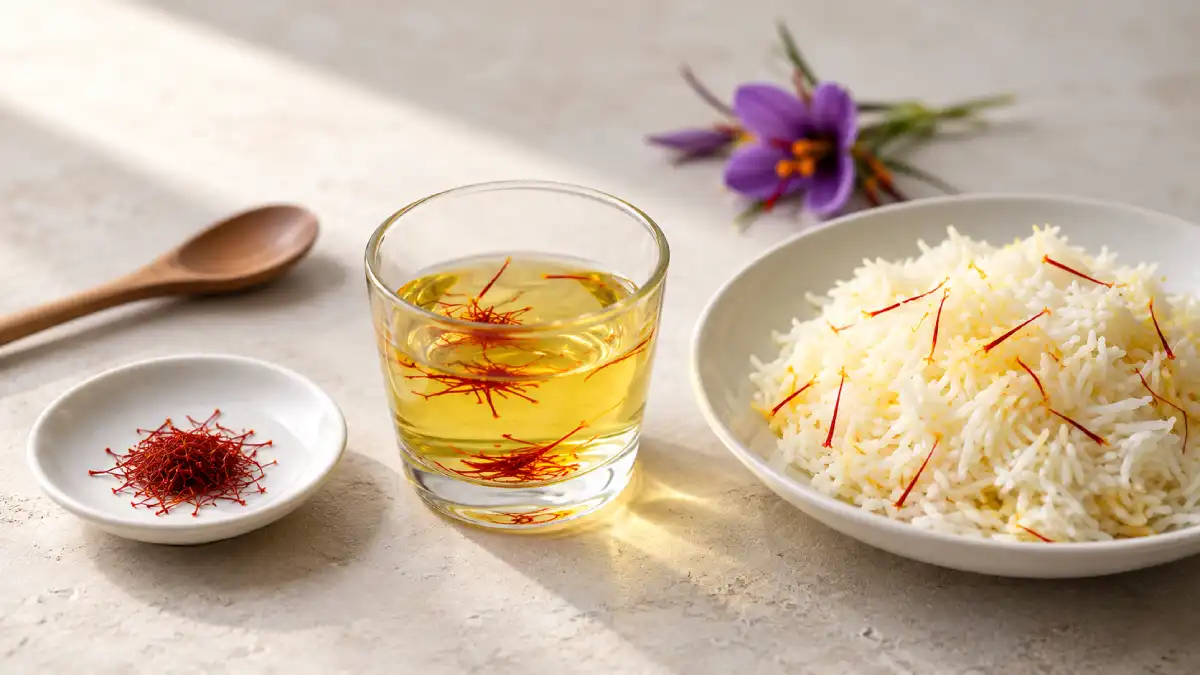
To use saffron threads, crush them into a fine powder, then bloom them in 2 to 3 tablespoons of warm (not boiling) water, stock or milk for 15 to 20 minutes until the liquid turns deep golden. Add both the liquid and the saffron to your dish, ideally in the second half of cooking. For most dishes, 0.1 g (about 45 to 50 threads) is enough for 4 servings. Too much makes the dish bitter and medicinal.
Key takeaways
- ◆Crush first, then bloom: grinding and steeping releases far more colour and aroma than adding whole threads.
- ◆Warm, not boiling: hot enough to extract, gentle enough to keep the aroma. Melting ice over ground saffron is the slowest, gentlest method.
- ◆A little goes a long way: 0.1 g flavours 4 portions of rice or risotto; one gram is roughly 450 to 500 threads.
- ◆Add it late: long boiling dulls the aroma. Add bloomed saffron in the last 10 to 20 minutes, or drizzle it on at the end.
- ◆A 5 g tin makes about 50 dishes for four people, so good saffron costs less per plate than it looks.
Contents
Saffron basics: what you are working with
Saffron threads are the dried red stigmas of the saffron crocus (Crocus sativus). Three natural compounds do the work in your kitchen:
| Compound | What it gives | In the kitchen |
|---|---|---|
| Crocin | Golden-yellow colour | Dissolves easily in water |
| Picrocrocin | Bitter taste | Dissolves in water; the source of the aroma compound safranal as saffron dries |
| Safranal | The typical sweet, honeyed aroma | Volatile: released by warmth, lost with long boiling |
That is why the method matters: you want enough warmth and time to draw out colour and aroma, but not so much heat that the aroma evaporates.
How to bloom saffron, step by step
“Blooming” means steeping saffron in liquid before adding it to a dish. It is the single most important step.
- 1Measure. Take the amount you need (see the dosage table below). For 4 servings, about 0.1 g or a generous pinch.
- 2Crush. Grind the threads with a pinch of sugar or salt in a small mortar, or crumble them between your fingers. The crystals act as an abrasive.
- 3Add liquid. Pour over 2 to 3 tablespoons (30 to 45 ml) of warm water, stock, milk or wine. Warm, never boiling.
- 4Wait. Cover and leave for 15 to 20 minutes, or longer for more intensity. The liquid turns deep orange-gold.
- 5Use everything. Add the liquid and the saffron particles to your dish.
Many cooks prepare a small jar of saffron water to use over a few days (see storage below).
Three blooming methods compared
| Method | How | Time | Best for |
|---|---|---|---|
| Warm water or stock (classic) | Ground saffron plus 2 to 3 tablespoons of warm water | 15 to 20 min | Rice, risotto, paella, stews, sauces |
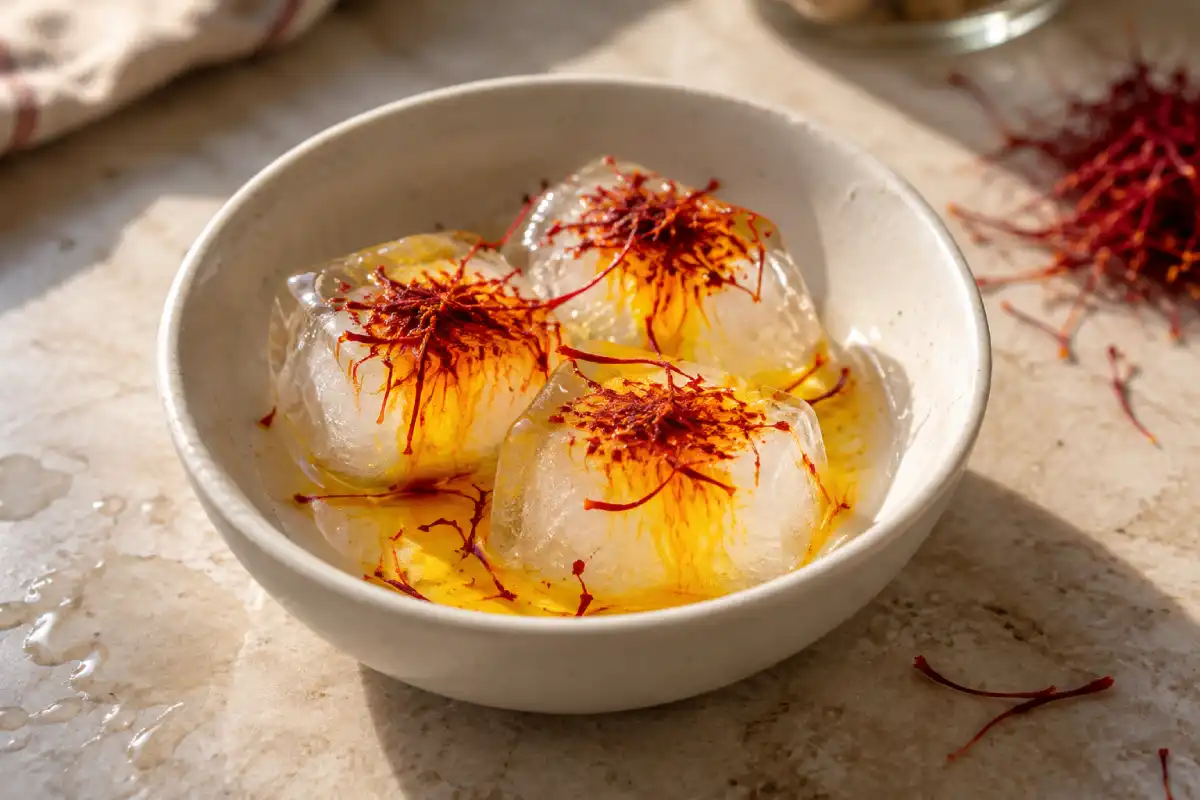
| Ice cubes (Persian method) | Sprinkle ground saffron on 2 to 3 ice cubes and let them melt at room temperature | 20 to 30 min | Persian rice, desserts, drinks; the gentlest extraction |
| Warm milk or cream | Steep the threads in warm milk or cream | 10 to 20 min | Baking, custards, ice cream, rice pudding |
White wine, vodka and a little lemon juice also extract saffron well. Fats such as oil or butter carry the aroma but are poor at extracting colour, so bloom in a water-based liquid first and then add it to the fat.
How much saffron should you use?
Saffron is strong. These are starting points for good-quality saffron. Each flower has three stigmas and it takes about 150,000 to 170,000 flowers for a kilogram (Cid-Pérez et al., 2021), which works out to roughly 450 to 500 threads per gram. So 0.1 g is about 45 to 50 threads.
| Dish | Servings | Saffron | Approx. threads |
|---|---|---|---|
| Persian saffron rice (chelow, tahdig topping) | 4 to 6 | 0.1 to 0.2 g | 45 to 100 |
| Risotto alla milanese | 4 | 0.1 to 0.15 g | 45 to 70 |
| Paella | 4 to 6 | 0.15 to 0.25 g | 70 to 120 |
| Bouillabaisse or fish stew | 4 to 6 | 0.1 to 0.2 g | 45 to 100 |
| Biryani | 6 | 0.15 to 0.2 g | 70 to 100 |
| Swedish saffron buns (lussekatter) | about 25 buns | 0.5 g | about 225 to 250 |
| Rice pudding, custard, ice cream | 4 to 6 | 0.05 to 0.1 g | 20 to 50 |
| Saffron tea or latte | 1 cup | 0.01 to 0.02 g | 5 to 10 |
| Saffron aioli or butter | 1 small bowl | 0.02 to 0.05 g | 10 to 25 |
For a full recipe, see our Persian saffron rice with tahdig or sholeh zard, the saffron rice pudding.
- ◆Start low. You can add more saffron water later; you cannot take it out.
- ◆Grade matters. Cuts that are all red (Negin, Sargol) colour more than threads with yellow ends, so you need less. See our guide to saffron grades.
- ◆Too much tastes bitter, metallic or medicinal. If that happens, dilute it with more of the base (rice, stock).
- ◆Stick to culinary amounts. In cooking, saffron is used in fractions of a gram.
When to add saffron during cooking
| Dish type | When to add the bloomed saffron |
|---|---|
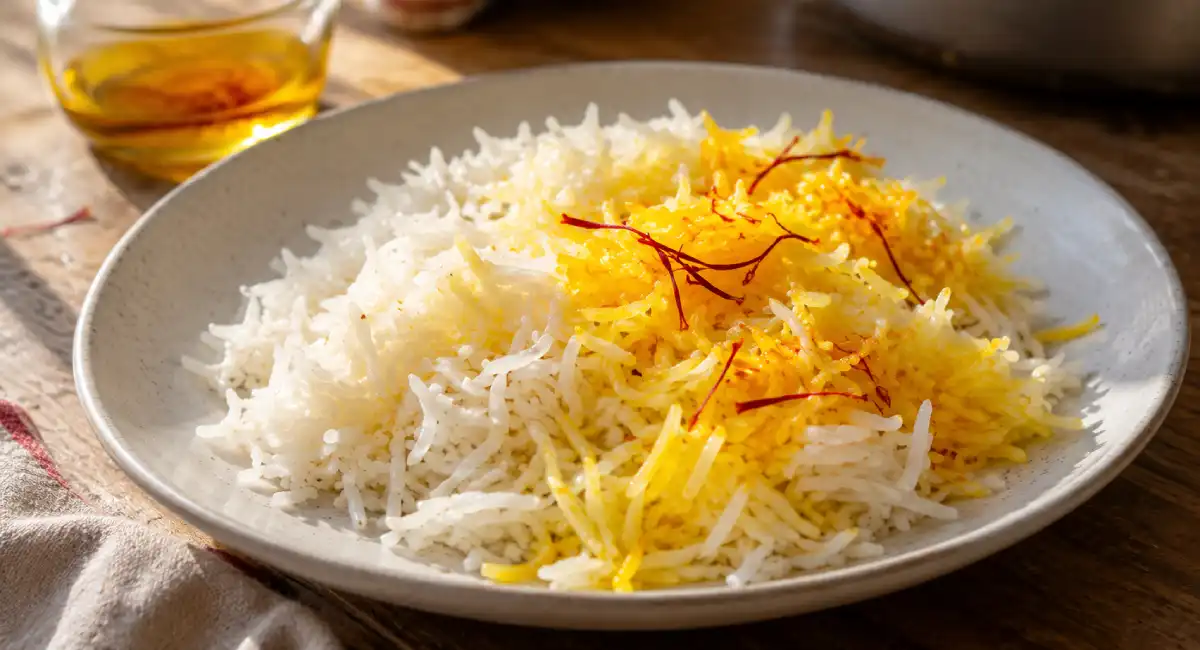
| Rice (Persian style) | Drizzle over the cooked rice at the end, or mix into a portion of rice for a golden layer |
| Risotto | In the last 5 to 10 minutes of cooking |
| Paella | With the stock, before the rice simmers undisturbed |
| Stews, soups, sauces | In the last 15 to 20 minutes |
| Baking | Mixed into the milk or butter of the dough |
| Desserts and drinks | Into the warm milk, cream or syrup, then cooled |
The rule: the shorter the boiling, the stronger the aroma. Colour survives cooking well; aroma does not.
To toast or not to toast?
Some Spanish recipes briefly toast saffron threads in a dry pan before crushing them. This dries them further so they crumble easily and can deepen the aroma.
- ◆Very well-dried threads usually do not need toasting. They crush easily as they are.
- ◆If you toast, do it for a few seconds over low heat, shaking the pan constantly. Burnt saffron is bitter and wasted.
Saffron pairs well with…
- ◆Grains: rice, couscous, bulgur, pasta, polenta
- ◆Seafood: mussels, prawns, white fish, scallops
- ◆Poultry and lamb: roast chicken, tagines, braises
- ◆Dairy: cream, yoghurt, butter, milk, mild cheese
- ◆Sweet spices and aromatics: cardamom, cinnamon, vanilla, rose water, orange blossom
- ◆Fruits and nuts: orange, lemon, pistachio, almond, pear, apricot
- ◆Drinks: tea, warm milk, cocktails, syrups
7 common mistakes with saffron
- 1Adding whole threads straight into the dish. You lose much of the colour and aroma. Crush and bloom first.
- 2Using boiling water. It drives off the delicate aroma. Use warm water or the ice method.
- 3Steeping too briefly. Two minutes is not enough. Give it at least 15 minutes.
- 4Using too much. It makes food bitter and wastes saffron. Follow the table above.
- 5Boiling it for a long time. Add it in the second half of cooking.
- 6Buying powder of unknown origin. It is easy to adulterate with turmeric or other fillers. Buy threads and test them: see how to tell if saffron is real.
- 7Storing it badly. Light, heat and moisture destroy aroma. Keep it airtight and dark.
How many dishes do you get from a tin?
Good saffron looks expensive per gram but is affordable per plate. Our 5 g tin of Iranian Sargol saffron costs CHF 24.62 (21 October 2026). At 0.1 g per dish for four people, that is about 50 dishes, or roughly CHF 0.49 of saffron per dish.
| Amount | Approx. threads | Dishes for 4 people |
|---|---|---|
| 1 g | 450 to 500 | about 10 |
| 5 g (our tin) | 2,250 to 2,500 | about 50 |
How to store saffron water and saffron threads
- ◆Saffron water (bloomed saffron): keep it in a small, closed glass jar in the fridge and use it within about 3 to 4 days.
- ◆Saffron threads: keep them in an airtight, light-proof container in a cool, dry cupboard, away from the stove. Not in the fridge for daily use, where condensation can form. For the best aroma, use them within about one to two years of the harvest. See also how to store saffron.
Frequently asked questions
Do you have to soak saffron before using it?
It is strongly recommended. Soaking (blooming) crushed threads in warm liquid for 15 to 20 minutes releases much more colour and aroma than adding them dry.
How much saffron do I need for 4 people?
About 0.1 g, or 45 to 50 threads, for most rice, risotto or stew dishes for four. Paella and biryani may take a little more; desserts and drinks less.
How many saffron threads are in a gram?
Roughly 450 to 500. Each flower has three stigmas and a kilogram takes about 150,000 to 170,000 flowers. The exact number varies with thread size and grade.
Can I use saffron threads without grinding them?
Yes, but you will get less flavour from the same amount. If you prefer visible threads in the dish, steep them whole for longer, 30 minutes or more.
What liquid is best for blooming saffron?
Warm water or stock for most savoury dishes, milk or cream for baking and desserts, and white wine for some risottos and seafood dishes. Avoid boiling liquids.
Can I use saffron in cold dishes and drinks?
Yes. Bloom it in a little warm water first, let it cool, then add it to dressings, aioli, lemonade, cocktails or ice cream.
Why does my dish taste bitter?
Usually because too much saffron was used, or it was burned while toasting. Use less next time and toast only for a few seconds, if at all.
How long does bloomed saffron keep?
About 3 to 4 days in a closed jar in the fridge.
Can I replace saffron with turmeric?
Only for colour. Turmeric gives a similar yellow but none of saffron’s honeyed aroma. See saffron vs turmeric for the differences.
Cook with real saffron
Good saffron needs only a few threads to transform a dish. Choose deep-red threads, crush, bloom, and let the colour and aroma do the rest.
Sources
- Fujii S. et al. (2022), Longhua Chinese Medicine: Saffron: production, quality standards and the ISO 3632 categories
- Cid-Pérez T.S. et al. (2021), Molecules 26(22):6954: Saffron: flowers per kilogram and harvesting work
- ISO: ISO 3632-1: Spices — Saffron (Crocus sativus L.) — Part 1: Specification (2011 edition, withdrawn)
- ANSI Webstore: ISO 3632-1:2025 Spices — Saffron (Crocus sativus L.) — Part 1: Specification
Dosages, times and temperatures are general culinary guidance, not laboratory values.