
◆ Last updated: ◆ By LeDiamont — Zervan GmbH
Look, smell, then water
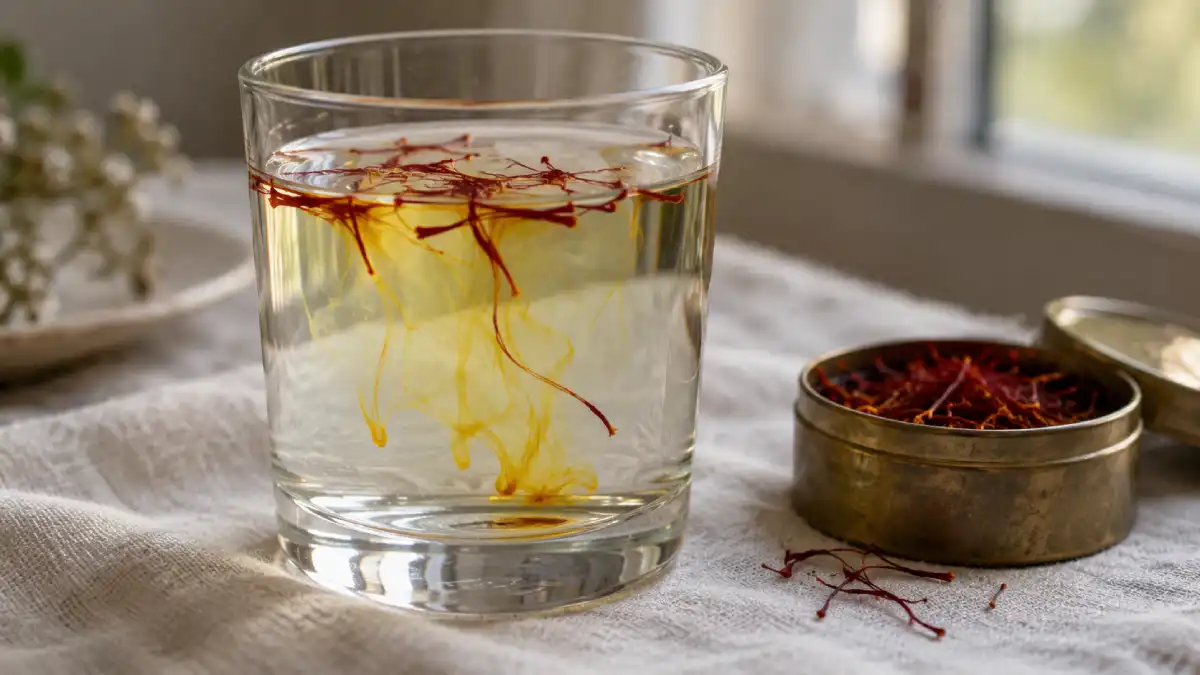
Real saffron threads are deep red and widen into a small trumpet at one end. They smell sweet, like honey and hay, but taste slightly bitter. Put a few threads in a glass of water: real saffron slowly releases a golden-yellow colour while the threads stay red. Fake saffron (safflower, dyed corn silk, dyed paper) usually turns the water orange or red almost at once, loses its colour or falls apart. A price far below that of specialist sellers is another warning sign.
Key takeaways
- ◆The water test is the quickest check: a slow, golden colour is a good sign; instant red or orange points to dye.
- ◆Shape matters: each real thread is a single stigma, thin at the base and widening into a small trumpet at the tip.
- ◆Smells sweet, tastes bitter. Real saffron never tastes sweet.
- ◆Avoid powder unless you trust the seller. It is the easiest form to adulterate with turmeric or paprika.
- ◆Home tests catch obvious fakes, not everything. Only a laboratory can measure quality according to ISO 3632.
Contents
Why is saffron faked so often?
Saffron is the dried red stigma of the saffron crocus (Crocus sativus). Each flower has only three stigmas, picked by hand during a short autumn harvest, and it takes around 150,000 to 170,000 flowers for one kilogram. That makes saffron one of the most expensive spices in the world, and a frequent target for fraud. Fraud comes in two forms:
- 1Complete fakes: materials that look like saffron but contain none.
- 2Adulterated saffron: real saffron bulked up with cheaper material or extra weight.
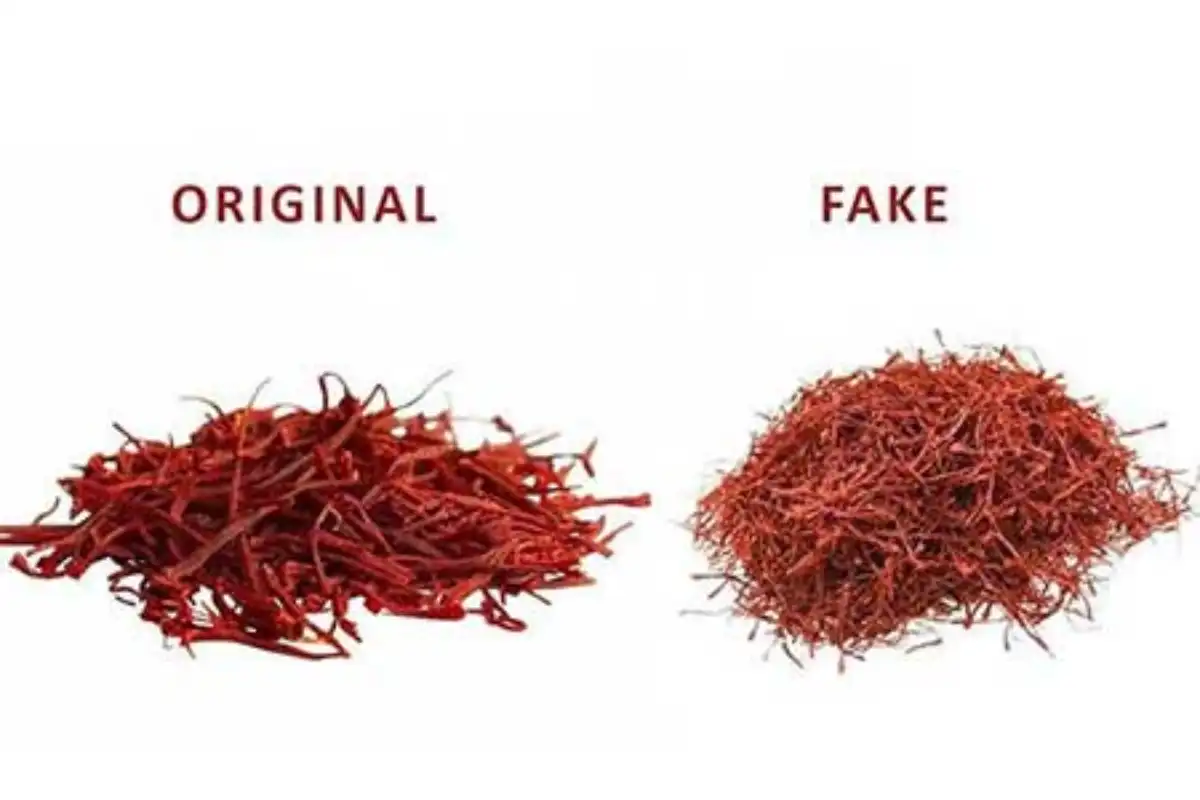
| Fake or adulterant | What it is | How to spot it |
|---|---|---|
| Safflower (“bastard saffron”) | Petals of Carthamus tinctorius | Flat, frayed, orange-red petals; weak smell; little colour in water |
| Dyed corn silk | Corn stigmas dyed red, for example with beetroot juice | Very thin and uniform, no trumpet tip; dye bleeds red quickly |
| Dyed paper, silk or plastic | Synthetic or fibre strands | Unnaturally uniform colour; dye bleeds; may not soften in water |
| Calendula (marigold) petals | Dried flower petals | Flat, yellow-orange; no saffron aroma |
| Pomegranate peel or fibres | Red plant material | Irregular pieces; no saffron aroma |
| Saffron’s own yellow styles | Real but flavourless part of the flower | Yellow or white threads mixed in; dyed red in worse cases |
| Water, oil or syrup | Added for weight | Threads feel damp, sticky or clump together |
| Turmeric, paprika (in powder) | Cheap coloured spices | Wrong smell; colour too yellow or too red |
For the difference between saffron and its most common yellow substitute, see saffron vs turmeric.
7 simple tests to tell if saffron is real
You only need a few threads, a glass of water, a white tissue and a pinch of baking soda.
1. Look at the shape
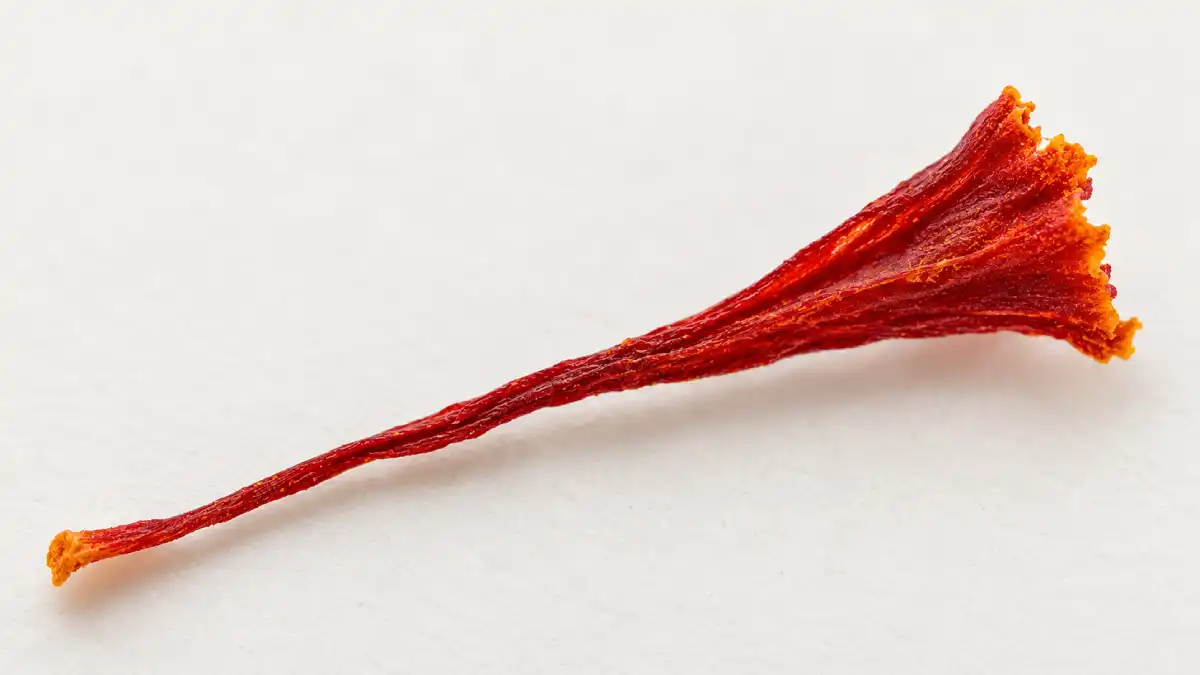
Use a magnifying glass or your phone camera. A real saffron thread is a single stigma: thin at one end and widening into a small, slightly frilled trumpet at the other. It is deep red, sometimes with an orange or yellow end in lower grades.
- ◆Real: trumpet tip, slightly irregular, matt to slightly glossy.
- ◆Fake: perfectly uniform threads, flat petals (safflower) or tiny curly fibres (corn silk).
2. Do the water test
This is the most useful home test:
- 1Fill a clear glass with room-temperature or lukewarm water.
- 2Drop in three to five threads. Do not stir.
- 3Watch for several minutes.
- ◆Real: the colour spreads slowly as a golden-yellow haze, and the threads stay red and intact for a long time.
- ◆Fake: the water turns red or orange immediately, or not at all; the threads lose their colour, turn pale or fall apart.
Hot water speeds everything up, so for testing use cool or lukewarm water. The golden liquid from real saffron is not wasted: use it in your next dish, such as Persian saffron rice with tahdig or sholeh zard.
3. Smell it
Real saffron has a strong, distinctive aroma: sweet, honey-like and earthy, with notes of hay. Even a small amount has a characteristic smell, and fresh saffron fills the tin with scent as soon as you open it.
- ◆Real: intense, complex, sweet smell.
- ◆Fake: little or no smell, or a dusty, chemical or plain “dried flower” smell.
4. Taste a thread
Put one thread on your tongue.
- ◆Real: slightly bitter and a little astringent, with a lingering flavour. It smells sweet but does not taste sweet.
- ◆Fake: sweet (often a sign of added sugar or syrup), tasteless or chemical.
After a minute, your saliva will turn yellow with real saffron.
5. The rub test
Place a thread on a white tissue and rub it gently with a wet finger.
- ◆Real: leaves a yellow-orange stain, and the thread stays mostly intact.
- ◆Fake: leaves a red stain (dye) or crumbles into powder.
6. The baking soda test
Mix a pinch of baking soda with a little water in a white cup, then add a few threads.
- ◆Real: the mixture turns yellow.
- ◆Fake: the mixture turns red or another colour.
This test is less reliable than the water test, because some dyes also turn yellow. Use it as a second check, not on its own.
7. Check the price
Real saffron cannot be cheap. For reference, our 5 g tin of Iranian Sargol saffron costs CHF 24.62, about CHF 4.90 per gram (21 October 2026). If you see “pure saffron” at a fraction of the price of specialist sellers, especially in large bags or as powder, be suspicious. Our saffron guide explains why saffron is so expensive.
Real vs fake saffron: results at a glance
| Test | Real saffron | Fake or adulterated |
|---|---|---|
| Shape | Single thread with a trumpet tip | Uniform strands, flat petals or tiny fibres |
| Water | Slow golden-yellow; threads stay red | Instant red or orange, or no colour; threads go pale or fall apart |
| Smell | Sweet, honey, hay, earthy | Weak, dusty or chemical |
| Taste | Slightly bitter | Sweet, tasteless or chemical |
| Rub test | Yellow-orange stain | Red stain, or crumbles |
| Baking soda | Yellow | Red or another colour |
| Feel | Dry and brittle | Damp, sticky or oily |
| Price | Consistent with specialist sellers | Suspiciously cheap |
If saffron passes most of these tests, it is very likely real. If it fails two or more, do not use it.
What home tests can’t tell you
Home tests catch obvious fakes (safflower, corn silk, dyed fibres). They are much less able to detect:
- ◆real saffron mixed with a proportion of cheaper yellow styles or dyed material,
- ◆old saffron that has lost most of its aroma and colour,
- ◆small amounts of added weight from moisture or syrup,
- ◆low-quality saffron sold as a premium grade.
For that, laboratories use the international standard ISO 3632, which measures three natural compounds:
| Compound | Responsible for | Category I (best) |
|---|---|---|
| Crocin | Colour (colouring strength) | 200 or more |
| Picrocrocin | Bitter taste | 70 or more |
| Safranal | Aroma | Between 20 and 50 |
The current edition, ISO 3632-1:2025, replaced the 2011 edition in July 2025, so a serious certificate should name the edition it was tested against. The standard also sets limits for moisture and floral waste. Experts note that a complete set of methods, such as microscopy and chromatography, may be needed to authenticate saffron fully.
Grade names are not lab grades. Trade names such as Super Negin, Negin, Sargol and Pushal describe how the threads are cut (all red, or with some yellow style attached), not a laboratory category. Our guide to Iranian saffron grades explains them.
Why saffron powder is riskier
Powder is convenient, but it is the easiest form to adulterate: once ground, you can no longer see the shape of the threads. Turmeric, paprika, safflower and synthetic dyes can be mixed in without changing the colour much. If you buy powder:
- ◆buy only from a seller you trust, ideally with laboratory results,
- ◆check that it is deep orange-red, not bright yellow or brick red,
- ◆do the water test: real saffron powder colours water golden, not orange or red,
- ◆better still, buy threads and grind them yourself just before use.
How to buy real saffron: a checklist
- 1Buy threads, not powder.
- 2Look for deep, even red threads, with few or no yellow ends for the top cuts.
- 3Check the origin and, if possible, the harvest year on the label. Saffron is best within one to two years of the harvest.
- 4Prefer small, airtight, light-proof packaging, such as tins or dark glass.
- 5Look for quality information: an ISO 3632 category, a laboratory certificate or at least a clear cut name.
- 6Be wary of very low prices and large quantities sold cheaply.
- 7Test it at home with the water and smell tests as soon as it arrives.
Iran produces 85 to 90% of the world’s saffron (FAO, 2025); Spain, Afghanistan, Greece, Morocco and Kashmir are other known origins. Quality varies within every origin, so the cut, the freshness and the seller matter more than the country. See Iranian vs Spanish saffron for a comparison.
Our Iranian saffron is a Sargol from Khorasan, in whole threads, sold in 5 g tins and shipped by Swiss Post within Switzerland and Liechtenstein in 1 to 2 working days.
How to keep saffron at its best at home
Even genuine saffron loses aroma and colour if stored badly. Keep it:
- ◆in an airtight container,
- ◆away from light, heat and moisture (a cupboard, not above the cooker),
- ◆out of the fridge for daily use, because condensation forms when you take a cold tin in and out,
- ◆for the best flavour, within about one to two years of the harvest.
Frequently asked questions
What is the fastest way to tell if saffron is real?
The water test. Drop a few threads into room-temperature water: real saffron slowly releases a golden-yellow colour while the threads stay red. Instant red or orange colour points to dye.
What colour should saffron turn water?
Golden yellow, gradually. If the water turns red or orange within seconds, the saffron is likely dyed.
Does real saffron taste sweet?
No. Real saffron smells sweet and honey-like but tastes slightly bitter. A sweet taste can mean sugar or syrup was added.
What is fake saffron made of?
Most often safflower or calendula petals, corn stigmas dyed red, dyed paper or silk fibres, or pomegranate peel. Real saffron is also sometimes bulked up with its own cheaper yellow styles, moisture or syrup.
Is cheap saffron always fake?
Not always, but very cheap saffron is usually fake, very old or low grade. Compare with the prices of specialist sellers.
Does real saffron dissolve in water?
No. Real threads release their colour slowly but stay intact and red for a long time. Threads that fall apart or turn white quickly are a warning sign.
Can you test saffron powder at home?
Only roughly. Real powder colours water golden yellow, not orange or red, and smells strongly of saffron. Because powder is easy to adulterate, buy threads whenever possible.
What is ISO 3632?
The international standard for saffron. It classifies saffron by colouring strength (crocin), bitterness (picrocrocin) and aroma (safranal), and sets limits for moisture and floral waste. The current edition dates from 2025.
Taste real saffron
The best way to recognise real saffron is to know what good saffron smells, looks and tastes like. Start with a small tin and try the water test yourself.
Sources
- University of Leicester (December 2016): Spice up your life: how to tell real saffron from a fake
- NutraIngredients (15 March 2022), on the ABC-AHP-NCNPR Botanical Adulterants Prevention Program bulletin: Adulterants bulletin highlights “multifaceted fraud” associated with saffron
- ISO: ISO 3632-1: Spices — Saffron (Crocus sativus L.) — Part 1: Specification (2011 edition, withdrawn)
- ANSI Webstore: ISO 3632-1:2025 Spices — Saffron (Crocus sativus L.) — Part 1: Specification
- Fujii S. et al. (2022), Longhua Chinese Medicine: Saffron: production, quality standards and the ISO 3632 categories
- Cid-Pérez T.S. et al. (2021), Molecules 26(22):6954: Saffron: flowers per kilogram and harvesting work
- FAO in Iran (25 November 2025): FAO and Iran: new step to innovation and quality integrity in saffron value chain