
◆ Last updated: ◆ By LeDiamont — Zervan GmbH
A neutral spoon for a delicate taste
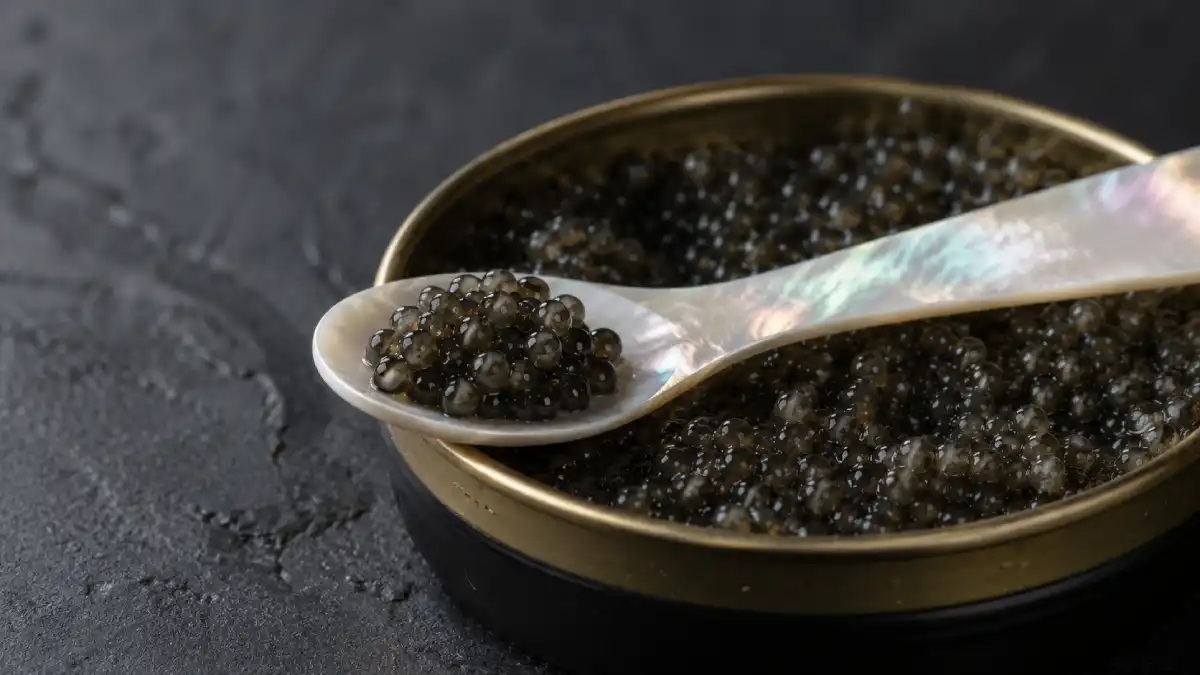
Caviar is traditionally served with a mother-of-pearl spoon because the material is neutral: it does not react with the salty roe, and its smooth, thin edge slides under the pearls without crushing them. Glass, porcelain, horn and wood are good alternatives, and food-grade stainless steel is acceptable. The one metal to avoid is silver, which tarnishes with salt and egg and can give caviar a metallic taste.
Key takeaways
- ◆Silver is the real problem. It tarnishes in contact with salt and eggs, and can leave a metallic taste.
- ◆Stainless steel is not a disaster. Good food-grade stainless steel is acceptable, even if it lacks the tradition and feel of a caviar spoon.
- ◆Mother-of-pearl is neutral, light and beautiful, which is why it became the classic choice.
- ◆Good alternatives: glass, porcelain, horn, wood, gold, and even a clean plastic tasting spoon.
- ◆Care matters: wash mother-of-pearl by hand in lukewarm water, never in the dishwasher, and keep it away from lemon and vinegar.
Contents
Why is caviar eaten with a mother-of-pearl spoon?
Mother-of-pearl, also called nacre, is the iridescent inner layer of certain shells, such as pearl oysters and abalone. It is made of tiny plates of calcium carbonate held together by a natural protein. For caviar, it offers four practical advantages:
- 1It is non-reactive. It does not interact with salt or the oils in the roe, so the caviar tastes only of caviar.
- 2It does not conduct heat like metal. It stays at room temperature and does not feel cold or harsh in the mouth.
- 3It is smooth and light. A thin, polished edge slides under the pearls without crushing them.
- 4It looks the part. Its soft iridescence sets off dark caviar beautifully, and it has long been part of the caviar ritual.
Myth vs reality: is metal really bad for caviar?
Many guides simply say “never use metal”. The truth is more precise.
| Claim | Reality |
|---|---|
| “Any metal spoon ruins caviar.” | Not exactly. Good food-grade stainless steel is acceptable. It is not the traditional choice, but it does not spoil the caviar. |
| “Silver spoons give caviar a metallic taste.” | True. Silver tarnishes quickly in contact with salt and with the sulphur compounds in eggs, and can leave a metallic note on delicate caviar. Silver-plated cutlery behaves the same way. |
| “Caviar must never touch metal.” | False. Caviar is packed in metal tins, but they are lined with a protective, non-reactive coating. That is why you should not scrape the tin hard, or keep opened caviar in a damaged tin. |
| “Mother-of-pearl improves the taste.” | It does not add anything; it simply takes nothing away. That neutrality is the whole point. |
Bottom line: avoid silver, silver-plated cutlery and reactive metals such as copper, brass or aluminium. Food-grade stainless steel is acceptable. For the best experience, use a neutral material such as mother-of-pearl, glass or porcelain.
Caviar spoon materials compared
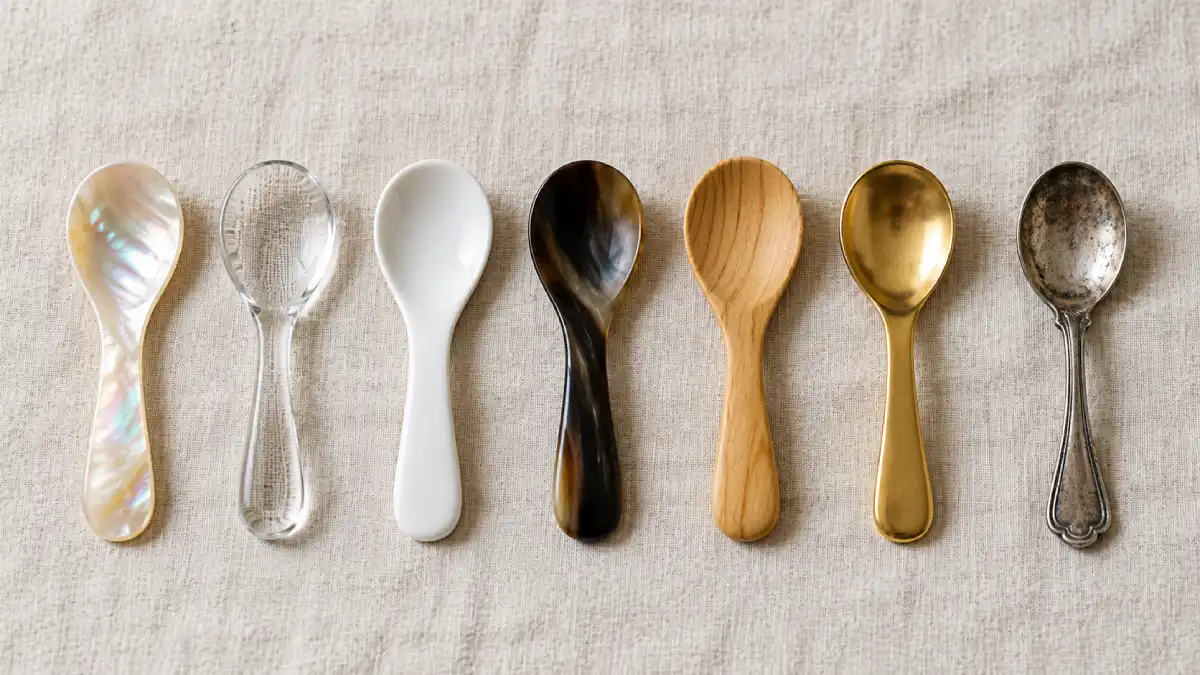
| Material | Neutral taste? | Pros | Cons | Verdict |
|---|---|---|---|---|
| Mother-of-pearl | Yes | Classic, light, elegant, smooth edge | Fragile; hand-wash only; avoid acids | Best choice |
| Glass or crystal | Yes | Neutral, easy to clean | Can chip; feels thicker | Very good |
| Porcelain | Yes | Neutral, elegant, easy to find | Can chip; thicker edge | Very good |
| Horn | Yes | Traditional, durable, warm look | Can dry out or crack; hand-wash only | Very good |
| Gold (solid or gold-plated) | Yes | Very unreactive; luxurious | Expensive; plating can wear | Very good, but costly |
| Wood | Mostly | Natural, affordable | Can absorb flavours and stain | Good |
| Bone | Yes | Neutral, traditional | Can absorb odours; hand-wash only | Good |
| Plastic | Yes | Neutral, hygienic; used at tastings | Does not feel special | Acceptable |
| Food-grade stainless steel | Mostly | Always to hand | Not traditional; colder feel | Acceptable |
| Silver or silver-plated | No | Looks elegant | Tarnishes; metallic taste with caviar | Avoid |
Antique spoons: avoid spoons made of tortoiseshell or ivory. Both come from protected species, and their trade is strictly restricted under CITES.
Sizes and shapes: which caviar spoon do you need?
Caviar spoons are smaller than an ordinary teaspoon, with a shallow, oval or paddle-shaped bowl. There are three main types:
| Spoon | Size | Used for |
|---|---|---|
| Tasting spoon | Small | Eating caviar directly; one spoon per guest |
| Serving spoon | A little longer | Taking caviar from the tin to blini or plates |
| Caviar knife or spreader | Flat blade | Spreading crème fraîche or butter, levelling caviar on blini |
For a home tasting, plan one small spoon per person, plus one serving spoon per tin. Our guide to how much caviar per person helps you plan the amount: around 30 g per person for a tasting, about 50 g for a generous aperitif.
How to use a caviar spoon
- 1Keep the tin cold until the last moment, then set it on a bed of crushed ice, without the pearls touching the ice.
- 2Scoop gently from the top, sliding the spoon under the surface without digging or stirring, so the pearls stay intact.
- 3Place the caviar on the back of your hand (the traditional “caviar bump”) or eat it straight from the spoon.
- 4Press the pearls against the roof of your mouth with your tongue rather than chewing.
- 5Use a separate spoon for each tin if you serve several varieties, so the flavours do not mix. Serve small quantities and keep the rest in the fridge.
For the full serving ritual, see how to serve and eat caviar.
How to clean and care for a mother-of-pearl spoon
Mother-of-pearl lasts for years, but it is softer than metal and sensitive to heat and acids:
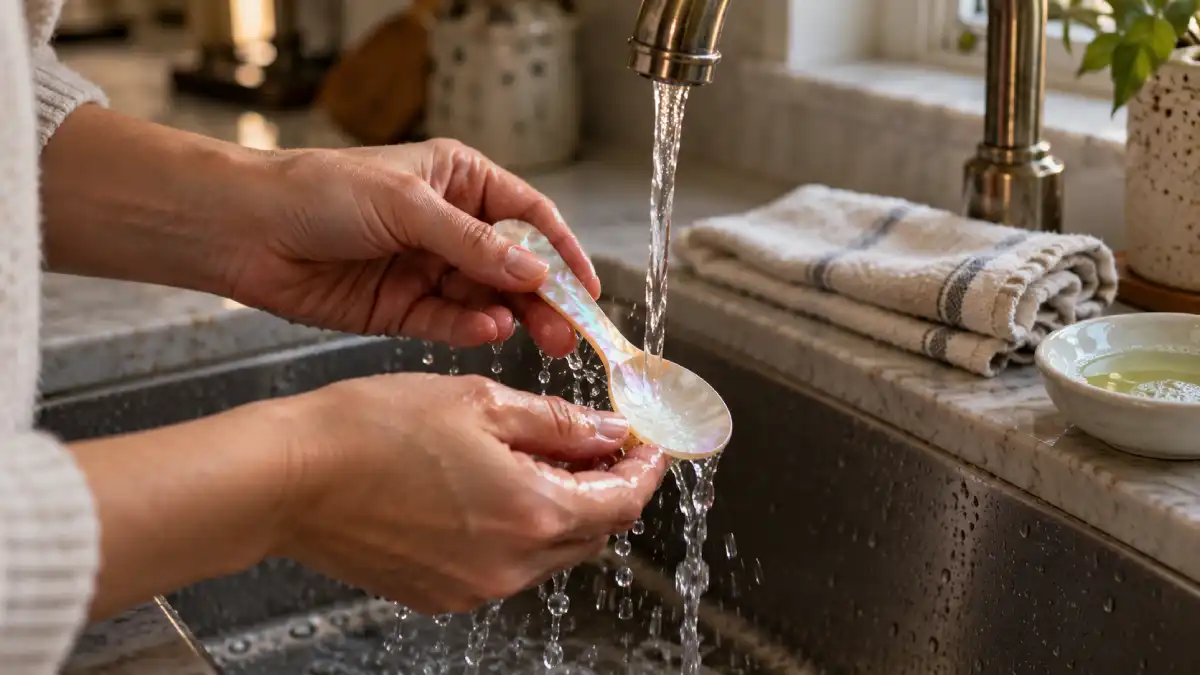
- 1Rinse soon after use in lukewarm, not hot, water to remove salt and oils.
- 2Wash gently with a drop of mild, non-acidic washing-up liquid and a soft cloth. No scouring pads.
- 3Never soak it, and never put it in the dishwasher.
- 4Keep it away from acids: lemon juice, vinegar and some cleaning products slowly dissolve the calcium carbonate and dull the shine.
- 5Dry it immediately with a soft towel.
- 6Store it separately in a soft pouch or box, so it does not scratch or chip against other cutlery.
- 7Restore the shine from time to time with a drop of neutral oil on a soft cloth, then wipe dry.
Horn and bone spoons need the same treatment. Glass, porcelain and plastic are easier to care for, and gold-plated spoons should be washed by hand to protect the plating.
Choosing a caviar spoon: what to look for
- ◆Material: genuine mother-of-pearl shows a natural, uneven iridescence. A perfectly uniform rainbow sheen may be plastic or resin.
- ◆Thickness: a thin, smooth edge slides under the pearls more easily.
- ◆Size: a small spoon for eating, a slightly longer one for serving.
- ◆Finish: no cracks, sharp edges or glue lines where the handle meets the bowl.
- ◆Gift potential: a pair of mother-of-pearl spoons with a small tin of caviar is a classic, thoughtful present. See our caviar gift guide for ideas.
No caviar spoon? Here is what to use
You do not need special equipment to enjoy caviar. In order of preference:
- 1A small glass or porcelain spoon from your kitchen.
- 2A horn, wood or bone spoon, if you have one.
- 3A clean plastic tasting spoon. Professionals often use these at tastings, for hygiene.
- 4A food-grade stainless steel teaspoon.
- 5The back of your hand. The traditional “caviar bump” needs no spoon at all.
Just leave the silver cutlery in the drawer.
Frequently asked questions
Why can’t you use a metal spoon for caviar?
The concern is mainly silver and other reactive metals, which tarnish in contact with salt and eggs and can give caviar a metallic taste. Food-grade stainless steel is acceptable, but a neutral material like mother-of-pearl gives the cleanest flavour.
Is a silver spoon bad for caviar?
Yes. Silver tarnishes in contact with salt and the sulphur compounds in eggs and can make caviar taste metallic. It is the one material to avoid.
Can I use a stainless steel spoon for caviar?
Yes. Good food-grade stainless steel is acceptable. It is not the traditional choice, and mother-of-pearl, glass or porcelain give a more neutral experience.
Are gold caviar spoons good?
Yes. Gold is very unreactive, so it does not affect the taste. Gold spoons are a luxury choice; gold-plated versions need gentle hand-washing.
Can mother-of-pearl spoons go in the dishwasher?
No. Heat, strong detergents and soaking can crack or dull mother-of-pearl. Rinse and wash by hand in lukewarm water, then dry immediately.
What else can I use a mother-of-pearl spoon for?
Other delicate foods such as fish roe, sea urchin or tartare. Avoid acidic foods like citrus or vinaigrettes, which dull the nacre.
Enjoy caviar the right way
The right spoon helps, but the caviar is the star. Choose a tin, a neutral spoon and a little crushed ice, and the rest takes care of itself. All our caviar comes from farmed sturgeon and is shipped chilled by Swiss Post within Switzerland and Liechtenstein, in 1 to 2 working days.
Sources
- Institute of Food Technologists, Food Technology (February 2020): How caviar is processed: packing in lacquer-lined tins
- CITES: The CITES Appendices: protected species, including hawksbill turtle (tortoiseshell) and elephants (ivory)