
◆ Last updated: ◆ By LeDiamont — Zervan GmbH
Airtight, dark, cool, dry
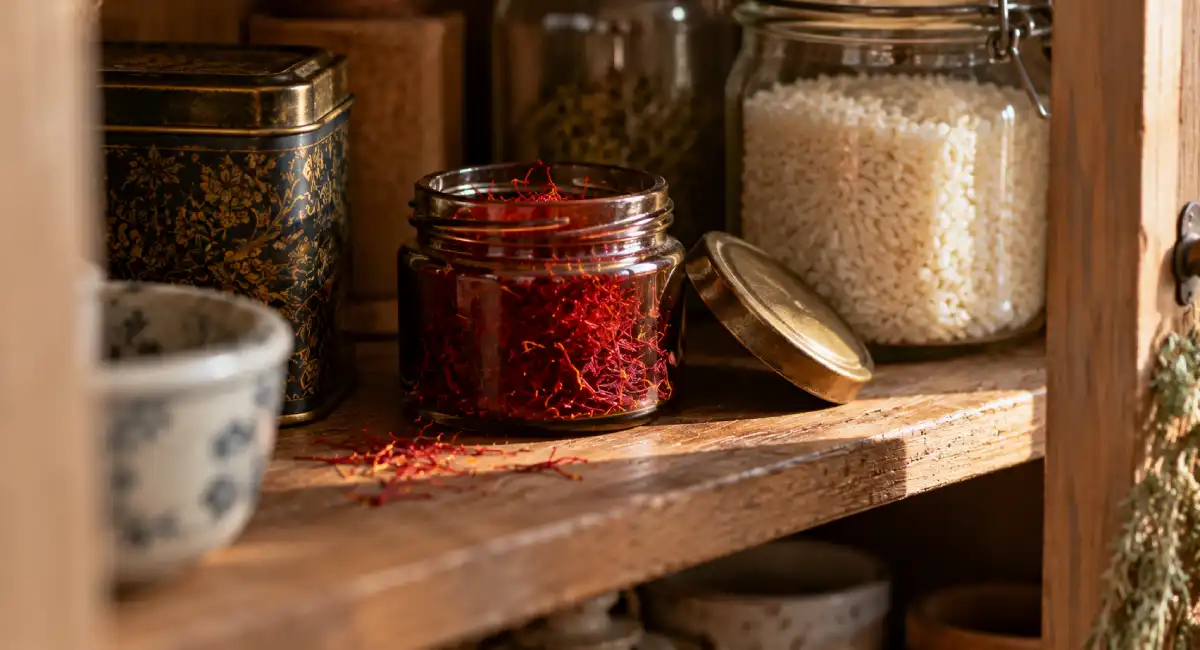
Store saffron threads in an airtight, light-proof container (a small tin or dark glass jar) in a cool, dry, dark cupboard, away from the stove and from sunlight. Do not keep the jar you use every day in the fridge, because condensation adds moisture. Stored well, saffron threads keep their best colour and aroma for about one to two years after harvest and stay usable, though weaker, for a while after that. Ground saffron loses strength faster.
Key takeaways
- ◆Four enemies: light, heat, moisture and air. Studies show colour is lost faster as temperature and humidity rise.
- ◆Airtight, dark, cool and dry is the whole rule.
- ◆No fridge for everyday use. Cold jars attract condensation when opened in a warm kitchen.
- ◆Threads last longer than powder. Buy threads and grind them as you need them.
- ◆Saffron mostly fades rather than spoils. Old, dry and clean saffron is just weaker; throw away anything musty, damp or mouldy.
Contents
What damages saffron?
Saffron’s value lies in three natural compounds: crocin (colour), picrocrocin (bitter taste) and safranal (aroma). Different things attack them:
| Enemy | What it does | What is affected |
|---|---|---|
| Heat | Speeds up the breakdown of the colour compounds | Crocin (colour) |
| Moisture and humidity | Accelerates colour loss and can cause mould | Crocin; the whole product |
| Light (especially sunlight) | Generally considered to bleach the red colour; threads turn orange, then pale | Crocin (colour) |
| Air (oxygen) | Lets the aroma escape and the product dry out and fade | Aroma and colour |
Two laboratory studies measured temperature and moisture. Tsimidou and Biliaderis (1997) found that the degradation of saffron’s colour compounds depended strongly on temperature and water activity. Bolandi et al. (2009) stored saffron for 12 weeks at 20, 30 and 40 °C and at three humidity levels: colour strength fell as temperature rose and as water activity rose. Light was not part of these two studies, so the point about sunlight is general guidance.
The Bolandi study also found that after 12 weeks the bitterness had decreased but the aroma had increased, which fits with picrocrocin slowly turning into safranal. This is one reason colour tends to fade before aroma does.
How to store saffron, step by step
- 1Keep it in its original sealed pack until you need it, if the pack is airtight and light-proof.
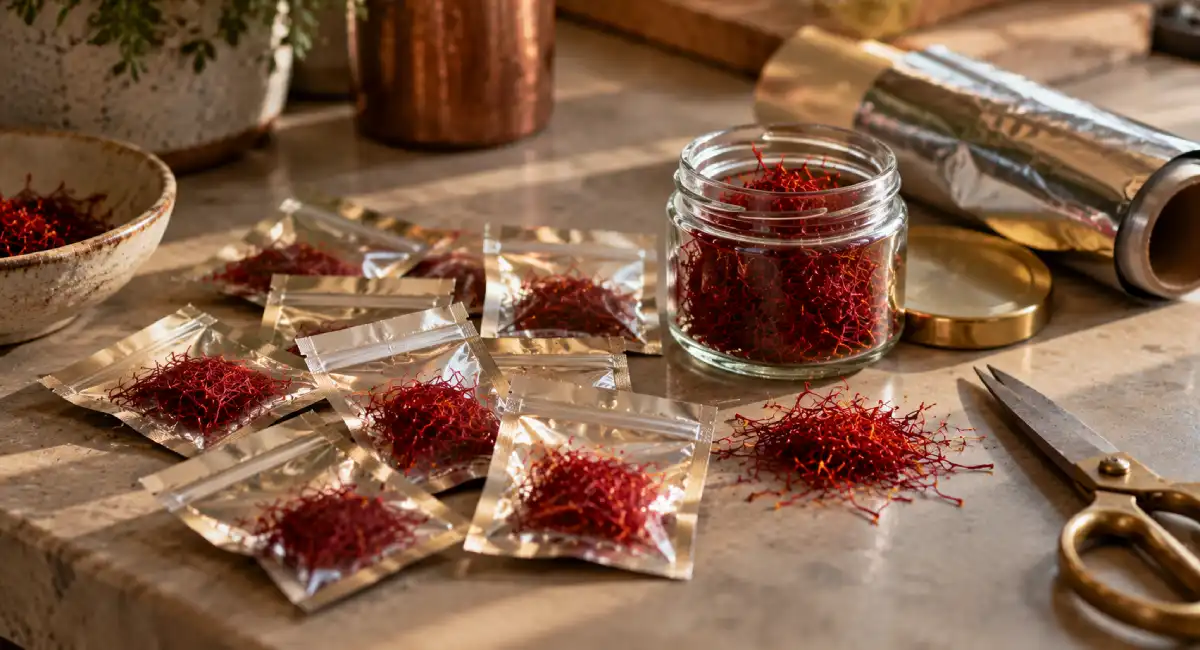
- 2Once opened, transfer it to a small airtight container: a metal tin, a dark glass jar or a tightly sealed foil pouch. The smaller the container, the less air inside.
- 3Shield clear jars from light by wrapping them in foil or keeping them in a closed box.
- 4Choose a cool, dark cupboard, away from the stove, oven, kettle, dishwasher and sunny windows.
- 5Keep it dry: always use a dry spoon or dry fingers, and close the container immediately.
- 6Label it with the date you opened it and, if you know it, the harvest year.
- 7Do not store it next to strong spices such as cumin or cloves; saffron’s aroma is delicate.
Choosing a container
| Container | Light protection | Airtight | Verdict |
|---|---|---|---|
| Small metal tin with a tight lid | Excellent | Good to excellent | Best for everyday use |
| Dark (amber or cobalt) glass jar | Very good | Excellent | Best; you can see the threads when you hold it to the light |
| Clear glass jar | Poor | Excellent | Good only if kept in a dark box or cupboard |
| Resealable foil pouch | Excellent | Good | Fine; squeeze out the air before closing |
| Plastic bag or plastic box | Poor to fair | Fair | Avoid for long storage; can let in air and odours |
| Paper envelope | Fair | Poor | Avoid |
Many cooks keep a small working jar with a few weeks’ supply and a reserve that stays sealed. That way the main stock is not exposed to air and moisture every time you cook.
Should you keep saffron in the fridge or freezer?
| Option | When it makes sense | How to do it |
|---|---|---|
| Cool, dark cupboard | Everyday use; most kitchens | Airtight, light-proof container |
| Fridge | Generally not recommended for the jar you use daily | Each time you open a cold jar, moisture can condense on the threads |
| Freezer | Long-term storage of a larger quantity, or a very hot and humid home | Divide into small, double-wrapped airtight portions; take out one portion at a time and let it reach room temperature before opening |
The main risk of cold storage is not the cold itself but condensation: warm, humid kitchen air meets cold threads and leaves moisture behind. If you freeze saffron, never refreeze a portion you have opened.
How long does saffron last?
| Form | Best quality | Notes |
|---|---|---|
| Threads, well stored | About one to two years from harvest | Colour fades first; use a little more if they are older |
| Powder | Shorter than threads | Larger surface area, so it loses strength faster, and it is easier to adulterate |
| Saffron water (bloomed) | About 3 to 4 days in a closed glass jar in the fridge | Make small amounts and use them up |
Dates on packs are “best before” dates. As saffron ages it loses colour and aroma, so the closer to the latest harvest (autumn) you buy, the better. If the pack shows no harvest year, ask the seller.
How to tell if saffron has gone stale or bad
| Check | Fresh saffron | Stale saffron | Throw it away |
|---|---|---|---|
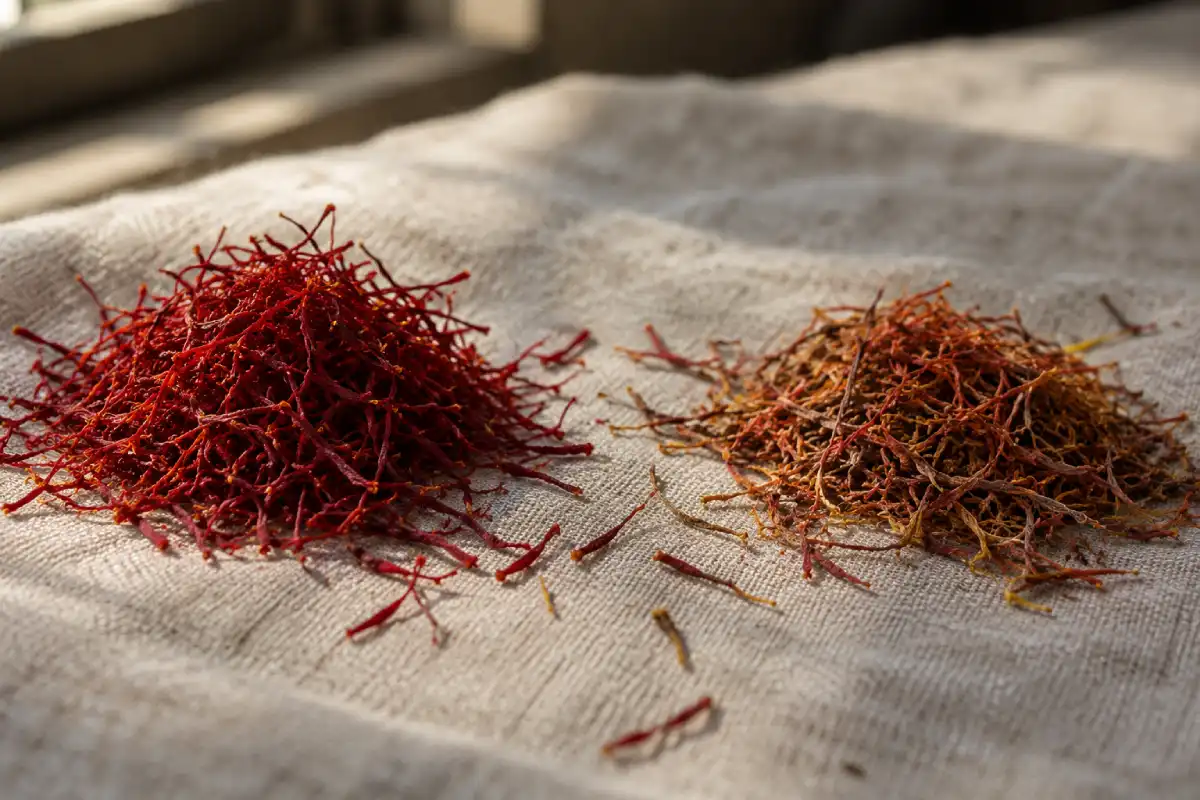
| Colour | Deep crimson red | Orange, brownish or pale | — |
| Smell | Strong, sweet, honey and hay | Weak, dusty or flat | Musty, mouldy or sour |
| Texture | Dry, brittle, separate threads | Dry but crumbly | Damp, sticky, clumped |
| Water test | Slow, strong golden colour | Pale yellow, little colour | — |
| Appearance | Clean threads | — | Any visible mould or insects |
The water test from our guide how to tell if saffron is real also works as a freshness test: fresh saffron gives a rich golden colour, old saffron only a pale yellow.
Using older saffron
If your saffron is a little old but dry and clean, you can still use it:
- ◆Use a little more than the recipe says, and taste as you go.
- ◆Grind it finely and bloom it for longer, 30 minutes or more, to extract as much as possible.
- ◆Use it where colour matters less: stews, soups, tea or saffron syrup rather than plain rice.
For blooming and amounts, see how to use saffron threads, and for ideas to use it up, our saffron recipes.
Buying tips that make storage easier
- 1Buy small quantities you will use within a year or two.
- 2Buy threads, not powder, for longer life and to avoid adulteration.
- 3Choose light-proof, airtight packaging from the start.
- 4Check the harvest year where possible.
- 5Buy from a seller who stores it properly, not from open jars on a sunny stall.
Our Iranian saffron is a Sargol from Khorasan, in whole threads, sold in 5 g tins. At 0.1 g per dish for four, a tin makes about 50 dishes, enough to use while the saffron is at its best. Why saffron costs what it does explains the price.
Frequently asked questions
What is the best way to store saffron?
In a small airtight, light-proof container (a tin or a dark glass jar) in a cool, dry, dark cupboard, away from the stove and sunlight.
Should saffron be refrigerated?
Generally no. Each time you open a cold container, moisture from the air can condense on the threads. A cool, dark cupboard is better for everyday use.
Can you freeze saffron?
Some cooks do, for long-term storage of larger amounts. Divide it into small, double-wrapped airtight portions, and let each portion reach room temperature before opening to avoid condensation.
Does saffron expire?
Dry saffron does not spoil quickly, but it slowly loses colour and aroma. Threads are at their best for about one to two years after harvest; powder loses strength faster.
Should I throw away old saffron?
Only if it smells musty or sour, feels damp or sticky, or shows mould or insects. Dry, clean saffron that is simply old is just weaker, so use a little more of it.
How do I know if my saffron is still good?
Check that the threads are still deep red, smell strong and sweet, and colour water a rich golden yellow. Pale colour and a weak smell mean it has faded.
Why did my saffron turn orange?
Usually because of light or heat exposure, or simply age. The colour compounds break down over time, especially in warm places and in clear containers.
Can I store saffron in a plastic bag?
Only for short periods. Plastic lets in some air and odours and gives little light protection. A tin or dark glass jar is much better.
Keep it golden
Good saffron rewards good care: an airtight tin, a dark cupboard and dry hands are all it takes to keep its colour and aroma.
Sources
- Tsimidou M. and Biliaderis C.G. (1997), Journal of Agricultural and Food Chemistry 45(8): 2890–2898: Kinetic studies of saffron (Crocus sativus L.) quality deterioration
- Bolandi M. et al. (2009), Journal of Crop Production and Processing 13(47): 61–66: Effect of temperature, water activity and storage time on color strength, aroma and bitterness of saffron
- Fujii S. et al. (2022), Longhua Chinese Medicine: Saffron: production, quality standards and the ISO 3632 categories