
Published by LeDiamont — Zervan GmbH
◆ Last updated: ◆ By LeDiamont — Zervan GmbH
From CHF 5 to over CHF 60 a gram
In Switzerland, genuine saffron threads cost roughly CHF 5 to 30 per gram depending on grade, origin and pack size; Swiss-grown saffron from Valais or Graubünden reaches CHF 28–63 per gram. LeDiamont’s Iranian Sargol saffron costs CHF 24.62 for 5 g, or CHF 4.92 per gram, because it is imported directly and sold in a 5 g tin rather than a 0.1 g sachet. Per dish, that is about 50 centimes.
Key takeaways
- ◆Price per gram is the only fair comparison. Supermarket sachets of 0.1–0.5 g often cost CHF 15–20 per gram; 3–5 g tins from importers cost CHF 5–10 per gram.
- ◆Four things set the price: the cut (Negin, Sargol, Pushal), the origin, the pack size and how many hands the saffron passed through.
- ◆Saffron is not “more expensive than gold”. Gold traded around USD 130 per gram in October 2026; good saffron costs a fraction of that.
- ◆Very cheap saffron is a warning sign. Genuine all-red threads rarely sell below about CHF 3 per gram at retail; EU controls found 11 % of 141 saffron samples suspicious.
- ◆A 5 g tin seasons about 50 dishes for four people, so the cost per meal is well under a franc.
Contents
How much does saffron cost in Switzerland in 2026?
There is no single saffron price. The same spice is sold in 0.1 g sachets at the supermarket checkout, in 1 g tubes at delicatessens and in 5 g tins by importers, and the price per gram can differ by a factor of ten. The table below lists prices we observed on Swiss retail sites and in Swiss media in November 2026, converted to a price per gram so that they can be compared. Retail prices change; treat the figures as indicative.
| Offer (Switzerland) | Pack | Price | Per gram |
|---|---|---|---|
| LeDiamont Iranian Sargol saffron (threads, direct import) | 5 g tin | CHF 24.62 | CHF 4.92 |
| LeDiamont Iranian Sargol saffron, 3 g (temporarily out of stock) | 3 g tin | CHF 15.39 | CHF 5.13 |
| Supermarket own-brand organic saffron pistils | 0.35 g | CHF 5.40 | ≈ CHF 15.40 |
| Premium Iranian threads at a Swiss online delicatessen | 3 g | CHF 51.95 | ≈ CHF 17.30 |
| Organic ground saffron (German brand) at a Swiss online shop | 0.5 g | CHF 10.25 | ≈ CHF 20.50 |
| Mund saffron AOP, Valais (Swiss-grown) | per gram | about CHF 28 | ≈ CHF 28 |
| Saffron grown in Fläsch, Graubünden (Swiss-grown) | 0.1 g ≈ 60 threads | about CHF 12 | ≈ CHF 63 |
Prices seen on Swiss retailer sites and in Swiss media (swissinfo, SRF) at the time of writing, November 2026. Pack sizes under 1 g are rounded.
Two things stand out. First, the smaller the pack, the higher the price per gram: a 0.35 g sachet looks cheap at CHF 5.40 but costs three times more per gram than a 5 g tin. Second, Swiss-grown saffron is a separate market altogether. Mund in Valais produces only a few kilos a year, and Bündner saffron is picked by hand on tiny plots, which is why these local saffrons cost CHF 28–63 per gram and sell out quickly. They are wonderful regional products, but they are not the benchmark for everyday cooking.
Rule of thumb for Switzerland: CHF 5–10 per gram for good Iranian or Spanish threads in 1–5 g packs, CHF 15–20 per gram for supermarket mini-sachets, CHF 25 per gram and above for Swiss-grown or boutique-branded saffron.
Why does the price per gram vary so much?
Four factors explain almost every price difference you will see on a shelf or a product page.
1. The cut: Negin, Sargol, Pushal and bunch
Iranian saffron is sold in trade cuts that describe how much of the stigma is included. Negin is the thick, all-red tip of the stigma with no yellow style attached; it has the strongest colour per gram and the highest price. Sargol (“top of the flower”) is also all-red but includes shorter and finer threads, so it is a little cheaper per gram while giving almost the same colouring power. Pushal keeps part of the yellow-orange style attached to the red stigma; you pay less per gram, but a share of the weight is style, which adds little colour or aroma. Dasteh (bunch) is the whole stigma with the style, tied in bundles, and is the cheapest. Spanish grades work the same way: Coupé is all-red, Mancha includes some style. Our saffron is Sargol, which is why it sits in the good-value middle rather than at the Negin premium.
2. Origin
Iran grows roughly 85–90 % of the world’s saffron (FAO, November 2025), mostly in Khorasan, which keeps Iranian saffron the most affordable per gram at equal quality. Spanish La Mancha PDO, Kashmiri and Greek Kozani saffron are produced in far smaller quantities and carry a scarcity premium; Swiss Mund saffron is the extreme case. Origin tells you about scarcity and tradition, not automatically about quality: laboratory values and the cut matter more than the flag on the tin. If you want to compare the two biggest origins, read our guide on Iranian versus Spanish saffron.
3. Pack size
Packaging, labelling, a glass tube, a display box and the retailer’s margin cost roughly the same whether the pack holds 0.1 g or 5 g. Spread over 0.1 g, those fixed costs dominate the price; spread over 5 g, they almost disappear. That is why a 5 g tin at CHF 24.62 can cost less per gram than a 0.35 g sachet at CHF 5.40 without any difference in the saffron itself.
4. The length of the supply chain
Saffron that passes from a farmer to a regional collector, an exporter, a European importer, a distributor and finally a supermarket picks up a margin at each step. Importers that buy in Iran and sell directly to Swiss customers skip several of those steps. This is the main reason LeDiamont can sell Sargol threads at under CHF 5 per gram: the saffron is imported directly and shipped from stock in Switzerland, with no wholesaler or retail chain in between.
What does saffron cost per dish?
The price per gram is only half the story, because a dish needs very little saffron. For a risotto, a paella or a Persian rice for four people, about 0.1 g of threads (roughly 40–50 threads, or a generous pinch) is enough. On that basis a tin lasts far longer than most people expect.
| Pack | Price | Dishes for 4 (≈ 0.1 g each) | Cost per dish | Cost per serving |
|---|---|---|---|---|
| LeDiamont 5 g tin | CHF 24.62 | ≈ 50 | ≈ CHF 0.49 | ≈ CHF 0.12 |
| LeDiamont 3 g tin | CHF 15.39 | ≈ 30 | ≈ CHF 0.51 | ≈ CHF 0.13 |
| Supermarket 0.35 g sachet | CHF 5.40 | ≈ 3–4 | ≈ CHF 1.50 | ≈ CHF 0.38 |
| Swiss-grown saffron at CHF 28 per gram | CHF 28.00 per g | ≈ 10 per gram | ≈ CHF 2.80 | ≈ CHF 0.70 |
Indicative figures. Dosage varies with the recipe and the colouring strength of the saffron; a saffron tea or a dessert may use less, a large tahdig more.
In other words, even premium saffron adds well under a franc per portion. Buying a larger tin only makes sense if you will use it within its best period, which for whole threads stored airtight, dark and dry is one to two years. For storage details see how to store saffron, and for dosages by dish see how to use saffron threads.
Why is saffron expensive at all?
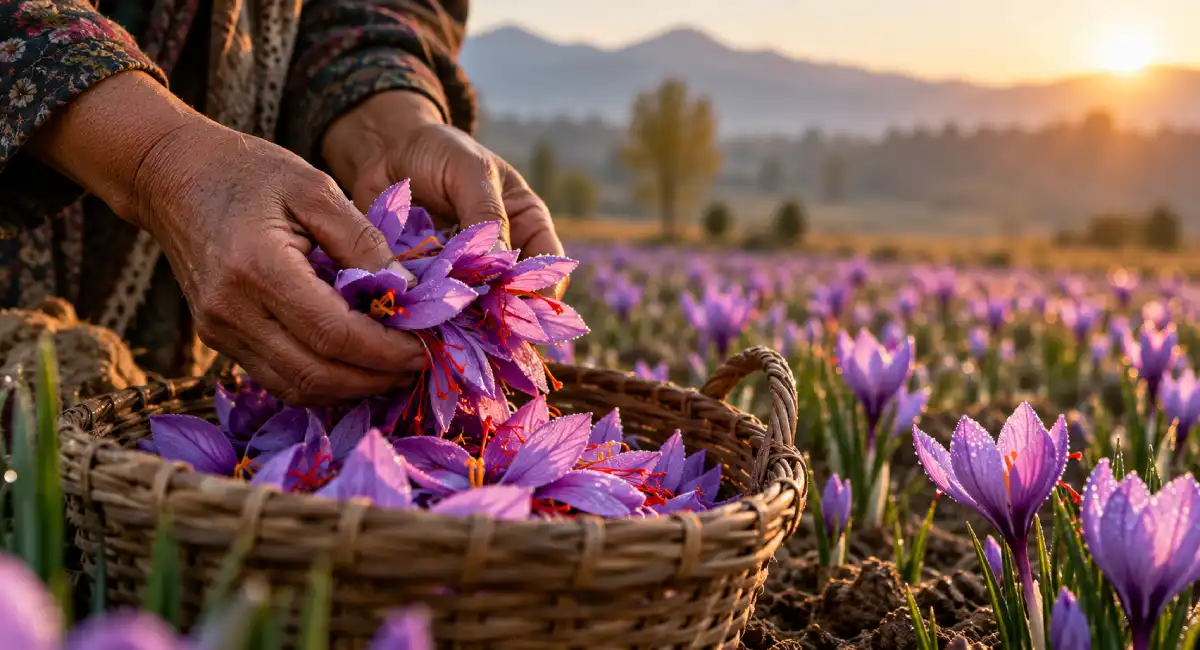
Saffron is the dried stigma of the saffron crocus, Crocus sativus. Each flower produces three stigmas, the flowers open for only two to three weeks in October and November, and every stigma is picked and separated by hand on the day the flower opens. It takes roughly 150–170 flowers to produce one gram of dried saffron, and about 150,000–200,000 flowers for a kilo; the fresh stigmas lose around four fifths of their weight when dried. A good picker handles a few thousand flowers in a morning, so the labour behind a single gram is measured in hours, not minutes. We explain the full cost chain in why saffron is so expensive.
What this means for the price: labour, not land or inputs, is the cost. Countries with large harvests and lower wages produce the most affordable genuine saffron, which is why Iranian saffron dominates both the world market and the Swiss import statistics.
Is saffron really worth more than gold?
No, and it has not been for a long time. The comparison survives because saffron is the most expensive spice by weight, but the numbers do not support it. In October 2026 gold traded at roughly USD 130 per gram. Good saffron costs CHF 5–30 per gram at retail; even Swiss Mund saffron at CHF 28 per gram is a quarter of the gold price, and the kilo prices paid to exporters are lower still. What is true is that saffron is far more valuable than any other spice: vanilla, cardamom and real cinnamon are all priced in francs per 100 g, saffron in francs per gram.
When is cheap saffron a warning sign?
Because saffron is valuable and light, it is one of the most adulterated foods in Europe. In the European Commission’s 2021 coordinated control plan on herbs and spices, 11 % of 141 saffron samples were judged suspicious: some were safflower or other plant material, some real saffron bulked out with dyed fibres or extra moisture. Price is the first filter.
| Retail price per gram (threads, Switzerland) | What it usually means |
|---|---|
| Under about CHF 2–3 | Suspicious. At this level the saffron is often Pushal or bunch sold as premium, old stock, or not saffron at all. Check the threads before you cook. |
| CHF 3–6 | Realistic for genuine Iranian Sargol or Pushal bought in 3–10 g packs directly from an importer. |
| CHF 6–12 | Typical for Negin, Spanish Coupé and branded 1 g packs from specialist shops. |
| CHF 12–25 | Mini-sachets at supermarkets and pharmacies, organic labels, boutique brands; you pay for packaging and retail, not necessarily for quality. |
| Above CHF 25 | Swiss-grown saffron (Mund, Graubünden), PDO La Mancha in gift packaging, or luxury branding. |
Indicative bands for whole threads; ground saffron is cheaper to adulterate and should be bought only from a source you trust.
Price alone never proves authenticity. Real threads are deep red, widen into a small trumpet at one end, smell of honey and hay and colour warm water slowly over several minutes without falling apart. Our step-by-step guide to real versus fake saffron shows every check, including the ones that catch dyed safflower.
Where to buy saffron in Switzerland, and what to expect to pay
- 1Supermarkets (Migros, Coop, Manor): convenient 0.1–0.5 g sachets and small jars, usually CHF 12–20 per gram. Fine for an occasional risotto; expensive if you cook with saffron regularly.
- 2Delicatessens and pharmacies: 0.5–1 g tubes of branded or organic saffron, often CHF 10–25 per gram. Look for the cut and the harvest year on the label.
- 3Online marketplaces: the widest range and the widest quality spread, from CHF 3 to over CHF 30 per gram. Compare the price per gram, not the pack price, and read what the seller says about origin and cut.
- 4Direct importers such as LeDiamont: 3–5 g tins of a single origin and cut at CHF 5–10 per gram, shipped from Swiss stock. LeDiamont’s 5 g tin of Iranian Sargol costs CHF 24.62 and is delivered by Swiss Post within Switzerland and Liechtenstein, usually within 1–2 working days.
- 5Swiss producers (Valais, Graubünden): CHF 28–63 per gram, tiny quantities, often sold out by December. Buy it for the story and the terroir, not to save money.
For a practical overview of the Swiss market, including which supermarket formats exist, see our guide to buying saffron in Switzerland, and for the origin, grades and uses of Iranian saffron, our complete Iranian saffron guide.
Frequently asked questions
How much does 1 gram of saffron cost in Switzerland?
Between about CHF 5 and CHF 30 at retail in 2026, depending on the cut, origin and pack size. Supermarket mini-sachets work out at CHF 15–20 per gram; 3–5 g tins from importers cost CHF 5–10 per gram; Swiss-grown saffron costs CHF 28 per gram and more.
How much does a kilo of saffron cost?
Retail prices of CHF 5–30 per gram correspond to CHF 5,000–30,000 per kilo, but nobody buys a kilo at retail prices. Wholesale and export prices for Iranian saffron are much lower per kilo and move with each harvest; they are not a useful guide for a home cook buying a few grams.
Why is LeDiamont saffron cheaper per gram than supermarket saffron?
Three reasons: it is sold in a 5 g tin instead of a 0.1–0.5 g sachet, it is imported directly without wholesalers or a retail chain, and it is Sargol rather than the Negin premium cut. The price is CHF 24.62 for 5 g, about CHF 4.92 per gram.
Is expensive saffron better?
Not automatically. Price reflects the cut, the origin, the brand and the pack size as much as the laboratory quality. Two tins of all-red Iranian saffron at CHF 5 and CHF 15 per gram can be the same grade; the difference is often packaging and distribution.
What is the minimum price for genuine saffron?
At Swiss retail, be cautious below about CHF 2–3 per gram for threads. Genuine Sargol bought in bulk by an importer can be sold at CHF 3–5 per gram, but anything much lower is usually a lower cut sold as premium, old stock or adulterated.
How many dishes does 5 grams of saffron make?
About 50 dishes for four people if you use the usual 0.1 g (40–50 threads) per dish, which comes to roughly 50 centimes per dish or 12 centimes per serving.
Is saffron more expensive than gold?
No. Gold traded around USD 130 per gram in October 2026, while good saffron costs CHF 5–30 per gram. Saffron is the most expensive spice, not the most expensive substance.
Does the saffron price change with the season?
Yes. The harvest in October and November sets the new year’s prices, and a poor Iranian harvest pushes export prices up for the following year. Retail prices in Switzerland react slowly and mostly through pack sizes and promotions.
Is ground saffron cheaper than threads?
Per gram it is often similar or slightly cheaper, but powder is much easier to stretch with turmeric, paprika or safflower and loses aroma faster. For the price, whole threads are the safer purchase.
Try the saffron behind these prices
LeDiamont’s Iranian Sargol saffron comes from Khorasan, only the red part of the stigma, hand-picked and sold in a 5 g tin for CHF 24.62, about 50 dishes’ worth. It is delivered by Swiss Post within Switzerland and Liechtenstein. A 3 g tin exists as well and will be back when stock allows.
Sources
- ◆UN Iran / FAO (November 2025): FAO and Iran strengthen the saffron value chain (Iran produces 85–90 % of world saffron)
- ◆European Commission (2021): Results of the first EU-wide survey on herbs and spices authenticity (11 % of saffron samples suspicious)
- ◆JRC, Maquet et al. (2021): Results of an EU wide coordinated control plan to establish the prevalence of fraudulent practices in the marketing of herbs and spices (JRC126785)
- ◆swissinfo.ch (2015): Saffron, the ‘red gold’ from the mountains of Valais
- ◆SRF, Gesichter und Geschichten: Vom Feld auf den Teller: Rebecca Clopath und das «rote Gold»
- ◆University of Vermont, North American Center for Saffron Research & Development: Saffron growing resources (about 167 flowers per gram)
- ◆Migros Migipedia: Migros Sélection Bio Knospe saffron pistils, 0.35 g
- ◆ISO 3632-1:2025 (summary): Spices — Saffron (Crocus sativus L.) — Part 1: Specification