
◆ Last updated: ◆ By LeDiamont — Zervan GmbH
Red gold from Khorasan
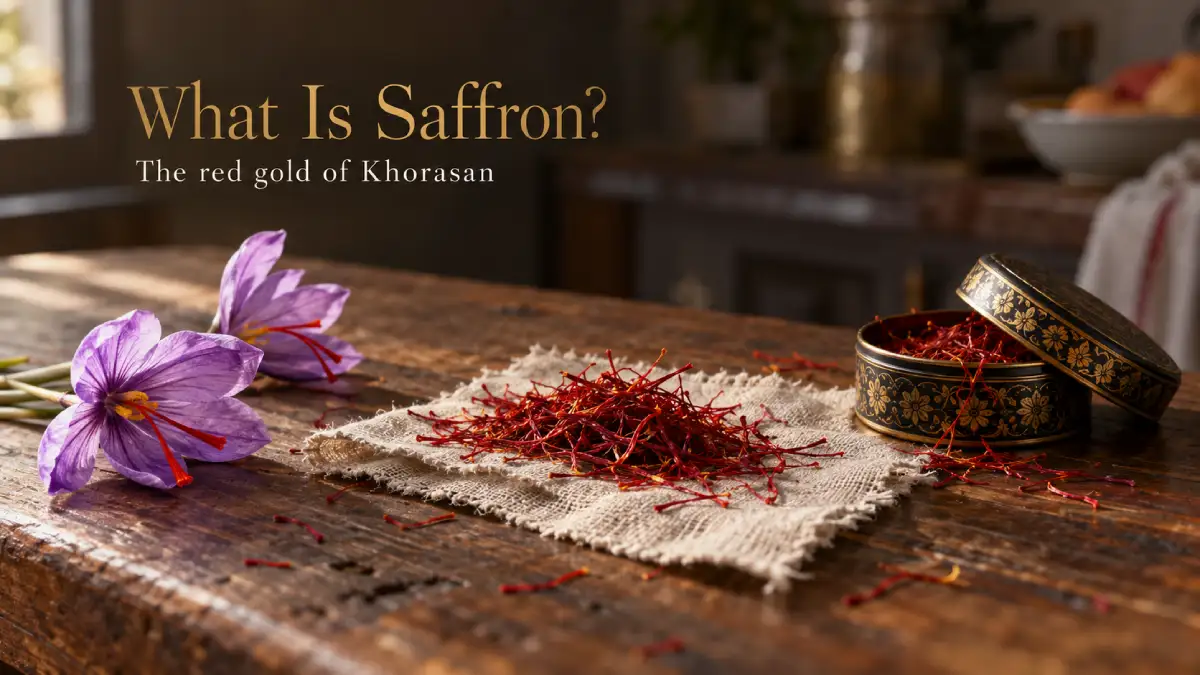
Saffron is a spice made from the dried red stigmas of the saffron crocus, Crocus sativus. Each flower carries only three stigmas, picked by hand, and it takes about 150–170 flowers to make one gram. Saffron gives food a golden colour, a honeyed, hay-like aroma and a gently bitter taste. Iran grows 85–90% of the world’s saffron, mainly in Khorasan, where it is sold under cuts such as Negin, Sargol and Pushal. At LeDiamont, Iranian Sargol saffron is available in Switzerland in 3 g and 5 g tins. To buy Iranian saffron in Switzerland, our shop offers Khorasan Sargol in 5 g tins.
Key takeaways
- ◆Saffron is a flower part, not a seed or a root: the three red stigmas of Crocus sativus, dried after a hand harvest in October and November.
- ◆Iran is by far the leading producer, with 85–90% of world output, mostly from Khorasan. Switzerland has its own tiny harvest in Mund, Valais.
- ◆Grade names describe the cut, not a certified quality. Only a laboratory analysis according to ISO 3632 measures quality objectively.
- ◆A little goes far: about 0.1 g (40–50 threads) flavours a dish for four, so a 3 g tin covers around 30 such dishes.
- ◆Choose threads rather than powder, prepare them in warm liquid or with the Persian ice method, and store them airtight, dry and dark.
Contents
- What is saffron?
- How it is grown and harvested
- Where saffron comes from
- A short history
- What saffron tastes like
- Iranian grades: Super Negin to powder
- How to recognise real saffron
- How to use it, and how much
- Why saffron is so expensive
- How to store it
- What can replace saffron?
- Is saffron safe to eat?
- Buying in Switzerland
- FAQ
What is saffron?
Saffron is the dried stigma of the saffron crocus (Crocus sativus L.), a small autumn-flowering plant of the iris family. Inside each purple flower sits a pale style that splits into three bright red stigmas, the part of the flower that catches pollen. Those three red filaments, dried, are what you buy as saffron “threads”.
It is used mainly to colour and flavour food. In the European list of food additives, saffron used as a colour carries the code E164. It has also been used for centuries as a dye and in perfume, which is why “saffron” also names a colour. The word reached English through Old French safran and Medieval Latin, from the Persian za’faran.
One plant fact explains much of its story: the cultivated crocus is sterile. It cannot make viable seed, so every saffron field in the world is planted by hand from underground bulbs called corms, divided and replanted year after year. Saffron does not grow wild.
How is saffron grown and harvested?
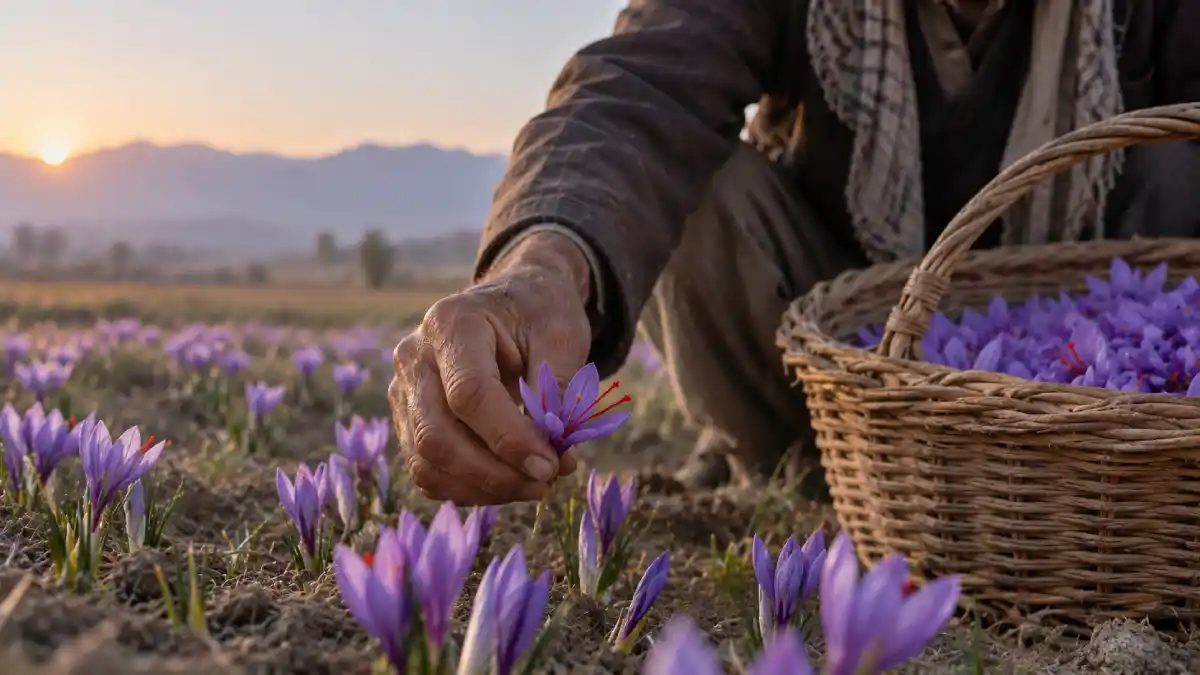
Saffron is one of the few spices still harvested almost entirely by hand. From field to tin, it follows the same steps everywhere:
- 1Planting (late summer). Corms go into dry, well-drained soil. They rest through the heat and wake with the first autumn rains.
- 2Flowering (October–November). The flowers of a field open within a window of a few weeks.
- 3Picking at dawn. Flowers are cut early in the morning, before they open fully, because they wilt the same day and the sun damages the stigmas.
- 4Separating the stigmas. The three red stigmas are pulled from each flower by hand. The finest cuts also remove the yellow-white style.
- 5Drying. The stigmas are dried within hours and lose about four-fifths of their weight: roughly 5 kg of fresh stigmas give 1 kg of dried saffron. Drying also develops the aroma.
- 6Sorting and packing. The threads are sorted by cut and colour, then packed airtight, away from light.
The arithmetic is unforgiving: with three stigmas per flower, it takes about 150–170 flowers for one gram, or roughly 150,000–170,000 flowers for a kilogram. One gram holds around 400–500 threads.
Where does saffron come from?
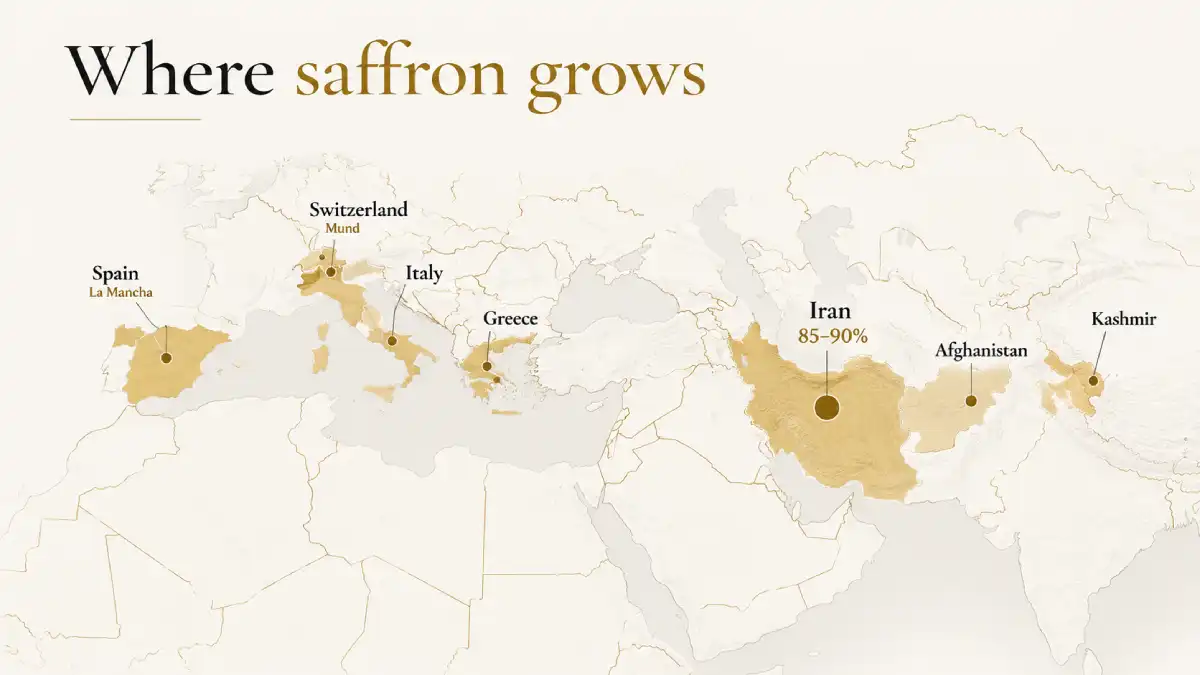
Saffron grows in a belt of dry, sunny climates with cold winters, from Spain to Kashmir. Production is extremely concentrated: according to the FAO (2025), Iran produces 85–90% of the world’s saffron, mostly in the provinces of Khorasan Razavi and South Khorasan, around Torbat-e Heydarieh, Gonabad and Qaen. The climate there is dry and sunny, with cool autumn nights. In Gonabad, saffron is still grown in places with water from qanats, ancient underground channels recognised by the FAO as a Globally Important Agricultural Heritage System.
| Origin | Main area | Good to know |
|---|---|---|
| Iran | Khorasan Razavi, South Khorasan | 85–90% of world production (FAO, 2025). Sold by cut: Super Negin, Negin, Sargol, Pushal… |
| Afghanistan | Herat | A fast-growing producer |
| Greece | Kozani, Macedonia | Protected origin “Krokos Kozanis” (PDO) |
| Spain | La Mancha | Protected origin “Azafrán de La Mancha” (PDO); check the country of cultivation, not only the country of packing |
| Italy | L’Aquila (Abruzzo), Sardinia | “Zafferano dell’Aquila” is a protected origin, grown on a very small area |
| India | Kashmir (Pampore) | Geographical indication since 2020; small, weather-dependent harvests |
| Switzerland | Mund, Upper Valais | “Munder Safran AOP” since 2004; about 1–4 kg a year, mostly sold in the village |
Is there Swiss saffron? Yes, but very little. Mund, a village above Naters in Upper Valais, has grown saffron for centuries and received its AOP in 2004. Valais tourism puts the yearly harvest at one to four kilos, all worked by hand: wonderful to taste in the village, but not a supply most kitchens can rely on. Agroscope has also supported small new saffron plots elsewhere in Switzerland.
No origin is better by principle: quality depends on the batch. For a detailed comparison, read our article Iranian vs Spanish saffron.
A short history of saffron
- ◆Origins are still debated. Iran, Greece, Mesopotamia and Kashmir have all been proposed. A 2019 genetic study concluded that the cultivated crocus arose in Attica, Greece, from the wild Crocus cartwrightianus.
- ◆Ancient Persia grew saffron for food, dye, perfume and baths; from there it spread to Kashmir, the Mediterranean and, with Arab agriculture, to Spain.
- ◆14th century, Switzerland. During the Black Death, demand for saffron soared. A stolen shipment sparked a 14-week “Saffron War”, and Basel began growing its own saffron.
- ◆Nuremberg enforced the Safranschou, a code under which sellers of adulterated saffron faced heavy penalties. Saffron fraud is not a modern invention.
- ◆England: the town of Saffron Walden took its name from the crop.
What does saffron taste like?
Good saffron smells honeyed and floral, with notes of dry hay. On the tongue it is subtly sweet, earthy and slightly bitter. Used too generously, the bitterness takes over, which is why recipes call for so little. Three natural compounds create that profile:
| Compound | What it gives | Why it matters in the kitchen |
|---|---|---|
| Crocin | The golden-yellow colour | Dissolves in water, stock or milk rather than in fat, so saffron is steeped in liquid first |
| Picrocrocin | The bitter, savoury taste | Gives saffron its depth; too much tastes harsh |
| Safranal | Most of the aroma | Forms during drying; volatile, so it fades with heat, light and age |
These three are exactly what the international standard ISO 3632 measures in a laboratory: colouring strength, bitterness and aroma.
Iranian saffron grades: Super Negin, Negin, Sargol, Pushal
In Iran, saffron is sold under trade names that describe how the threads are cut and sorted:
| Name | What it contains | Appearance | Good to know |
|---|---|---|---|
| Super Negin | Only the red part of the stigma, selected for the longest threads | Long, thick, straight, deep red threads | The most carefully selected cut; the difference is mainly visual |
| Negin (نگین) | Only the red part of the stigma | Long, thick threads | A very careful cut |
| Sargol (سرگل) | Only the red part, without the yellow or white style | Shorter, deep red threads, some broken | The most common cut for cooking |
| Pushal (پوشال) | The red part with a little yellow style at the end | Red threads with a short yellow tip | Slightly less colouring per gram |
| Dasteh (دسته) | The whole stigma, red and yellow | Presented in small bunches | Traditional presentation |
| Sefid (سفید) | Only the white or yellow style, separated during sorting | Pale threads | Much less colour and aroma |
| Narmeh (نرمه) | Saffron ground to a fine powder | Powder | Practical, but its appearance can no longer be judged: the form most easily adulterated |
These names tell you what is in the tin. On their own, they do not guarantee the quality of the batch: a poorly dried or old Sargol can be weaker than a fresh Pushal. Spain uses its own names (coupé, mancha and lower grades), and the same rule applies.
Threads or powder? Choose threads. You can see what you are buying, they keep their aroma longer, and they are much harder to adulterate. Powder dissolves instantly but can hide turmeric, paprika or dyes, and it loses its aroma faster.
How to recognise real saffron
Saffron is the most expensive spice in the world, and therefore one of the most frequently faked. The market includes dyed threads, corn silk, safflower or marigold petals, the crocus’s own yellow stamens, and saffron weighted with oil or sugar. Powder is the most exposed, because turmeric or paprika can be mixed in without it showing.
The laboratory certificate, the only objective proof
By eye, by smell or in water, you can rule out crude fakes. But only a laboratory analysis according to ISO 3632 really measures quality, through colouring strength (crocin), bitterness (picrocrocin) and aroma (safranal). The 2011 edition of the standard classified saffron into three categories:
| Indicator (measured by spectrophotometry) | Category I | Category II | Category III |
|---|---|---|---|
| Colouring strength, crocin (minimum) | 200 | 170 | 120 |
| Bitterness, picrocrocin (minimum) | 70 | 55 | 40 |
| Aroma, safranal | 20–50 | 20–50 | 20–50 |
The current edition, ISO 3632-1:2025, replaced the 2011 edition in July 2025 and adds an “extra class”, so a serious certificate should name the edition it was tested against. Before buying expensive saffron, ask the seller whether they can show an analysis certificate for the batch in question.
Signs you can check yourself
- ◆Appearance: a real thread widens into a small trumpet shape at one end. The threads are dark red, dry and brittle, never greasy or sticky, without loose yellow pieces.
- ◆Water: placed in lukewarm water, real saffron slowly releases a golden-yellow colour, and the thread stays red. If the water turns red immediately or the thread loses its colour, be wary.
- ◆Smell and taste: a powerful scent, somewhere between honey and hay, and a slightly bitter taste. Little or no smell, or a sweet taste, is a warning.
- ◆Price: saffron sold far below the market price almost always has a problem. For reference, our 3 g tin costs CHF 15.39, around CHF 5 per gram (21 October 2026).
These observations give clues. They do not replace a laboratory analysis.
How to use saffron, and how much
Saffron needs liquid and time to release its colour and aroma. It is always prepared before it is added to a dish:
- 1Measure about 0.1 g for a dish serving four, roughly 40–50 threads.
- 2Crumble the threads between your fingers, or grind them in a mortar with a pinch of sugar or salt.
- 3Steep for 15 to 20 minutes in two or three tablespoons of warm water, milk or stock.
- 4Add the liquid and threads to the dish: early for rice and risotto, so the colour spreads; into warm cream or syrup for desserts.
The Persian ice method
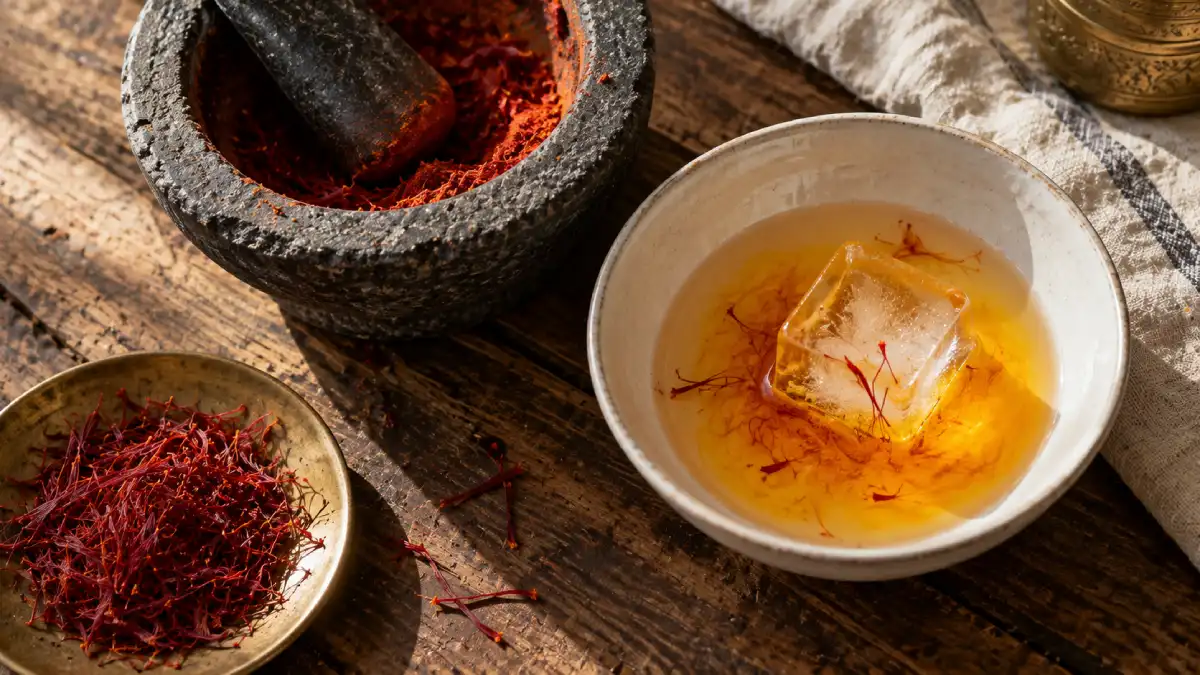
In Iran, saffron is not weighed: it is measured by hand, in pinches, and often generously. Many Iranian cooks use the ice method (ice-blooming, cold infusion): grind the threads in a mortar with a pinch of sugar, place the powder on an ice cube and let it melt slowly. The ice melts gradually and releases the colour and aroma of the saffron little by little.
The method draws on a very old Iranian tradition. Persians have grown saffron since ancient times, and for centuries they knew how to make and store ice in the middle of the desert, in yakhchal, large mud-brick ice houses. This is how saffron is prepared for tahdig rice, sholeh zard or saffron chicken.
| Dish (4 servings) | Saffron | Approx. threads |
|---|---|---|
| Custard, ice cream, poached fruit | 0.05 g | 20–25 |
| Risotto, saffron rice, fish soup | 0.1 g | 40–50 |
| Paella or a rice dish with strong colour | 0.1–0.15 g | 40–75 |
| Tin | Dishes for four | Price | Approx. cost per dish |
|---|---|---|---|
| 3 g | about 30 | CHF 15.39 | about CHF 0.51 |
| 5 g | about 50 | CHF 24.62 | about CHF 0.49 |
Classic saffron dishes
- ◆Switzerland and Italy: saffron risotto (risotto alla milanese); in Mund, saffron bread.
- ◆Iran: chelow and tahdig rice, saffron chicken, sholeh zard and saffron ice cream (bastani).
- ◆Spain and France: paella and bouillabaisse, the Marseille fish stew.
- ◆India and Pakistan: biryani, kheer and saffron sweets.
- ◆Sweden: lussekatter, the saffron buns baked for St Lucia’s Day on 13 December.
Why is saffron so expensive?
Everything is done by hand. Around 150,000 flowers are needed for one kilogram, and a study published in Molecules estimates that picking them takes 370 to 470 hours of work, before the stigmas are separated and dried. Each flower has only three stigmas, the harvest lasts just a few weeks in autumn, and drying removes about four-fifths of the weight. Yet because a dish needs only about 0.1 g, saffron costs around half a franc per dish for four.
How to store saffron
- ◆Keep the threads in their airtight tin, away from light and moisture, in a cool, dry cupboard away from the cooker.
- ◆No fridge for daily use: taking a cold tin in and out causes condensation. The freezer suits long-term reserves, in small sealed portions.
- ◆Threads are best within 1–2 years of the harvest; powder within 6–12 months.
- ◆Prepared saffron water keeps 3–4 days in the fridge, covered.
What can replace saffron?
Nothing reproduces saffron’s aroma. Substitutes only copy the colour:
| Substitute | What it copies | What it lacks |
|---|---|---|
| Turmeric | Yellow colour | Saffron’s honeyed aroma; adds an earthy, gingery taste |
| Safflower | Pale orange colour | Almost no aroma or flavour; sometimes sold misleadingly as “saffron” |
| Annatto | Orange-red colour | A different, peppery taste |
| Sweet paprika | Red-orange tint | A different flavour; colours oil rather than water |
If a recipe is built around saffron, such as risotto alla milanese, paella or bouillabaisse, it is better to cook something else than to substitute. To tell the two yellow spices apart, read saffron vs turmeric.
Is saffron safe to eat?
Yes, in culinary amounts. A dish for four uses about 0.1 g, roughly 0.025 g per person. A scientific review reports that amounts under 1.5 g are not considered toxic, far more than any recipe uses. Saffron is sold here as a spice, not as a supplement. If you are considering saffron extracts or capsules, or if you are pregnant or taking medication, ask your doctor.
Buying Iranian saffron in Switzerland
Look for three things on any saffron: the origin, the cut (Sargol, Negin, coupé…) and an airtight, light-proof pack, ideally with a harvest or packing date.
Our Iranian saffron is a Sargol from Khorasan, in whole threads picked by hand. It is available in 3 g and 5 g tins. All our stock is held in Switzerland, and delivery by Swiss Post takes 1 to 2 working days.
Saffron also pairs beautifully with caviar on a festive plate: discover our guide to Iranian caviar.
Frequently asked questions
What is saffron made of?
Saffron is made only of the dried red stigmas of the saffron crocus, Crocus sativus. Each flower has three, picked by hand. Nothing else should be in the pack.
Is Persian saffron the same as Iranian saffron?
Yes. Persian saffron and Iranian saffron are two names for saffron grown in Iran, mainly in the Khorasan region.
What does saffron taste like?
Honeyed, floral and hay-like, with a gently bitter finish. Too much makes a dish taste bitter, so recipes use only a pinch.
What is the difference between Super Negin, Negin and Sargol?
All three contain only the red part of the stigma. Super Negin and Negin consist of longer, thicker threads, Sargol of shorter threads. The names describe the cut, not a certified quality; to compare batches objectively, ask for an ISO 3632 analysis.
How can you tell if saffron is real?
Real threads are dark red, dry and widen into a small trumpet shape at one end. In lukewarm water they slowly release a golden-yellow colour while staying red. Only a laboratory analysis according to ISO 3632 gives objective proof.
Should I buy saffron threads or powder?
Threads. They keep their aroma longer, show their quality, and are much harder to adulterate than powder.
How much saffron should I use?
About 0.1 g, or 40–50 threads, for a dish serving four; half that for desserts. Steep it in warm liquid for 15–20 minutes first, or let it melt over an ice cube the Persian way.
How long does saffron keep?
Stored airtight, dry and dark, threads are best within 1–2 years of the harvest; powder within 6–12 months.
Is saffron grown in Switzerland?
Yes. The village of Mund in Upper Valais has grown saffron for centuries and holds an AOP since 2004, but it produces only about 1–4 kg a year, mostly sold locally.
Can I use turmeric instead of saffron?
Only for colour. Turmeric has an earthy, gingery taste and none of saffron’s aroma.
Sources
- FAO in Iran (25 November 2025): FAO and Iran: new step to innovation and quality integrity in saffron value chain
- FAO, Globally Important Agricultural Heritage Systems: Qanat-based saffron farming system in Gonabad, Iran
- ISO: ISO 3632-1: Spices — Saffron (Crocus sativus L.) — Part 1: Specification (2011 edition, withdrawn)
- ANSI Webstore: ISO 3632-1:2025 Spices — Saffron (Crocus sativus L.) — Part 1: Specification
- Fujii S. et al. (2022), Longhua Chinese Medicine: Saffron: production, quality standards and the ISO 3632 categories
- Cid-Pérez T.S. et al. (2021), Molecules 26(22):6954: Saffron: flowers per kilogram and harvesting work
- University of Vermont Extension: Saffron, the world’s most expensive spice
- Valais/Wallis Promotion: Saffron (Valais specialties)
- Agroscope (26 February 2015): Un souffle nouveau dans la culture du safran en Suisse
- Nemati Z. et al. (2019), Molecular Phylogenetics and Evolution: Saffron (Crocus sativus) is an autotriploid that evolved in Attica (Greece) from wild Crocus cartwrightianus
- Moshiri M., Vahabzadeh M., Hosseinzadeh H. (2015), Drug Research: Clinical applications of saffron (Crocus sativus) and its constituents: a review