

◆ Last updated: ◆ By LeDiamont — Zervan GmbH
Compare the batch, not the country
Neither origin is better by default. Iran produces most of the world’s saffron, sold under trade names such as Negin, Sargol and Pushal. [2] Spain produces far less, and the protected Azafrán de La Mancha is toasted and sold only as threads. [3] For any purchase, compare where the batch was grown, how it is graded and what laboratory evidence supports it. Kew lists Crocus sativus, the saffron species, in both Iran and Spain. [1]
Key takeaways
- ◆Same species, different scale. Iran grows most of the world’s saffron; Spain grows a small share.
- ◆Trade names are not lab grades. Negin, Sargol, Pushal and Coupe describe how threads were cut, not a test result.
- ◆The La Mancha PDO is specific. It requires toasting, sets minimum lab values and differs from saffron called “tipo Mancha”.
- ◆Research compares batches. Peer-reviewed studies find real differences, but also wide variation within one country.
- ◆Packed in Spain is not grown in Spain. Check the stated cultivation origin, batch and evidence.
Iranian vs Spanish saffron at a glance
| Point to compare | Iranian (Persian) saffron | Spanish saffron |
|---|---|---|
| Main growing area | Mainly Khorasan, north-east Iran | Castilla-La Mancha for the protected designation |
| Share of world production | Almost 90% in a published estimate | A small share of world production |
| Common trade names | Super Negin, Negin, Sargol, Pushal, Bunch | Coupe, “La Mancha” or “tipo Mancha” |
| Protected origin | Check supplier documents for the batch | PDO Azafrán de La Mancha for registered product |
| Processing | Drying method varies by producer: ask | PDO saffron is obtained by toasting the stigmas |
| What to request | Batch reference and laboratory analysis | Batch reference, laboratory analysis and PDO label where claimed |
Where each saffron is grown
Iran is the largest producer by a wide margin. A paper on the economics of saffron in Iran, published in Acta Horticulturae, puts Iran’s share of world production and export at almost 90% and identifies Khorasan as the key region. [2] Treat this as a published estimate: annual figures vary with the harvest.
Spain produces much less. Its best-known area is La Mancha, where the protected designation of origin Azafrán de La Mancha limits cultivation and processing to a defined zone of Castilla-La Mancha. [3] Saffron outside that designation can still be sold as Spanish, so the label wording matters.
Grade names: Iranian and Spanish trade terms
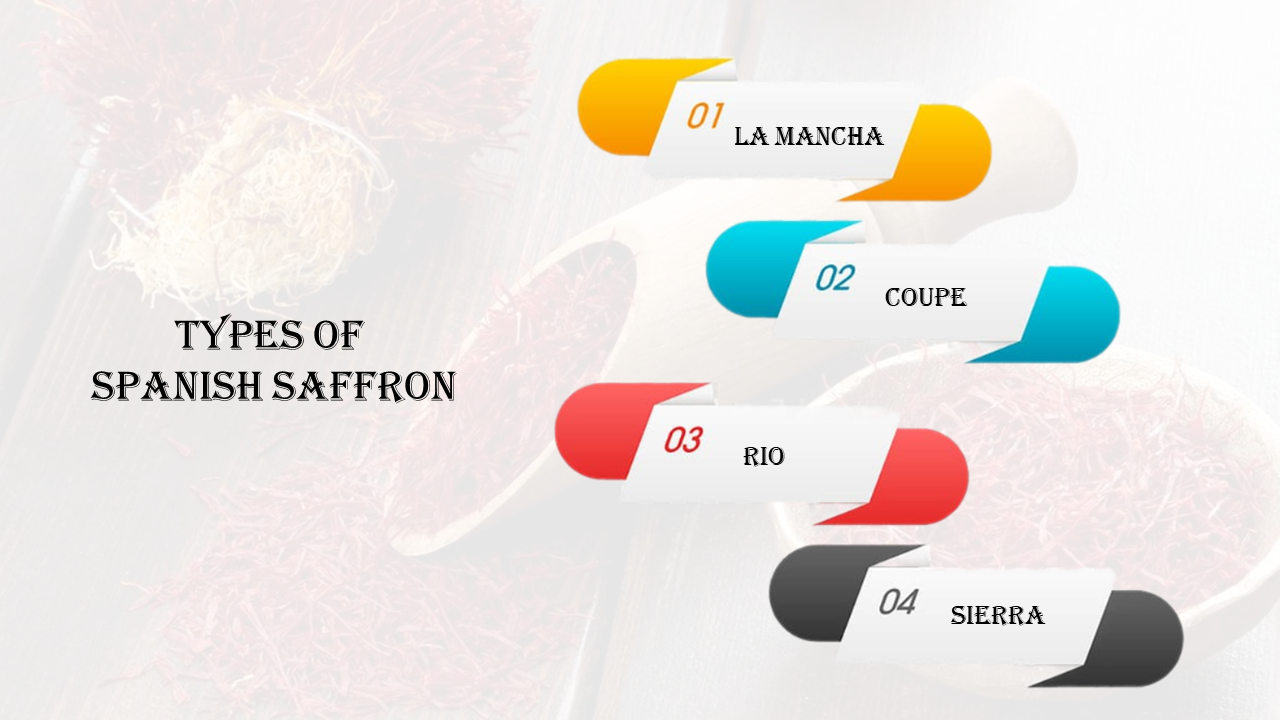
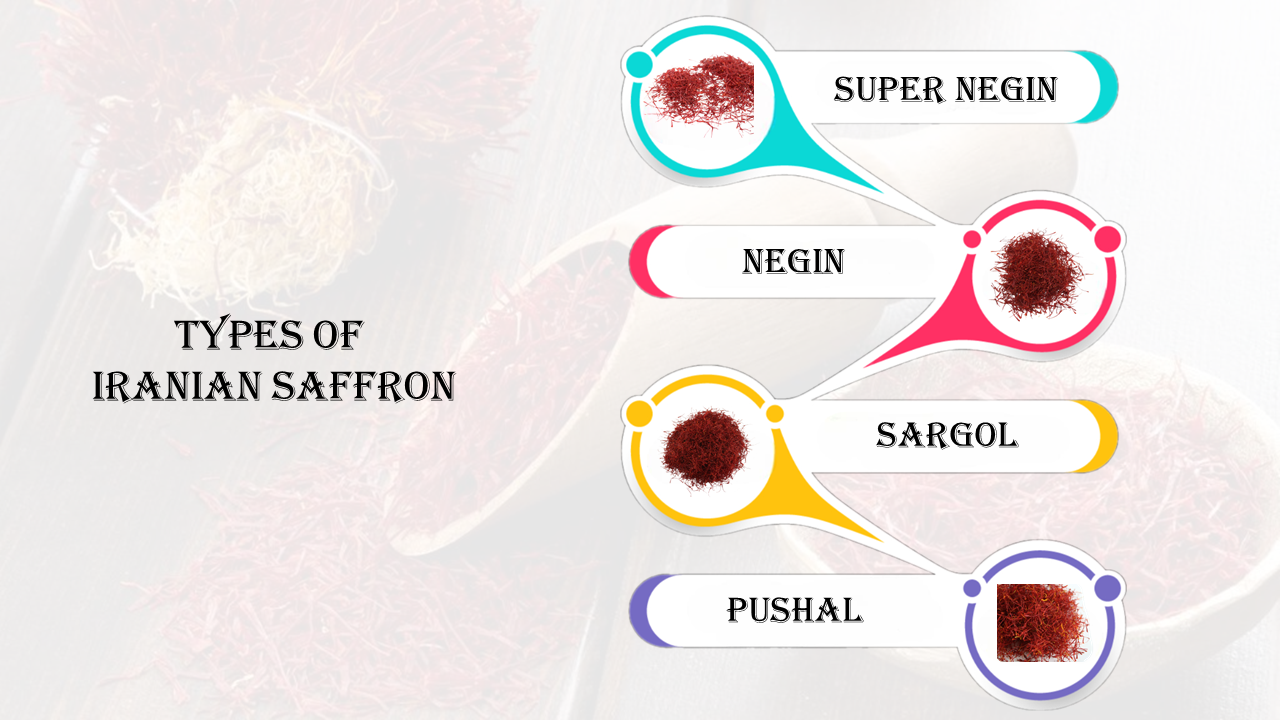
Trade names describe how the threads were cut and sorted. They are not laboratory grades, and suppliers do not always use them in the same way.
| Trade name | Usually describes |
|---|---|
| Super Negin / Negin | Seller names for long, all-red selections; no single public definition |
| Sargol | Red stigma tips with the yellow style removed |
| Pushal | Red stigmas with part of the yellow style attached |
| Bunch | Whole threads, red stigma and yellow style together |
| Coupe | Spanish trade term for red stigmas with the style cut off |
| “La Mancha” / “tipo Mancha” | A trade description; not the same as the protected designation |
A 2018 study in the journal GIDA analysed Iranian saffron from Sargol, Pushal and Bunch categories. In those samples, crocin content was highest in Sargol and lowest in Bunch. [5] This supports a general rule: more yellow style usually means less colouring power. It does not grade any specific product.
What the La Mancha PDO covers
The official specification of the Azafrán de La Mancha PDO defines the product as threads obtained by toasting the stigmas. [3] It sets minimum values for:
Colouring strength above 200, aroma above 20 and bitterness (picrocrocin) above 70, measured on packed PDO saffron.
Its regulatory council distinguishes PDO saffron from saffron described only as “tipo Mancha”. [4] If a seller claims the PDO, look for the designation on the label and ask for the batch reference.
Colour, aroma and flavour: what the lab measures
Three compounds drive saffron’s character: crocin gives colour, safranal gives most of the aroma and picrocrocin gives the bitter taste. ISO 3632-1:2025 sets requirements for dried saffron in filaments, cut filaments and powder [6]; ISO 3632-2 describes the test methods used to measure these properties. [7]
Country of origin does not fix these values. Growing conditions, harvest, sorting, drying and storage all play a part. A reference to a standard is not a test report: ask for the analysis of the batch you are buying.
What independent research shows
Most online comparisons are written by sellers of one origin. Peer-reviewed studies give a more cautious picture:
- A 2024 study in the Journal of the Science of Food and Agriculture compared 14 saffron samples from Iran, Spain and Türkiye. It found significant differences in colour, volatile compounds and sensory attributes, and linked them to corm origin, climate and farming conditions. [8]
- A study of five certified Iranian saffron packages, published in the Modares Journal of Medical Sciences, concluded that one sample cannot represent all Iranian saffron, because cultivation spans many regions and climates. [9]
Both points lead to the same conclusion: compare batches, not countries.
Drying and processing
Processing shapes flavour as much as origin. The La Mancha PDO specification requires toasting and describes toasted notes in the aroma and taste. [3] Iranian producers use a range of drying methods. If flavour profile matters for your recipe, ask the supplier how the batch was dried and when it was harvested.
Grown, packed or sold in Spain?
Check where the saffron was grown, who supplied it and how the batch is identified. Distinguish cultivation from packing or distribution: a product packed or sold in Spain is not necessarily grown there. If a regional origin or quality designation is advertised, ask for the evidence that applies to the product offered.
The same applies to trade names. Ask the supplier what Negin, Sargol or Coupe means for that particular selection. Do not use a trade name or a photograph as proof of a laboratory grade.
Can water prove authenticity?
A home infusion can help you observe the product, but it should not be treated as certification of purity or origin. The DGCCRF’s published spice investigation used specialist laboratory analysis and reported saffron composition substitutions and traceability problems. [10] For a disputed product, seek traceable evidence from the seller.
Price per gram: what drives it
Spanish saffron, and PDO saffron in particular, is often sold at a higher price than Iranian saffron of a similar trade grade. Smaller production, certification and labour costs can all contribute. Within each origin, the price also depends on the grade, the net weight and the packaging.
Compare the price per gram, not the price per pack, and check what evidence comes with the product. Prices change with each harvest; see the current price on the LeDiamont Iranian saffron page.
Which to choose for your cooking
Choose by recipe and format rather than by country alone. Whole threads suit infusions in rice dishes, sauces, desserts and drinks. Some cooks prefer a saffron from the dish’s own tradition, such as La Mancha saffron for paella or Iranian saffron for Persian rice. Both are a matter of taste, not a quality rule.
A practical buying checklist
- ✓Check the stated cultivation origin, supplier and batch.
- ✓Compare price per gram and net weight, not price per pack.
- ✓Ask what evidence supports any quality, grade or purity claim.
- ✓For a PDO claim, look for the designation on the label.
- ✓Follow the storage and cooking instructions for the actual product.
Read also: our complete guide to Iranian saffron, the Negin, Sargol and Pushal grades and how to recognise real saffron.
Frequently asked questions
Is Persian saffron better than Spanish saffron?
Not by default. Persian (Iranian) and Spanish saffron are the same species, and research shows that quality varies between batches within each country. Compare laboratory evidence for the batch you are buying.
What is the main difference between Iranian and Spanish saffron?
Volume and processing. Iran produces most of the world’s saffron. Spain produces much less, and its protected La Mancha saffron is toasted and sold only as threads.
Why is Spanish saffron more expensive?
Spanish production is small, labour costs are higher and PDO saffron carries certification costs. Price alone does not prove a higher grade.
Is all saffron sold as Spanish grown in Spain?
No. Saffron can be packed or distributed in Spain without being grown there. Check the stated cultivation origin, or the PDO designation for La Mancha saffron.
What do Sargol, Pushal and Coupe mean?
They are trade names for how the threads were cut. Sargol and Coupe usually mean red stigmas only; Pushal includes part of the yellow style. They are not laboratory grades.
Explore our saffron
Product-specific information, including net weight and the current price, is shown on each product page.
Sources
- Crocus sativus — Plants of the World Online, Royal Botanic Gardens, Kew. Species identity and native and introduced distribution.
- The economics of saffron in Iran — Acta Horticulturae 739, ISHS. Iran’s share of world production and export, and the role of Khorasan.
- Pliego de condiciones, DOP Azafrán de La Mancha — Junta de Comunidades de Castilla-La Mancha. Official PDO definition, toasting, minimum colouring, aroma and bitterness values, and production zone.
- El Azafrán de La Mancha — Consejo Regulador DOP Azafrán de La Mancha, 2017. Distinction between PDO saffron and saffron sold as “tipo Mancha”.
- Determination of crocin content and volatile components in different qualities of Iranian saffron — GIDA 43(3), 2018. Crocin and volatile compounds measured in Sargol, Pushal and Bunch samples.
- ISO 3632-1:2025 Spices — Saffron — Part 1: Specification — ISO. Public summary: requirements for dried saffron in filaments, cut filaments and powder.
- ISO 3632-2 Spices — Saffron — Part 2: Test methods — ISO. Public summary of the test methods.
- Comparative study on nutraceutical and sensorial characteristics of saffron cultivated in Iran, Spain, and Türkiye — Journal of the Science of Food and Agriculture, 2024. Peer-reviewed comparison of 14 samples from three countries.
- Quantitative and comparative analysis of crocin, picrocrocin and safranal in different packages of Iranian saffron — Modares Journal of Medical Sciences 13(2), 2010. Variation between certified Iranian saffron packages.
- Qualité des épices : enquête de la DGCCRF — French Ministry of Economy. Published laboratory investigation into spice quality, including saffron.
This guide compares origins in general. It does not grade any LeDiamont product.